

As a beginner you might find it hard to know exactly how to invest 1000 dollars in cryptocurrency, often leading to procrastination.
At the time, I was also concerned that cash was losing value to inflation.
This article records exactly how I would have allocated the money as a beginner while trying to balance return and risk.
The allocation shows what I would have done in that position.
My sample allocation was $500 in Bitcoin, $300 in Ethereum, and $200 in Chainlink. Under my 2021 price assumptions, the model produced a portfolio value of $2,866.
Here is why I chose that allocation.
How I Would Invest $1000 in Cryptocurrency
My beginner example consisted of Bitcoin, Ethereum, and Chainlink.
Let's go through my arguments for each one, as well as the diversification I would go with:
Bitcoin – The Index Fund of Cryptocurrencies
If you're unfamiliar with how the cryptocurrency market works, know this: Bitcoin is the market mover.
Whenever Bitcoin moves, the rest of the market follow. If Bitcoin surges up in price, most altcoins do as well, and if Bitcoin crashes – so does most altcoins.
One way to think about it, is that Bitcoin acts as an index fund for the cryptocurrency market.
It gives you a general exposure to the price-movements of crypto, with the least amount risk required.
Index funds are praised as the best investment option for "normal people" by people like Warren buffet. The reason for this is that index funds gives you broad exposure and great diversification, which is key for beginners.
Bitcoin does the same thing – it gives you broad exposure, and diversification, even though you technically put all your eggs in one basket. This is, again, because Bitcoin is the market mover.
The last thing you want to do is to out all you hard-earned money into one single altcoin like XRP or ADA.
Even though they have great potential returns to offer, it is way too risky to go all in on a project that might fail even if cryptocurrency succeeds as an asset class.
If cryptocurrency went mainstream, I expected Bitcoin to participate. The same outcome was less certain for any individual altcoin, including Ethereum.
For this reason, I would put 50% of the $1,000, or $500, into Bitcoin to gain broad exposure while limiting risk.
Ethereum – The Internet of Cryptocurrencies
My second pick for the best way to invest $1000 in cryptocurrency is Ethereum.
"Why not just go all in on Bitcoin?"
Because Ethereum offered more upside in my scenario than Bitcoin.
"Okay, but why Ethereum?"
Once again, the reason is that you gain broad exposure - this time, to the largest ecosystem of blockchain applications:
Ethereum is what we call a "programmable blockchain", which means "a platform to build stuff on".
You can think of Ethereum as "the internet of the cryptocurrency industry".
Developers can make applications on Ethereum, which use ETH (the Ethereum coin) to function; we call them dApps (decentralized apps). These applications gain the benefits of blockchain technology.
If many people use these applications, the value of Ethereum increases.
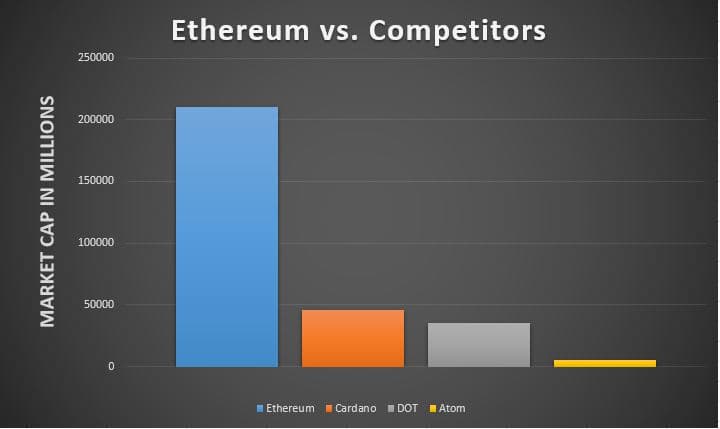
Right now, Ethereum is way ahead of it's competition, which is one of the reasons I think Ethereum is a good investment.
The image below shows how much bigger Ethereum is than its competition:
With Bitcoin, you get the "index fund" effect, the broad exposure to the general cryptocurrency market. With Ethereum, you get the added exposure to the ecosystem of dApps; applications that run on the Ethereum Blockchain.
Therefore, I would pick Ethereum as my number two when investing $1000 in cryptocurrency, giving it a 30% stake - $300.
Chainlink – The Oracle of Cryptocurrency.
Chainlink is one of the most promising altcoin projects out there. They solve something called the oracle problem:
This is a bit technical, but what Chainlink does, is to enable blockchains to communicate with the real world.
The Ethereum blockchain has no concept of what "one U.S. Dollar" means, and cannot verify that a user of the blockchain hold any USD in a wallet.
Chainlink makes it possible for a blockchain to understand what "one U.S. Dollar" is, and to check if you actually got some of it.
The way it works is that Chainlink uses “oracles” to verify data from the real world, like your bank account, and feeds this info to the blockchain and smart contracts.
This is a visual representation of what Chainlink does:

Chainlink linking real-world data with the Bitcoin blockchain
It connects the real world with the blockchain world. It's the link between real world data, and blockchain applications.
Another reason I would go with Chainlink is the amount of partnership they have.
At the time of writing, they have over 450 partnerships, including a partnership with Google.
This placed Chainlink deep in the crypto industry and supported its inclusion in my allocation.
As far as diversification goes, I would put 20% ($200), into Chainlink.
What Returns Can You Get by Investing $1000 in Cryptocurrency?
Given the portfolio of 50% Bitcoin, 30% Ethereum, and 20% Chainlink, the model produced the returns below.
I considered all three relatively established within the cryptocurrency industry, though each still carried substantial risk.
The modeled return depended heavily on the time frame.
As they say:
Time in the market beats than timing the market.
Modeled ROI From Investing $1,000 in Cryptocurrency in 2021:
I have price predictions for 2021 for all these coins:
My 2021 scenarios were $100,000 for Bitcoin, $8,000 for Ethereum, and $125 for Chainlink.
Under those assumptions and the prices at publication, the calculation was:
Bitcoin: $100K (predicted price) / $60K (current price) * $500 (invested amount) = $833
Ethereum: $8000 (predicted price) / $2000 (current price) * $300 (invested amount) = $1200
Chainlink: $125 (predicted price) / $30 (current price) * $200 (invested amount) = $833
Total value of portfolio at the end of 2021: $833 + $1200 + $833 = $2866
ROI = $572 / $200 = 2.86 = 186%
In other words, the model returned $2.86 for each dollar if every price assumption held.
Scaling the same assumptions to $3,000 produced a modeled value of about $8,600.
You can calculate it for yourself, using the formula this formula:
Predicted price / current price * invested amount = Value at end of 2021.
The historical price inputs came from CoinMarketCap: Bitcoin, Ethereum, and Chainlink.
Conclusion - How to Invest $1000 in Cryptocurrency
My allocation was 50% Bitcoin, 30% Ethereum, and 20% Chainlink.
Under my price assumptions, the model grew $1,000 to $2,866 by the end of 2021.
The same assets appear in my long-term cryptocurrency comparison.