


Some people just want to buy their damn crypto and forget about it. Well, that's actually not a bad idea, as HODLing is an excellent long-term strategy.
In this historical analysis, these were the cryptocurrencies I wanted to hold:
My three picks for the following five years were Bitcoin, Ethereum and Chainlink. Together, they provided exposure to three important sectors of the crypto market: Bitcoin as a store of value, Ethereum as a platform for dApps and Chainlink as the leading oracle service.
Let's dig deeper and find out why they are the best crypto investments for the next five years:
#1 Best Crypto Investment For The Next Five Years: Bitcoin
Bitcoin is my first pick for best crypto investment for the next five years for three reasons:
It gives you general exposure to the crypto market, you'll reap the benefits of another bitcoin halving and it has no serious competition.
First Reason: Bitcoin gives you general exposure.
Bitcoin is the king of crypto – the market mover. Whenever Bitcoin does something, the market follows.
You can think of Bitcoin as an index fund in the cryptocurrency market.
It's the best way to get exposure to the general market without taking on too much risk.
Second Reason: The Stock to Flow will Double
This is the biggest reason for Bitcoin being the best crypto investment for the next five years; you'll get to reap the benefit of another Bitcoin halving.
Bitcoin halvings happen every four years.
What happens is that the rewards that bitcoin miners receive get cut in half, decreasing the selling pressure from bitcoin miners.
It sounds boring, I know, but hear me out:
The halving is central to Bitcoin's supply schedule, and has historically coincided with major price cycles:
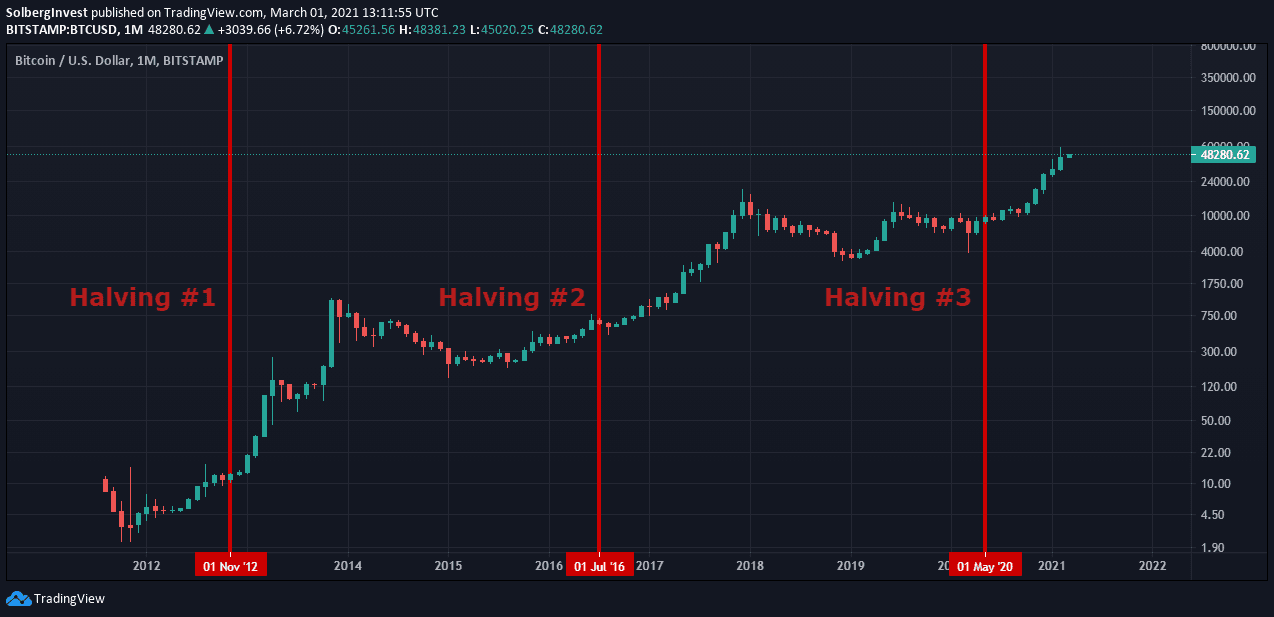
You can see that after each halving covered here, the price increased sharply. At the time, the next halving was expected around March 2024.
"The skinny" of why the halving makes the price of Bitcoin increase:
When people sell their Bitcoin, the price falls because supply and demand is the mechanism that decides the price of Bitcoin.
If the number of Bitcoins that miners receive as an incentive/reward for mining gets cut in half, the selling pressure from miners gets cut in half.
Miners selling newly issued Bitcoin is one source of selling pressure, so cutting issuance can support a higher price when demand holds steady or rises.
This assumes that the demand for Bitcoin stays constant or increases.
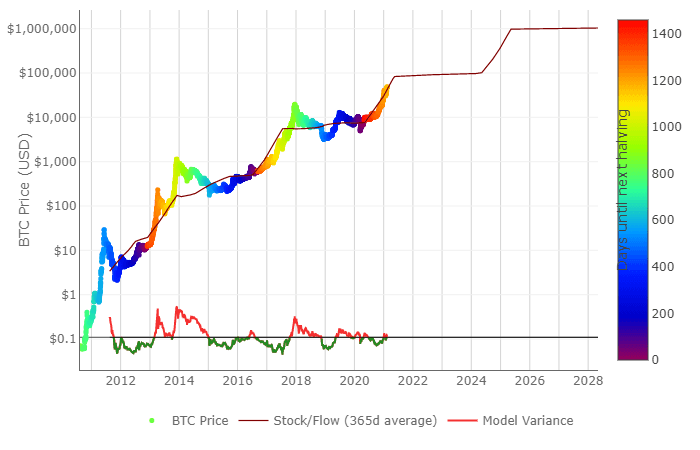
There is a model made by a guy named "plan B", which predicts the future Bitcoin price based on the halvings of Bitcoin.
More specifically, it models the price of Bitcoin based on something called "the stock to flow".
Stock to flow is a number telling us how long it would take to double the supply of something.
For instance, a stock to flow of 10 means that it would take Bitcoin miners ten years to double the supply (amount in circulation) of Bitcoin.
Much of what gives gold its value is its high stock to flow of around 60, and it's currently the precious metal with the highest stock to flow.
**A high stock to flow means that it's hard to make more of it in a short amount of time – making it impossible to experience a supply shock, driving the price down.
Bitcoins stock to flow is currently nearing up on 52.
The fact that miner rewards get cut in half every four years means that the stock to flow doubles every four years, which this model associated with higher prices.**
Below you see the stock to flow model. The colorful dots are the Bitcoin price, and the line is the stock to flow. You see the Bitcoin price on the left vertical axis and the number of days until the next halving on the right. (Source: [www.lookintobitcoin.com](https://www.lookintobitcoin.com/))
Third Reason: It has no serious competitors
Bitcoin was built as a reaction to the 2008 financial crisis, and it was created to protect people against inflation and reckless money printing.
Bitcoin exists to do one thing: Store wealth practically and safely.
At the time, I regarded Bitcoin as the strongest candidate for this role. That view also informed my argument that Bitcoin could reach $1,000,000 in this decade.
For related background, see my article about inflation, money printing and Bitcoin.
I described the approach behind this allocation in my historical Bitcoin investing and trading strategy.
In summary, Bitcoin is the best crypto investment for the next five years because:
It is gives you general exposure to the market, kind of like an index fund.
Another halving would reduce new supply entering the market.
It has no serious competition trying to take its place.
My illustrative allocation at the time put 50% into Bitcoin.
#2 Best Crypto Investment For The Next Five Years: Ethereum
The next best investment in the crypto market for the next five years is Ethereum. There are mainly two reasons for Ethereum making the list:
You get broad exposure to the ecosystem of dApps built on Ethereum, and Ethereum 2.0
First Reason: Broad exposure to the ecosystem of dApps
Ethereum has proven itself as the go-to "programmable blockchain", which basically means "platform to build stuff on".
Developers can build applications on the Ethereum blockchain, giving the applications the benefits of blockchain technology like decentralization, trustlessness, and transparency.
Another great thing about Ethereum is smart contracts:
A smart contract is simply a digital contract that executes automatically when the two or more parties involved meet the requirements. Smart contracts solve the issue of trusting the other party, or a third party, when making a deal.
This enables dApps to be decentralized; the smart contracts can execute automatically whenever the predetermined conditions are met, without any third party sticking their nose into it.
Many other platforms are trying to compete with Ethereum. Still, no one is even remotely close to the level of adoption, meaning people and businesses using it, that Ethereum is seeing.
When investing in Ethereum, you invest in the ecosystem that is built on top of it. The reason this is true, is that the dApps that are built on Ethereum use Ethereum to function – driving the price up.
In other words:
You get exposure to the biggest ecosystem of dApps in the entire cryptocurrency market, which is why Ethereum is the next best crypto investment for the next five years.
Second Reason: Ethereum 2.0 Brings Staking
Ethereum is getting an upgrade called Ethereum 2.0. It will be done within a year or two. However, it's a gradual upgrade, meaning that Ethereum 2.0 consists of many smaller upgrades that get uploaded from time to time.
One of the significant changes that'll come with Ethereum 2.0 is proof of stake (POS). Currently, Ethereum uses the same verification process as Bitcoin, proof of work (POW), but that's going to change soon.
Without getting super technical, to "mine" ETH today, people need to buy expensive computers and use a ton of electricity. However, with staking, people can just put their Ethereum in a specific wallet that helps secure the network and validate transactions, and they receive a yield on this Ethereum.
In other words:
Staking means dedicating your coins to secure the network. Staked coins are held in a wallet, acting as a node on the network that helps in validating transactions and securing the network.
We're not getting into the details of staking, but just know that it's good news both for the price, scaling abilities, and decentralization of the network.
Other altcoins have POS as their verification protocol today, and it's working great. Some of these have over 75% of their total coins "staked," meaning they're locked up in a wallet to improve the security and decentralization of the network.
This is why Ethereum 2.0 is a reason for Ethereum being the second-best crypto investment for the next five years:
The obvious consequence is that the network is more secure, which increases the value of the network, and therefore, the coins.
The more people that stake their coins, the more secure and decentralized the network becomes.
In addition, this is attractive for developers, because the blockchain can handle more traffic, increasing the value of the network even more. If more developers use this blockchain, the price goes up.
Another consequence is that the circulating supply is cut down drastically - Which is good for the price.
Let's say that there are one hundred coins in circulation, and the supply/demand, or the people buying the coin vs selling the coin, holds the price at ten dollars. If 80% of the people holding the coin decide to stake them, suddenly the circulating supply drops down to twenty coins.
This coin just got a lot scarcer.
If the number of available coins drops and the number of people wanting those coins to stay the same, the price will increase.
Another great thing about staking is that it's cheaper than proof of work (mining).
Compared to mining, the costs are close to zero. Miners have to pay for electricity, which they often do by selling off their mined ETH.
Stakers usually keep their coins because they don't have to pay for stuff like electricity. This eliminates one of the largest sellers of the coin; the miners.
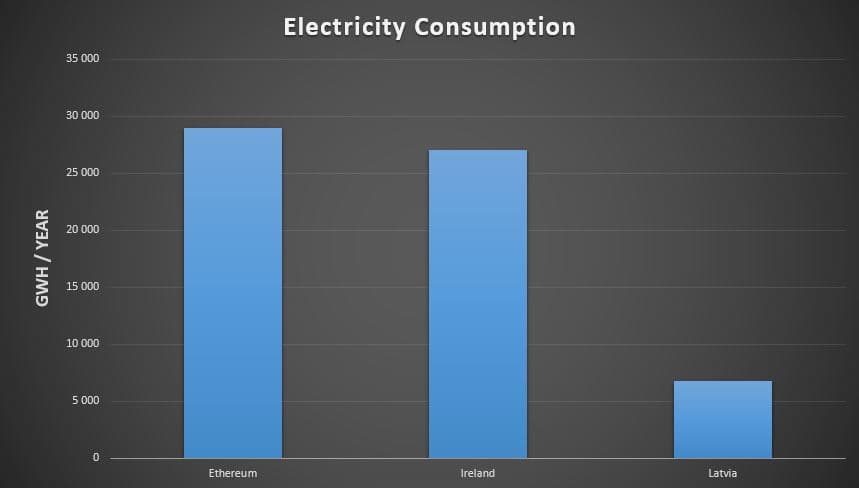
As you can see above, Ethereum uses almost 30 GWh/year, which is more than Ireland. That's right, more than a country...
Miners have to pay for this electricity by selling ETH, which drives the price down. When staking comes around, this selling pressure will disappear or at least drastically decreases.
This was why I saw strong growth potential in Ethereum over the next five years.
It already led the pack, and the expected upgrades supported my view that the network could become more valuable.
In summary, Ethereum is the second-best crypto investment for the next five years because:
You get a broad exposure to the ecosystem of different sectors like Decentralized finance and NFT projects.
The anticipated Ethereum 2.0 upgrade would introduce staking and its associated rewards.
My illustrative allocation at the time put 32.5% into Ethereum.
#3 Best Crypto Investment For The Next Five Years: Chainlink
My third pick for the best cryptocurrencies to hold for the next five years is Chainlink. My reasons were its approach to the oracle problem and its large number of partnerships.
First Reason: It is the solution to the oracle problem
Chainlink sets out to solve the "oracle problem" - The problem that smart contracts can't communicate with the outside world.
Smart contracts on the Ethereum blockchain can only receive information within the Ethereum blockchain, making it isolated - limiting its number of possible use-cases.
This means that smart contracts can't transfer Fiat currencies like USD or EURO, because there's no way for the Ethereum network to verify that you actually have FIAT currency (traditional currency like USD and EURO), and have no concept of what FIAT even is.
There is other stuff too, of course, but this is the biggest problem it solves.
The way it works is that Chainlink uses "oracles" to verify data from the real world, like your bank account, and feeds this info to the blockchain and smart contracts.
This makes it a lot easier for institutions and businesses to adopt the Ethereum blockchain, as it enables them to use USD instead of ETH, and fixes the problem of isolation of information.
Chainlink makes smart contracts better and more practical, making the Ethereum blockchain, as well as its competitors, easier to use.
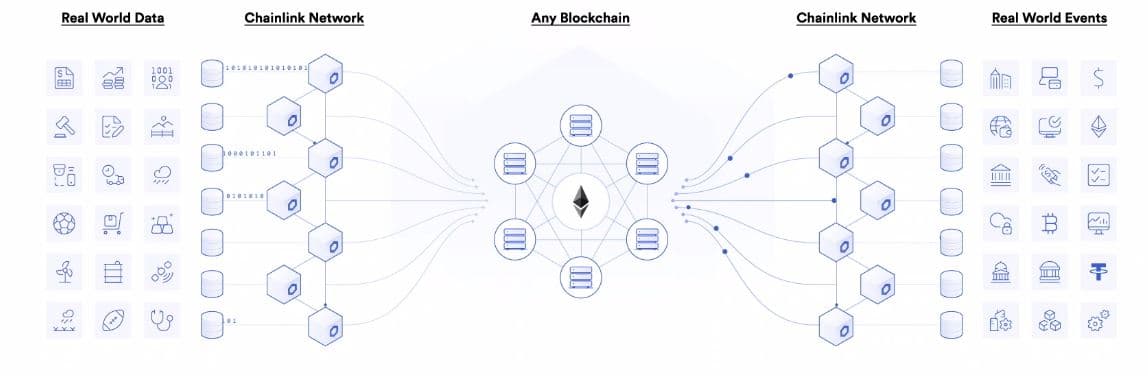
Below you see an image explaining what Chainlink does:
It takes data from the real world and makes it compatible with blockchains like Ethereum and Bitcoin, linking smart contracts with the real world. It can also work the opposite way, taking information on the blockchain and connecting it with real-world events.
(Source: chain.link/solutions)
Second Reason: Chainlink has tons of partnerships, and keep making more
Chainlink has nailed the networking and collaborating side of this industry. The list below contains some of their partnerships.
The names link to Chainlink ecosystem pages with details on each partnership.
Chainlink's ecosystem directory listed over 600 different companies and projects. That was significant for an oracle service like Chainlink.
This partnership lead was the main reason I gave Chainlink a place among my three picks. At the time, it had roughly 10 times more partnerships and integrations than its three biggest competitors combined.
My illustrative allocation at the time put 17.5% into Chainlink.
For the reasoning behind that comparison, see my historical Chainlink-versus-Ethereum analysis.
Conclusion: Bitcoin, Ethereum and Chainlink
My three picks at the time were Bitcoin, Ethereum and Chainlink, in that order. My illustrative allocation was 50% Bitcoin, 32.5% Ethereum and 17.5% Chainlink. Bitcoin provided broad market exposure and a halving-driven supply thesis; Ethereum provided exposure to its dApp ecosystem and staking transition; Chainlink provided exposure to oracle infrastructure and a large partnership network.