


Let me begin with this: I have invested in both Chainlink and Ethereum. I also included both in my long-term cryptocurrency comparison. In this article, I'll look at Chainlink vs Ethereum in terms of use case and investment and try to figure out which is the best cryptocurrency.
Chainlink is a decentralized oracle network, while Ethereum is a blockchain platform for developers to build applications on. In terms of market cap, Ethereum was 32 times larger. I saw more upside in Chainlink, but Ethereum's lower perceived risk made it my preference.
Both Ethereum and Chainlink are utilized in the real world and solve intricate problems.
Although it’s true that Chainlink and Ethereum are often mentioned in the same context, they are still worlds apart in terms of features, pros, and cons.
Today, I'll try to break down the differences between them and help you fundamentally understand them better.
This will give you a better base to stand on when making investment decisions and help you navigate the rough waters of cryptocurrencies.
What’s the Difference between Chainlink and Ethereum?
The relationship between Chainlink and Ethereum is fundamental and deep. You see, Chainlink is actually built on Ethereum.
This means that Chainlinks uses the Ethereum blockchain to "do its thing". At least initially, it is now branching out to several blockchains now, diversifying its base of operations.
But here's the thing: Ethereum also needs Chainlink!
The reason for this is that Ethereum can't use real-world data on its blockchain, isolating it and limiting the potential use cases it has.
Chainlink's function is to connect the real world with the Ethereum blockchain, making it usable for businesses and institutions outside the crypto-space.
Let's get more specific about the intricacies of Chainlink and Ethereum.
Chainlink Is A Decentralized Oracle Network:
Chainlink is what we call a decentralized oracle network, or DON for short. It is required to integrate real-world data into Ethereum’s smart contracts.
For example, if you want to develop a program where one of the variables is the population in a country or who the president of the united states is, a blockchain would never be able to handle this data.
It has no concept of "president of the USA" or "population of Nigeria".
Therefore, we need a link between the two - the real world and the blockchain world.
That's where Chainlink enters the conversation:
It makes real-world data, events, and payments understandable for the Ethereum blockchain and enables it to use this data in smart contracts:

REAL-WORLD DATA - CHAINLINK ORACLES - ETHEREUM BLOCKCHAIN (source: chain.link)
Chainlink is the leading "link" between these two worlds, by far...
A separate analysis compares Chainlink with its oracle-network competitors.
Like Ethereum, the minds working behind Chainlink are constantly improving the protocol and also bringing new iterations:
Chainlink also contributed to the formation and development of Decentralized Finance (or DeFi).
Global demand for decentralized products and services has been growing consistently, which has helped increase the demand for oracles like Chainlink.
LINK, the cryptocurrency associated with Chainlink, is rewarded to contributors participating in the Chainlink ecosystem.
Now that you have a basic understanding of Chainlink, let's get into what Ethereum is:
Ethereum Is A Platform For Developers To Build Applications:
Basically, Ethereum is a platform for developers to build applications on. These applications gain the benefits of blockchain tech, like decentralization and trustlessness.
A good comparison to Ethereum is "the internet":
The internet is a platform where people build online stores, social media apps, informational websites, etc.
Similarly, Ethereum is a platform where people can build the same kinds of applications like stores and social media apps, but in a decentralized and trustless manner.
Chainlink is one of these applications built on Ethereum. It started as an Ethereum based project, but has since moved on, at least partially.
Also, the whole DeFi sector couldn't exist without fundamental platforms like Ethereum.
Today, Ethereum is seen as the Altcoin giant second to Bitcoin.
Bitcoin is the king of crypto, but Ethereum is the prince. (And XRP is the jester ;) )
Nevertheless, Ethereum does have its problems:
It is struggling with scaling issues - It can not handle all the transactions on its blockchain. Basically, Ethereum is being crushed by its own success.
This leads to extremely high fees and slow transactions.
In Q1 of 2021, I had to pay $280 for one single transaction. The reason was that extremely many people were using Ethereum based projects and loading the blockchain with millions of transactions.
Ethereums competitors handle scaling much better.
I have an article about the fees of Solana, a competing blockchain platform, where I calculated that the fees on Solana are 60 000 times lower than on the Ethereum blockchain.
At the time, Ethereum's planned upgrades were expected to address this problem.
The roadmap aimed to increase transaction capacity and reduce fees substantially.
Ether (ETH) is the native currency on the Ethereum blockchain. It's the currency used for paying transactions fees and rewarding node operators (miners/stakers).
Chainlink And Ethereum Are Intertwined, But Differ Grately:
If you read the previous part, you already understand this:
Ethereum and Chainlink are both cryptocurrencies with real-world use cases and fundamentally valuable projects. They are intertwined in a synergic manner, each giving the other more potential to expand. Ethereum is the fundamental platform that Chainlink is built on, while Chainlink simultaneously enables Ethereum to communicate with the real world.
Another obvious difference is the market capitalization (market cap) of the two projects:
Market cap is calculated like this: the number of coins in circulation multiplied by the price per coin.
In other words, the market cap is a number telling you the total value of all the coins in circulation.
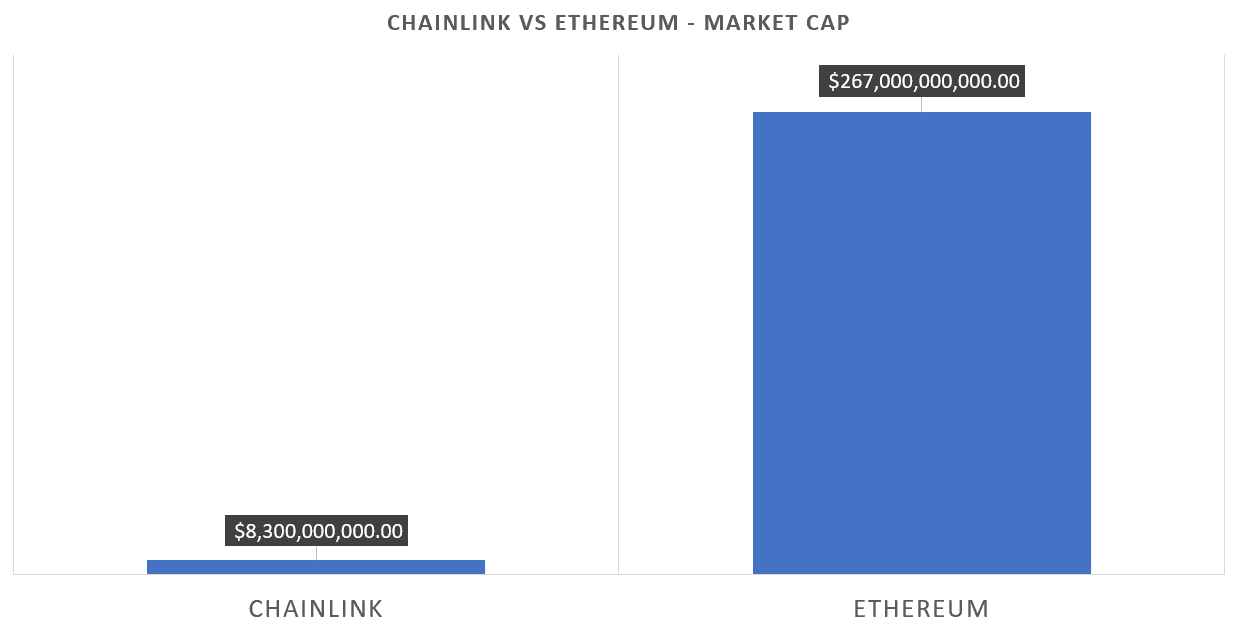
Below you see a chart showing the difference in market cap between Ethereum and Chainlink:
(source: Coinmarketcap)
From the image above, you can clearly see the difference in size between Ethereum and Chainlink. Ethereum is WAYhead in terms of market cap.
In fact, Ethereum is 32 times bigger.
Ethereum vs Chainlink: Which is a Better Investment?
As I mentioned in the introduction, I have invested in both of these cryptocurrencies. But if I had to pick one, it would be Ethereum.
The reason is that Ethereum is less risky and gives me broader exposure than Chainlink.
Why I Have Invested In Ethereum:
Ethereums value is based on how much the Ethereum blockchain is being used.
The usage of the Etheruem blockchain is primarily done indirectly through the various application built on top of it.
For example, if you use Uniswap or AAVE, you're indirectly using Ethereum.
This means that Ethereum becomes more valuable whenever the applications built on it become adopted.
For me, holding Ethereum provided indirect exposure to the applications built on top of it.
It's almost like investing in an index fund, which generally is a great idea.
Nevertheless, Chainlink also has a lot going for it:
Why I have Invested In Chainlink:
The biggest reason I invested in Chainlink was its leading position in a sector I viewed as vital to wider cryptocurrency adoption.
Hear me out:
Oracle Networks like Chainlink are needed for using blockchain tech in the real world. Now, I really believe blockchain tech will be used in the real world, and that Oracles therefore will have a huge part to play in the future.
In other words, I really want an Oracle network type of coin in my portfolio, but which one should I pick?
At the time, Chainlink had roughly 10 times more adoption than its three biggest competitors combined.
That gap made Chainlink my preferred oracle-network investment.
Price Scenarios I Considered:
At the time, I explored separate long-term price scenarios for both coins.
My Chainlink scenario reached $1,000 this decade.
This is based on several factors, but mainly the historical market share, historical price data, and future expectations for the cryptocurrency market as a whole.
My Ethereum scenario reached $100,000 this decade.
This is largely based on my future expectations of the Bitcoin price and the future development in the Bitcoin / Ethereum ratio.
From the July 2021 prices of $20 for LINK and $2,300 for Ethereum, those assumptions implied:
Ethereum: $100 000 / $2300 = 43.5x
Chainlink: 50x
In other words, both scenarios implied a rough 50x from the prices of July 2021.
Now, the risk of investing in Chainlink is much higher than the risk of investing in Ethereum.
The fact that you get such broad exposure through Ethereum effectively diversifies your investment across the entire ecosystem of applications built on it.
On that basis, I preferred Ethereum despite the lower upside in my model.
Conclusion: I Preferred Ethereum
Even though I saw more upside in Chainlink, Ethereum's lower perceived risk made it my preference. I held both Chainlink and Ethereum myself.
In terms of use-case and fundamentals, they both work together synergistically, but in different ways:
Chainlink is a decentralized oracle network, while Ethereum is a blockchain platform for developers to build applications on. Chainlink was built on Ethereum, while Chainlink "de-isolates" Ethereum and makes it able to use real-world data.
My long-term Ethereum thesis explains that view in more detail.