


(Updated 17. Septmeber 2022)
I'm a huge Ethereum bull and have a large portion of my personal portfolio carved out for it. With all the exciting stuff going on lately, I've been wondering: Can Ethereum reach $100K at some point in the future?
Here's the short answer:
Yes, Ethereum can reach $100K. The reasons are digital bonds, tokenized real estate and securities, DEFI, NFT, institutional accumulation, and ETH 2.0. Ethereum might hit $100,000 when Bitcoin reaches 1.5 million, probably within the next decade.
Let's examine how, when, and why Ethereum can reach $100K.
Please keep in mind: This is not a price prediction. It is a thought experiment.
5 Reasons Why Ethereum Can Reach $100K:
To answer this question, we have to look at the fundamental potential of Ethereum.
Does Ethereum have enough real-world use cases and potential to reach a price of $100 000?
Yes, it absolutely does. Let's go over a few of the most exciting things about Ethereum:
Applications (dApps) Can Be Built On Ethereum
Ethereum is what we call a "programmable blockchain", meaning developers and programmers can build stuff on it.
Stuff built on the Ethereum blockchain gains the benefits of blockchain technology like decentralization, security, and transparency.
Think about it like this:
Facebook and Amazon are like the applications that can be built on Ethereum, while Ethereum itself is like the internet.
Basically, Ethereum is "the internet 2.0".
There are other blockchains, like Solana and the Binance smart chain, but Ethereum is the number one choice for developers and users (by far). I'll show you just how much Ethereum dominates in the next section!
The DeFi and NFT Market Is Dominated by Ethereum
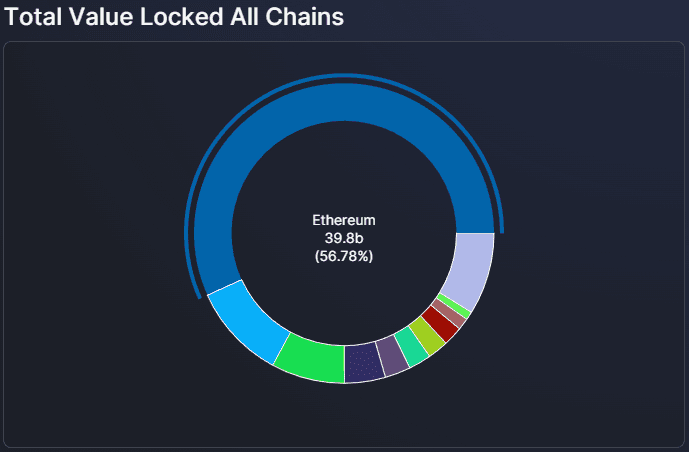
Ethereum is the go-to chain for DeFi and NFT projects. On the chart below you'll see how Ethereum is dominating the DeFi space:
(source)
Ethereum has almost 60% of all the value locked in DeFi Applications. The largest competitor is the Binance smart chain with a modest 10% of the DeFi market.
It also dominates the NFT market and has dominated it since NFTs first became a thing.
The table below shows the percentage of total NFT sales volume over time:
| Chain | Last 24 Hours | Last Month | All Time |
|---|---|---|---|
| Ethereum | 70.76 | 73.45 | 75.12 |
| Solana | 16.05 | 17.38 | 6.70 |
| BNB | 1.71 | 1.93 | 0.30 |
| Ronin | 0.72 | 1.02 | 10.41 |
| Polygon | 0.62 | 0.77 | 1.22 |
| TOTAL VOLUME | $17,250,000 | $520,000,000 | $39,260,000,000 |
(percentage of total NFT sales, source)
It's obvious that Ethereum dominates both the NFT and the DeFi sectors, but Solana has captured a significant portion of the NFT market lately. The main reason that competing chains like Solana (for NFTs) and BNB (for DeFi) are gaining some market share is their high speed, low fees and impressive scalability. But now, with ETH 2.0 in place and future upgrades in the pipeline, these competitors are likely to diminish over time.
My thesis was that better speed, lower costs, and greater scale would reduce the incentive to launch DeFi apps or mint NFTs on competing chains. I expected the network effect to keep Ethereum dominant in these sectors.
Governments Can Use Ethereum
It's not only applications that could benefit from blockchain technology; Governments too.
We have already seen interest from some governments to write their laws on the Ethereum blockchain. Brazil is one of them.
Also, Governments have shown interest in logging information about who owns land/real estate on the Ethereum blockchain.
There is an unlimited number of possible use cases for Ethereum by Governments, but these two are the two major cases we've already seen interest in.
Central Banks Already Use Ethereum
Just four days before writing this article, this happened:
"The European Investment Bank (EIB), the investment bank owned by the EU Member States, has announced the issuance of the organization’s first-ever digital bond built on a public blockchain. The bond was issued using Ethereum and the issuance invoked $121 million two-year bonds placed with key market investors."
That's right; a bank just issued a fricking bond on the Ethereum blockchain!
At the time, I regarded that as important evidence for the Ethereum investment thesis:
The bond market is a $100 trillion market. If Ethereum became a major venue for digital bond issuance, that would be material to the network. Adoption in bonds could also strengthen the case for other public-sector uses, including central bank digital currencies.
As a Norwegian, I'm excited to share that our central bank is currently testing its CBDC (central bank digital currency) on Ethereum:
"A crypto company working with the central bank of Norway has published the source code for the sandbox created to trial the digital version of the Nordic nation’s fiat currency. The prototype digital krone is being built on the Ethereum network and the regulator wants to test various technologies and evaluate the potential impact on financial stability."
- Lubomir Tassev (news.bitcoin.com)
With the successful merge to ETH 2.0, Ethereum is increasingly able to scale to meet national needs. This makes me hopeful for Ethereum's future as the go-to blockchain to run CBDC.
Tokenized Real Estate On Ethereum
Real estate is traditionally a "high ticket" investment, meaning you need a lot of money to start. Ethereum changes this:
Suppose you have a property that's 10,000 square feet big and worth $1 million. Suddenly you need some cash, but you don't want to sell the property yet. What you can do is tokenize the property.
This is how: You create an ERC-20 token (token on the Ethereum blockchain) which derives its value from the property. For instance, you can create one token per square foot and value them at $1 million / 10 000 = $100 each.
Then you can sell 2000 tokens to investors and keep 8000 of them for yourself.
This way, you keep 80% of the property while other investors own 20% of it.
**If it's a rental apartment, the rent can be paid in Ethereum directly into a smart contract which automatically pays out the appropriate percentage of the rental income to the owners.
"How far away is this?"
It's already here!**
Last week, a friend of mine actually talked to a Norwegian billionaire real estate guy looking to tokenize some of his properties.
For one 2021 example, Cointelegraph reported on Reinno, a platform with over $200 million worth of tokenized real estate at the time.
These use cases formed the basis of my $100K thesis. Continued adoption was the key assumption.
Now, let's take a more technical approach and try to figure out when we can expect a $100K Ethereum to materialize, according to historical data and models:
When Could Ethereum Reach $100,000?
To estimate when Ethereum could hit $100,000 we'll look at charts and the cyclical nature of the cryptocurrency market. Please remember that this is pure speculation, and not meant as a price prediction.
The Cyclical Nature of The Ethereum:
The cryptocurrency market behaves cyclically, meaning that it's somewhat predictable in the long-term timeframe.
The market is cyclical because Bitcoin, which the altcoin market follows, is cyclical by design.
Think about it like this:
Bitcoin has cycles of roughly 4 years due to the Bitcoin halving (read about the Bitcoin halving's effect on price here). Also, when Bitcoin moves, the market usually follows it.
This leads to a cyclical behavior of the entire cryptocurrency market, including Ethereum. The chart below shows how Bitcoins cycles work:
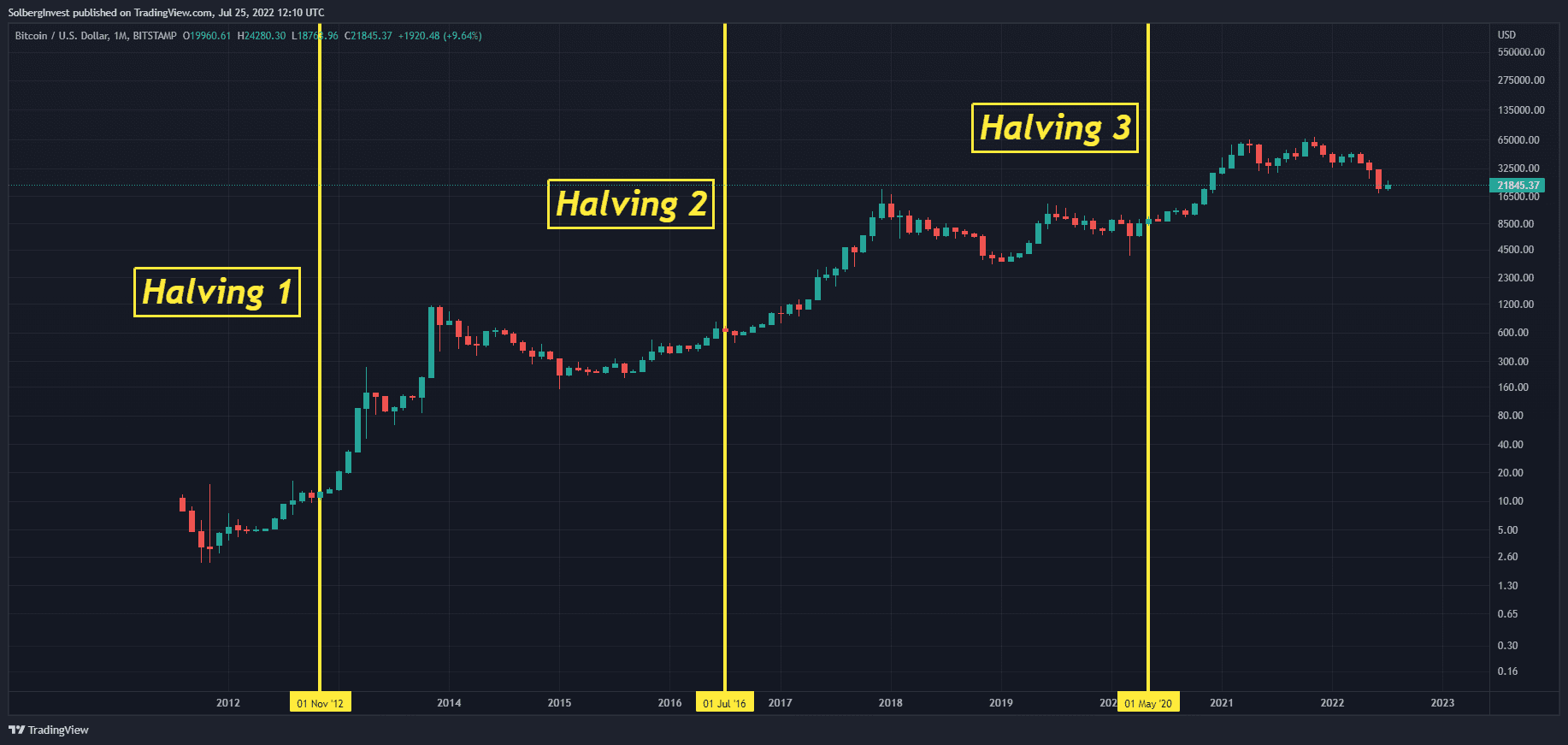
Notice how the market is relatively calm a year or two before the halving, but the price increases exponentially after each halving?
This is key to understand for all crypto investors, even if you invest exclusively in altcoins.
The reason is that altcoins, including Ethereum, follow Bitcoin's price movements.
Take a look at the Ethereum price chart, with the halvings of Bitcoin pointed out:
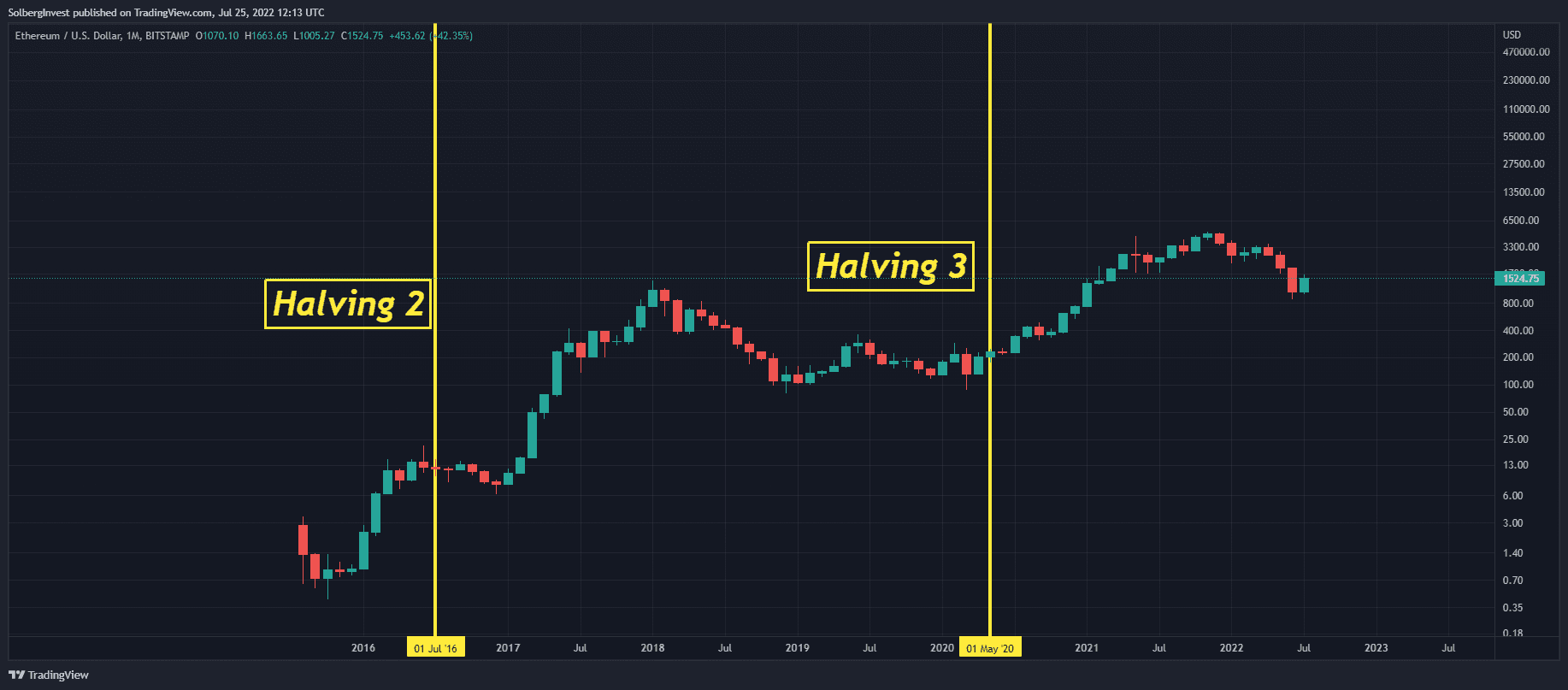
We see the same pattern with Ethereum - an exponential increase in price after Bitcoin halvings.
This pattern was the basis for my view that Ethereum could eventually reach $100,000 after enough Bitcoin cycles.
However, this seems a bit thin. I want to get deep into this topic and really try to figure it out. This is why we're going to do things differently than most people:
We need to figure out what Bitcoin will do and how much Ethereum will be worth, priced in Bitcoin.
The Relationship Between Ethereum And Bitcoin:
Bitcoin is the king of Cryptocurrencies, and Ethereum is the prince. Their relationship is interesting and somewhat predictable.
Let me show you:
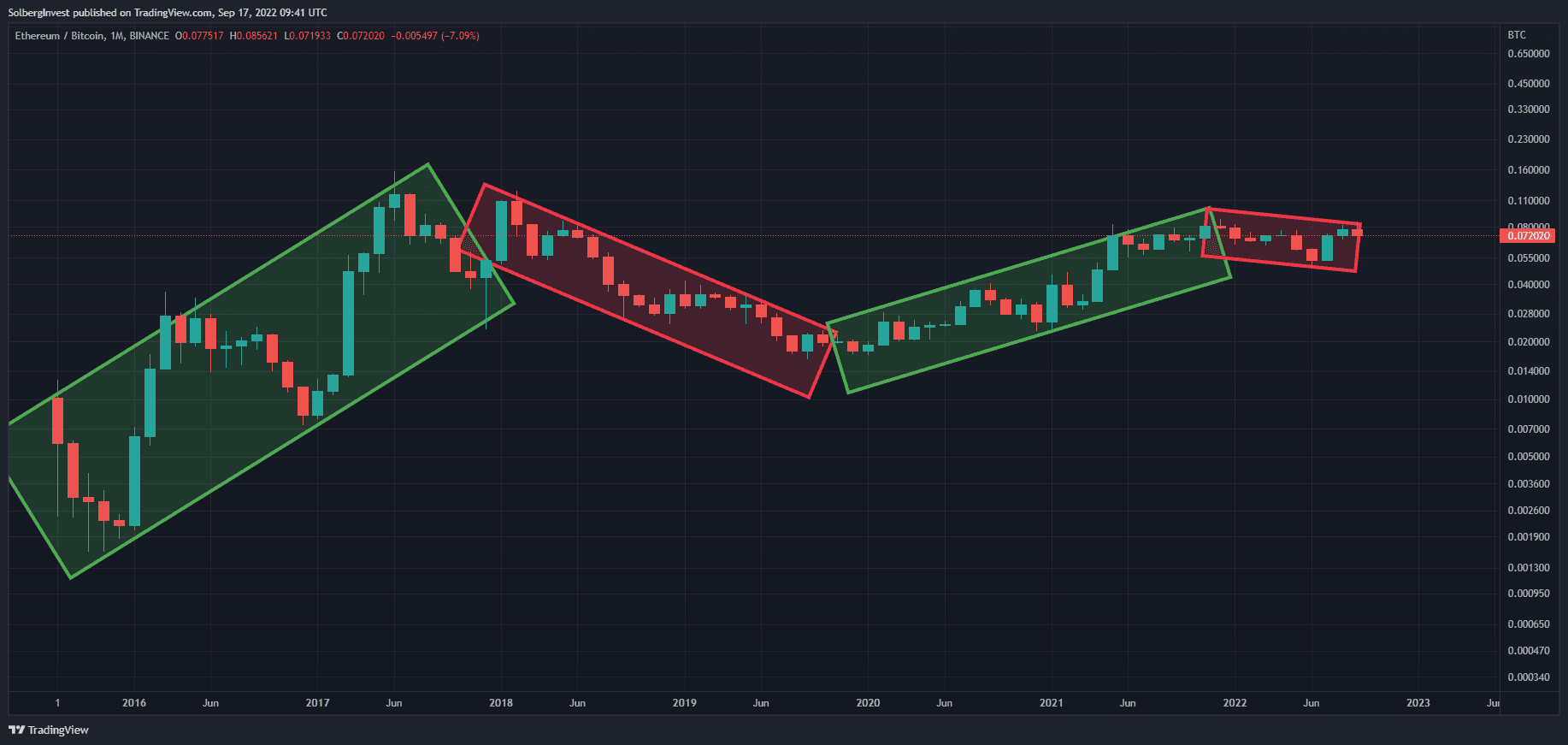
The chart above shows you the relationship between Ethereum and Bitcoin: It shows you how much Bitcoin you can get with one Ethereum.
If this chart goes up, it means that Ethereum is outperforming Bitcoin. If the chart goes down, it means that Bitcoin is outperforming Ethereum.
This chart indicates two things:
Ethereum outperforms Bitcoin in bull markets and underperforms it in bear markets: The chart went up in 2016-2017 (bull market), down in 2018-2019 (bear market), up again in 2020-2021 (bull market) and is yet again starting to bleed in the current bear market.
The volatility of the relationship between Bitcoin and Ethereum is decreasing: The trend channels are tightening over time.
Assuming that these two trends continue, the relationship between Ethereum and Bitcoin will eventually converge towards a specific value.
Maybe something like this:
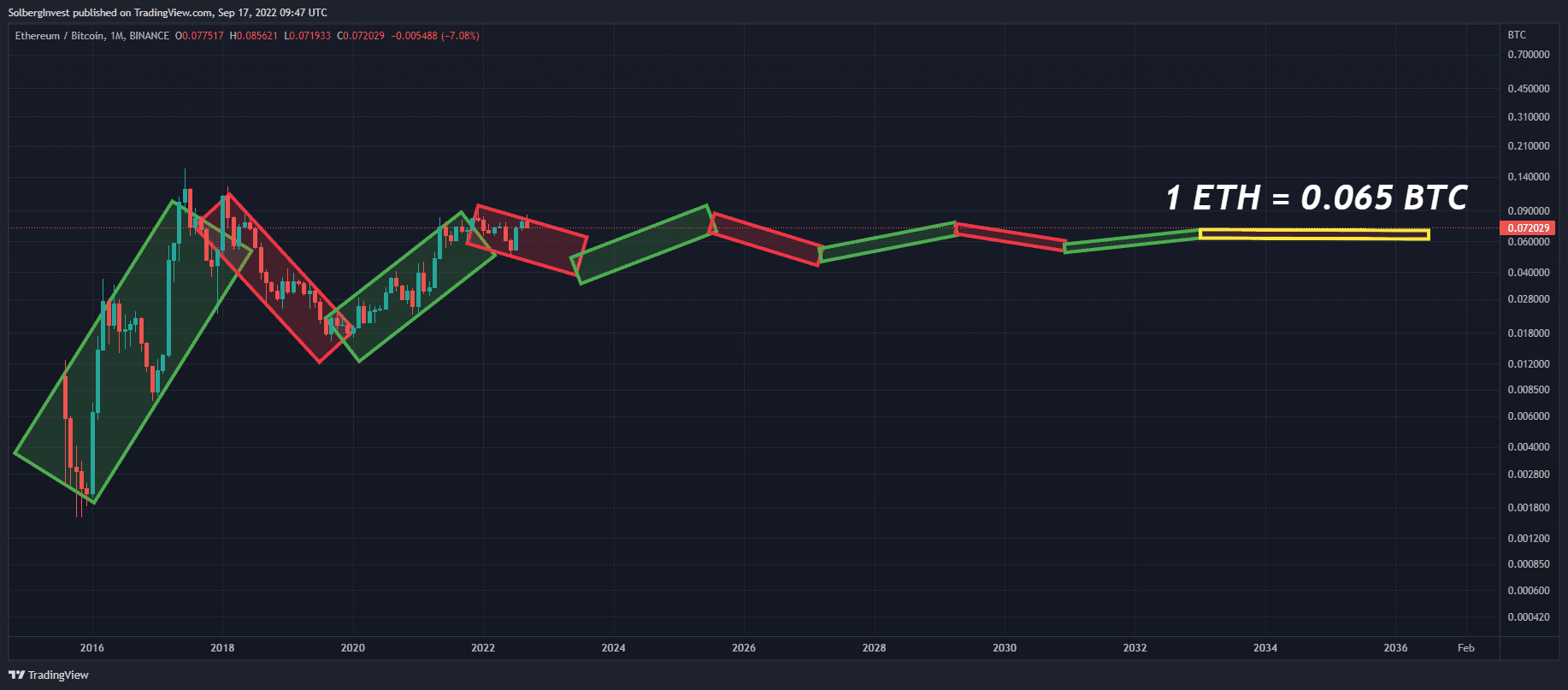
Please remember that this is pure speculation based on a small data sample. However, it's not unthinkable that something like this will happen because:
As Bitcoin and Ethereum grow, both will experience decreased volatility - It takes more buying/selling pressure to move the price of something big than something small.
We already know that Ethereum follows Bitcoins cycles and that they increase/decrease roughly simultaneously.
Profits generated by trading Bitcoin often trickle into Ethereum and vice versa. This means that if Bitcoin greatly outperforms Ethereum for a few months, a large portion of the gains will be put into Ethereum, making Ethereum catch up with the king. This balances the scales and readjusts the relationship between Bitcoin and Ethereum every time it "gets out of line".
Like the charts above, let's assume that the relationship converges to 0.065 Bitcoin per Ethereum. This ratio basically means that one ETH is worth 6.5% of what BTC is worth. We can use this to calculate what Bitcoin has to be worth for Ethereum to reach $100K:
If Ethereum is worth 6.5% of one Bitcoin, and one Ethereum is worth $100K, we can calculate the needed Bitcoin price like this: Bitcoin price = $100 000 / 0.065 = $1,538,462.
For Ethereum to reach $100K, we need to see a Bitcoin price of roughly $1,500,000.
Under this model, estimating when Ethereum could reach $100K depended on estimating when Bitcoin could reach $1.5 million.
My estimate at the time was somewhere between 2035 and 2040.
My stronger conviction at the time was the underlying million-dollar Bitcoin scenario; the additional move to $1.5 million was the next assumption.
Is A $100K Ethereum Realistic? (What it would look like)
Let's compare the market capitalization of Ethereum at $100,000 with other stuff, just to get an idea of what a $100K Ethereum would look like:
The market capitalization of Ethereum after reaching a price of $100K would be 11.5 Trillion U.S. Dollars. Here's the math behind that statement:
Market cap = price * supply = $100,000 * 115,000,000 = $11,500,000,000,000 (11.5 Trillion USD)
Let's put that into perspective:
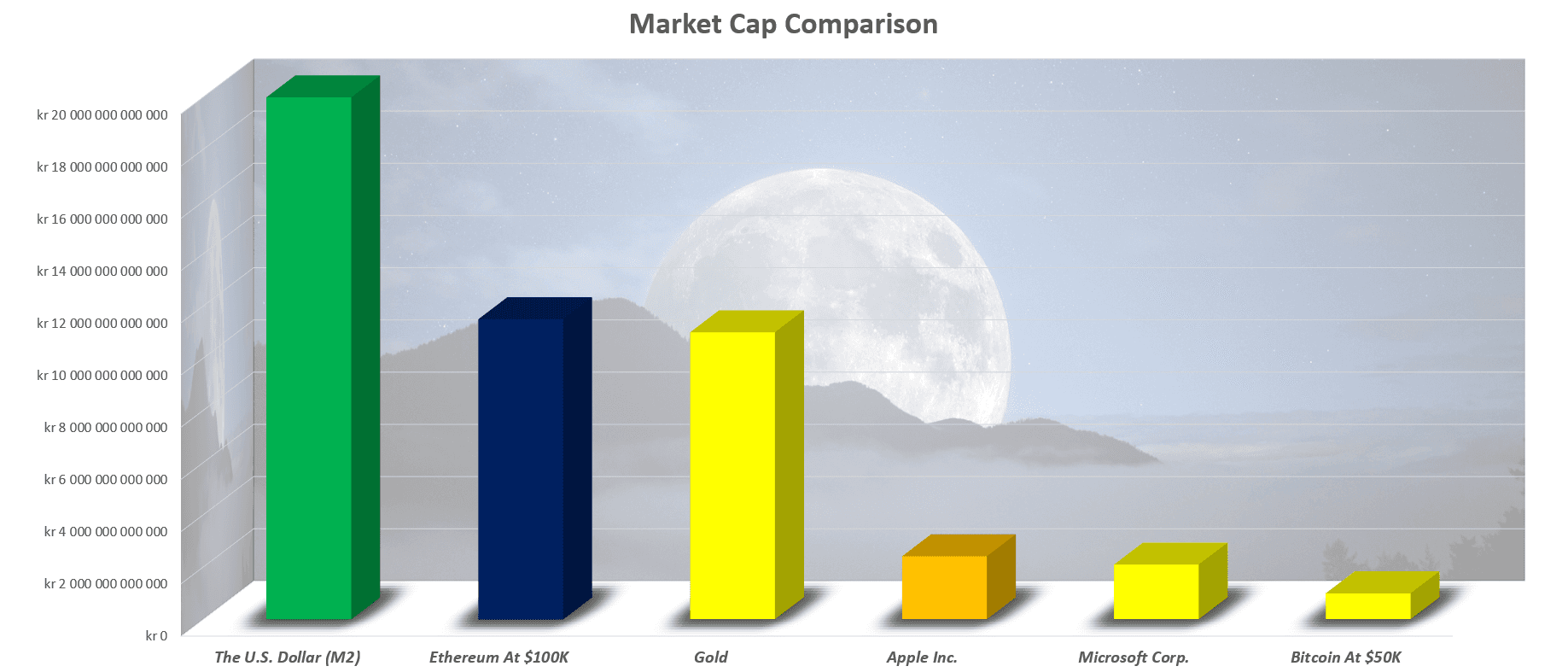
Above, you see a comparison of the market cap of Ethereum at $100K and a few other things. It would be a little bit bigger than Gold and roughly half of the M2 money supply.
And yeah, that's moon you see in the background, cuz eth be mooning baby!
Jokes aside, the takeaway from this calculation is the following:
A $100K Ethereum fit within the boundaries of this scenario. An $11.5 trillion market cap was large, but still within the comparison range I was testing.
Conclusion: Yes, Ethereum Can Reach $100K
My conclusion was that Ethereum could reach $100K if adoption in tokenized real estate, digital bonds, and public-sector blockchain use continued to grow.
If the Ethereum/Bitcoin balance converges to a 0.065 ratio, we might expect a $100K Ethereum within the next decade.
A $100,000 Ethereum would be larger than Gold is today and roughly half of the current market cap of the U.S. Dollar (M2). This is well within the range of what's realistic for the market capitalization of Ethereum in the long run.
For related background, see Is Ethereum A Good Long-Term Investment?