

(Updated 14. September 2022)
Ever since I started investing in Bitcoin, people have been dreaming about a "million-dollar Bitcoin". In this article, I'll take this question seriously and figure out how, why, when, and if Bitcoin can reach one million dollars.
Here's the short answer:
My scenario was that Bitcoin could reach $1,000,000 if institutional adoption accelerated and a sound regulatory framework emerged. At that price, it would have a fully diluted market capitalization of $21 trillion; the models explored below placed that outcome within the following decade.
Bitcoin at a million bucks seems abstract and far away.
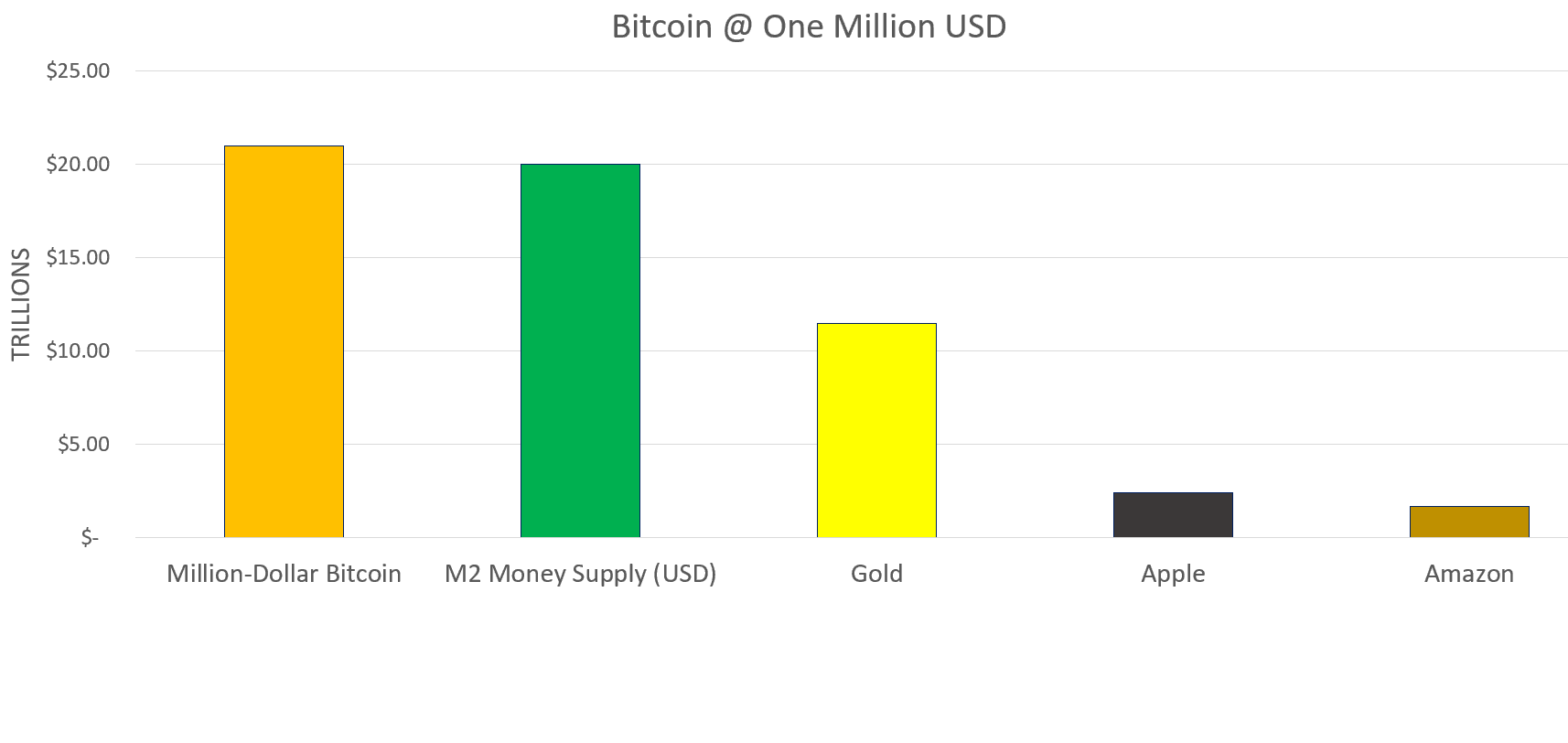
Let's compare the market cap of a hypothetical million-dollar Bitcoin to some other things you're familiar with:
(data from 2021)
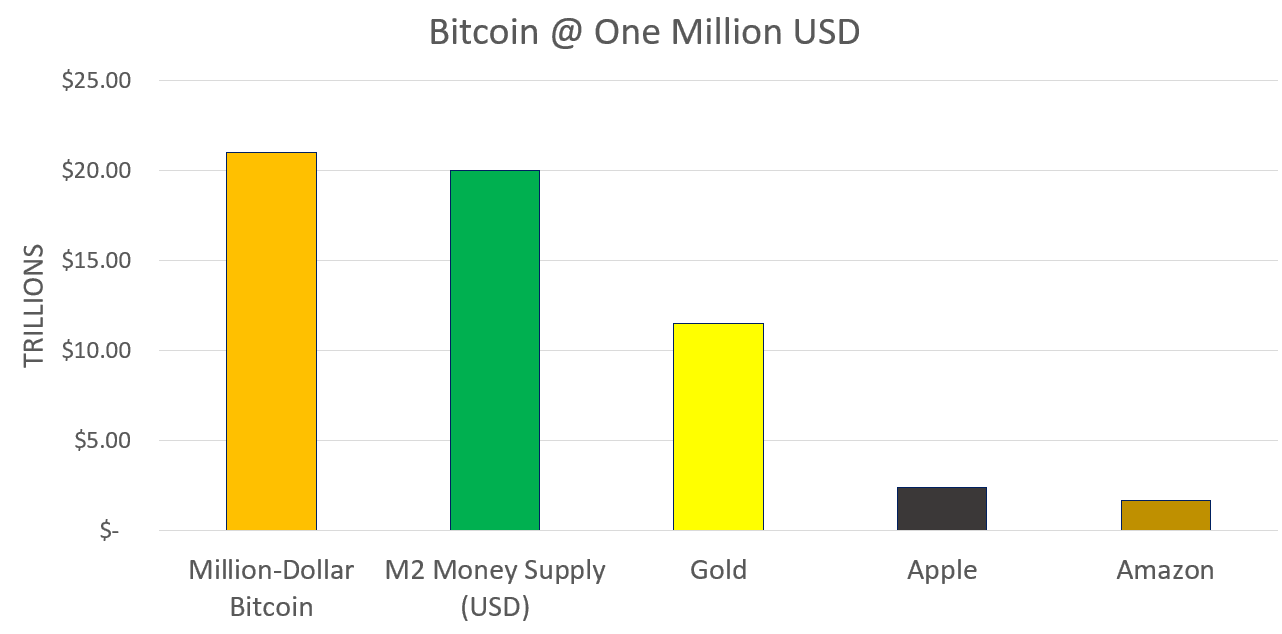
If Bitcoin reaches one million dollars, its market cap will exceed the M2 Money supply, which estimates the U.S. dollar's market cap.
"That sounds insane. Bitcoin worth more than the U.S. Dollar...?"
I know how it sounds if you're not a "Bitcoiner" yet, but hear me out.
The rest of the article explains the reasoning behind that long-term scenario.
How Bitcoin Can Reach One Million USD:
For Bitcoin to reach one million dollars, two things must happen:
More Adoption
Clear Regulation
Without these two, we'll probably never see the seven-figure prices that we're all dreaming about.
Let's break it down:
Bitcoin Needs Adoption To Reach $1,000,000:
In this thesis, adoption meant more people holding Bitcoin or using it in transactions.
Think about it: What's Bitcoins' function? What does Bitcoin do?
Bitcoin is (1) A "store of value" and (2) A "means of exchange".
The two relevant forms of adoption were transactional use and long-term ownership as a store of value.
Most people agree that before "the lightning network" is rolled out completely (an upgrade making Bitcoin super fast and cheap), Bitcoin is a suboptimal means of exchange.
It is relatively slow, expensive, and cumbersome to use for small, day-to-day transactions. Other alternatives, like Solana, are more suitable for this use case.
At the time, I regarded Bitcoin as an unusually strong store-of-value candidate.
In fact, Bitcoin is gaining acceptance by big investment banks like J.P Morgan and Morgan Stanley, asset managers like Black Rock and Greyscale, companies like Tesla and Micro Strategy, and the list goes on.
According to Morgan Stanely, we're at a critical threshold where crypto might become "accepted" as an investment class, not just as a "gambling vehicle" for retail investors. (source)
Also, if more countries follow El Salvador in making Bitcoin legal tender, things will only accelerate even more.
Remember, Bitcoin is a network:
If more people join, everyone in the network gains value from it. The more people that join the network and adopt Bitcoin, the more attractive it is for outsiders to join as well. It's like a snowball rolling down the hill. The bigger it gets, the faster it grows.
This network effect can compound quickly once adoption gains momentum.
Bitcoin Needs Clear Regulation:
This is important because institutions and businesses are held back by the lack of clear regulation. Many companies would probably love to buy Bitcoin, but they don't know how to maneuver the legal and regulatory landscape because it's unclear what the rules are.
Until we get clear regulation, which would be a good thing (as long as it's fair), we will not see one million dollars per BTC. We need the regulation to get more institutional adoption.
Why I Thought Bitcoin Could Reach $1 Million USD
For crypto enthusiasts, the "million-dollar question" is not a "how" question, but a "when" question.
If you haven't done your homework and spent 20-100 hours learning about how Bitcoin works, central bank monetary policy, and how the USD fails as a store of value, you're probably not convinced yet.
Let's go through why I believed Bitcoin could reach $1,000,000 and why I regarded the USD as a weak long-term store of value.
Please keep in mind that I'm not a financial advisor. Also, I will present a simplified version of the real world. It is only meant to give you an idea of what's going on.
The U.S. Dollar is Failing - Bitcoin is the Solution:
Look, I not saying we're going to stop using the U.S. Dollar. I'm saying that the U.S. Dollar will not remain the bedrock of our financial system forever.
Today, the U.S. Dollar is what every other currency is "backed" in. It's what other currencies derive their value from.
Another way to think about it is that "everything is valued in USD". We price all major commodities like oil and lumber in U.S. Dollars.
This begs the question: "Okey, but how do we evaluate the U.S. Dollar? What makes USD valuable and suitable as the bedrock of our economy?"
Well... The U.S. Dollar isn't backed by anything other than a promise from central banks and governments.
To recap quickly: Our current economic bedrock is the U.S. Dollar, which is backed by the promise of a central bank and a government. We call this system for "The FIAT system". It goes like this: "Central bank and government promise" < the U.S. Dollar < other FIAT currencies.
In the old system, all currencies were backed in U.S. Dollars, but the U.S. Dollar was then backed in Gold. This system, where gold is the bedrock of the economy, is referred to as "the Gold standard". It went like this: Gold < the U.S. Dollar < other FIAT currencies.
Under the Gold standard, you didn't have to trust the government, or a central bank, to keep your money valuable. Gold is amongst the best stores of value ever and doesn't need regulation or force to keep its value over time and space.
Under the Gold standard, banks could not create more FIAT than they had gold, making excessive money printing impossible.
Under the FIAT system, the central bank of The United States can do whatever it wants to the supply of USD, shaking the foundation of the entire world economy.
Let's recap:
Gold is one of the best, if not the best, stores of value ever. Placing Gold at the bottom of everything, making it illegal to create more FIAT currency than they held Gold, kept banks in check. Now, with the FIAT system, the only thing keeping banks in check is the promise of a Government. This has been broken repeatedly, as central banks mess with the value of FIAT currencies all the time.
The main distinction between the old system and the new system is this: Back in the day, it was hard to create new money. Today, it is easy to create new money.
This begs the question: "But why is it bad that it's easy to create new money?"
Why "Soft Money", Like FIAT, Is Bad:
Money that's easy to create more of in a short time is referred to as "soft money". Having something as soft as FIAT, which can be created arbitrarily at the will of a government, is nothing short of a catastrophe. Here's why:
No nation or government with the power to create money has ever managed to resist abusing it. For example, The Roman Empire started to remelt their coins, watering them out to create more coins with the same total amount of valuable metals. Unsurprisingly, this caused inflation and economic downturn and was a significant contribution to the collapse of The Roman Empire.
Governments and central banks are incentivized to think short term. Because their leaders are re-elected from time to time, they are pressured to make decisions that "look good", and benefit people "now". Instead of getting through an economic downturn, let's just print money and bail everyone out! This, of course, doesn't work in the long term and only pushes the problem forward and amplifies it exponentially.
FIAT increases the wealth gap by stealing from poor people and giving to rich people. Because FIAT is soft, central banks arbitrarily create more of it which leads to inflation and FIAT devaluation. Basically, printing money makes "stuff" more expensive and "FIAT" less valuable. How does this affect those who own stuff versus those who own nothing? Those who own "stuff", like stocks and real estate, benefit from the appreciation of the assets. In addition, they likely used debt to buy their "stuff", and since FIAT decreases in value, their debt decreases in value. In other words, it's a win-win for the rich; their stuff is more valuable than before, and their debt is less valuable than before. The poor, those who don't own anything, are wrecked by inflation. They don't have assets that appreciate. They don't have "good" debt that depreciates. They have their savings in FIAT, which only decrease in value. They spend most of their paycheck, if not all of it, on "getting by", which only gets more expensive over time. For poor people, it's a lose-lose situation. Their saving depreciates and their cost of living gets out of hand, and since the price of assets increase it gets harder and harder to start getting out of poverty.
I could go on and on, but you get the point. Placing "soft money" at the bottom of our economy is terrible, and we need to change it. We need "hard money" to be the bedrock of our economy. Bitcoin could play this role, as it is the hardest form of money ever.
Bitcoin Fixes This Problem:
It is impossible to mess with the supply of Bitcoin. The inflation rate of Bitcoin is hard-coded into the program. This makes it resistant to manipulation and removes the need to trust a third party (like governments or banks).
Also, Bitcoin's inflation will eventually reach zero. There can only ever be 21 million BTC. It is impossible to create more than that. This property of having a hard-capped supply is referred to as "absolute scarcity".
These properties, combined with decentralization and strong network security, made Bitcoin a compelling store-of-value candidate in my view.
"Yeah sure, but why do we need a store of value?"
A reliable store of value was central to long-term financial planning in my framework.
That was why I believed long-term savings needed exposure to assets rather than relying only on FIAT. In my view, assets such as stocks and real estate had historically stored value better than cash because inflation made goods and assets more expensive while reducing FIAT's purchasing power.
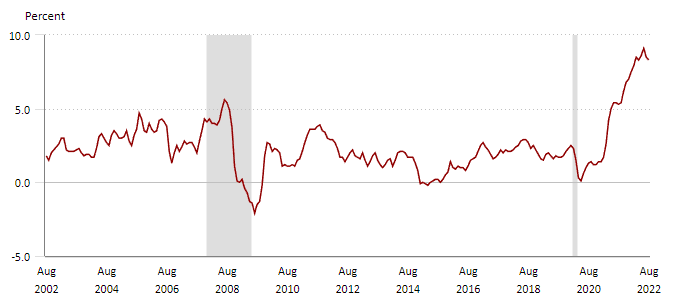
You've probably heard that inflation is about 2-3% per year. Well, it's much higher than that.
This is the last 20 years of inflation as reported by the U.S. BUREAU OF LABOR STATISTICS:
source: bls.gov
Now, after a decade of excessive money printing and near-zero interest rates, inflation is climbing close to 10% per year.
Oh, and did you know this:
They keep changing the way they measure inflation to keep the numbers low.
This is not a tin-foil hat conspiracy thing. They are transparent in the ways they measure it.
On the chart below, the blue line shows the current inflation measured like they did in the 90' vs how they measure it now (red line):
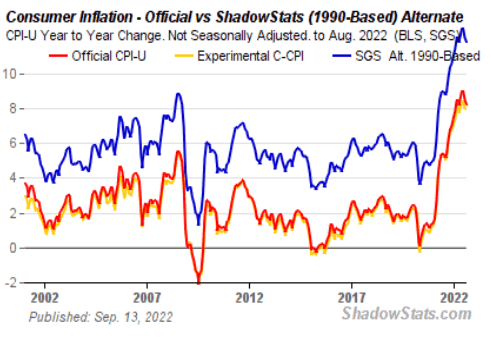
You can see that the blue line (90' way of measuring inflation) is consistently higher than the red.
Now, let's look at how they measured it in the 80':
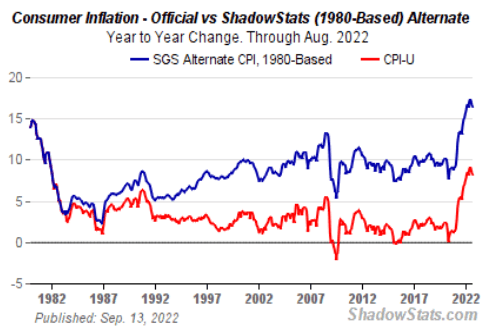
We see several years with inflation above 10%. This means that your hard-earned money loses 10% of its value every ear, depreciating exponentially.
I find it suspicious that every decade, their way of measuring inflation seems to spit out lower numbers, closing in on their target of 2-3 percent.
Nevertheless, it doesn't really matter if you believe inflation is 15% or 7%. What matters is that inflation is real and that it robs the poor and enriches the rich.
My Search for Something That Outpaced Inflation - Bitcoin
The question I asked was: "What investments could outrun inflation?"
Understand, if your returns are 7% and inflation is 10%, you're actually losing 3%...
I was looking for assets that could produce 10-20% per year over a long period.
In this analysis, the two candidates I focused on were technology stocks and Bitcoin.
Bitcoin has produced an annualized 200% return for over a decade.
That historical return stood far above the other asset classes in this comparison.
For example, The S&P 500 has a good year when it goes up 10%... 10% is just another Tuesday for Bitcoin.
In other words:
My conclusion at the time was that Bitcoin was the strongest inflation hedge in this comparison. The thesis was that rising demand for a scarce store of value could support a much higher Bitcoin price.
My metaphor was a life raft with 21 million seats beside a much larger ship: scarcity could make those seats more valuable if demand rose.
That was why I wanted exposure before broader adoption arrived.
Update On Inflation And Bitcoin More Than A Year Later:
More than one year after this article was written I've come back to check my claims, update the charts and do some editing.
By August 2022, inflation had risen sharply and the Federal Reserve was tightening monetary policy and raising interest rates.
Over the comparison period used below, Bitcoin still outperformed the other asset classes despite its severe drawdown.
Here's a chart of how different asset classes have performed since the pandemic, and the insane money printing that followed, started:
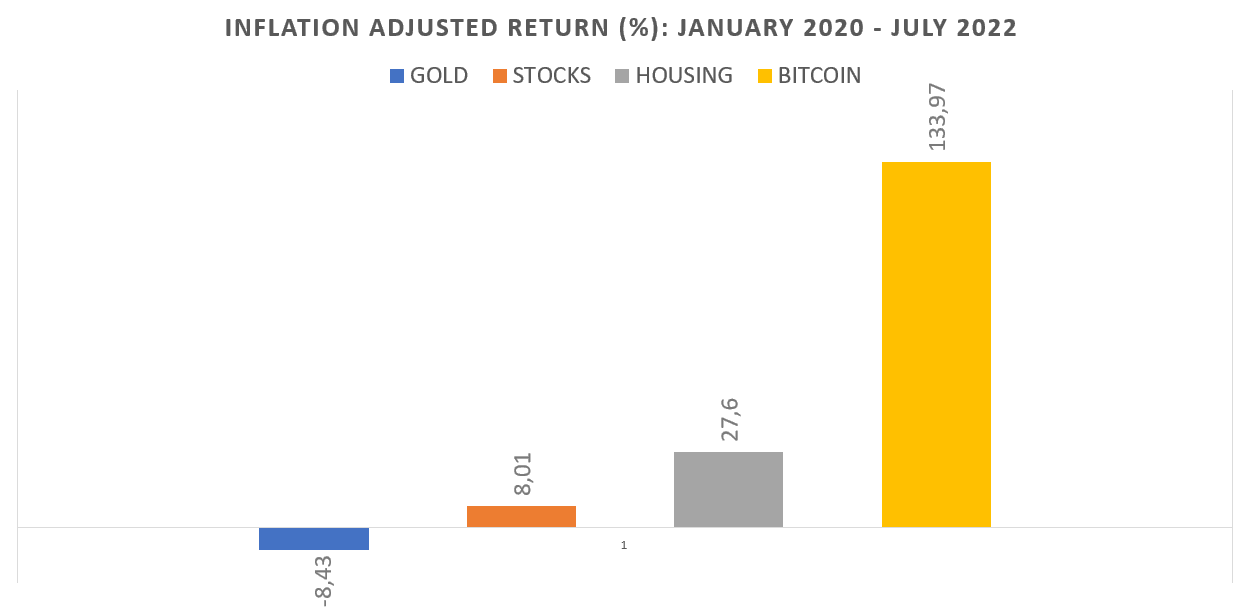
(Data from august 2022)
Bitcoin was down 70% over the preceding seven months, yet remained ahead of the other asset classes over the full comparison period.
If Bitcoin continued to protect purchasing power during inflationary periods, it would strengthen the case for a $1,000,000 price.
When Could Bitcoin Reach One Million Dollars?
To answer this question, we must use data science and models. Specifically, I'll look at The Log Fit Model, which is more conservative than the popular "stock to flow" model and many others.
The approach I used alongside this thesis is described in my historical Bitcoin investing and trading strategy.
The LogFit Model:
This model is purely technical, which means that it doesn't care about the fundamentals at all. It exclusively looks at historical price data, nothing else.
This model shows the logarithmic trendlines that make up the channel that bitcoin has been kept within for the past decade:
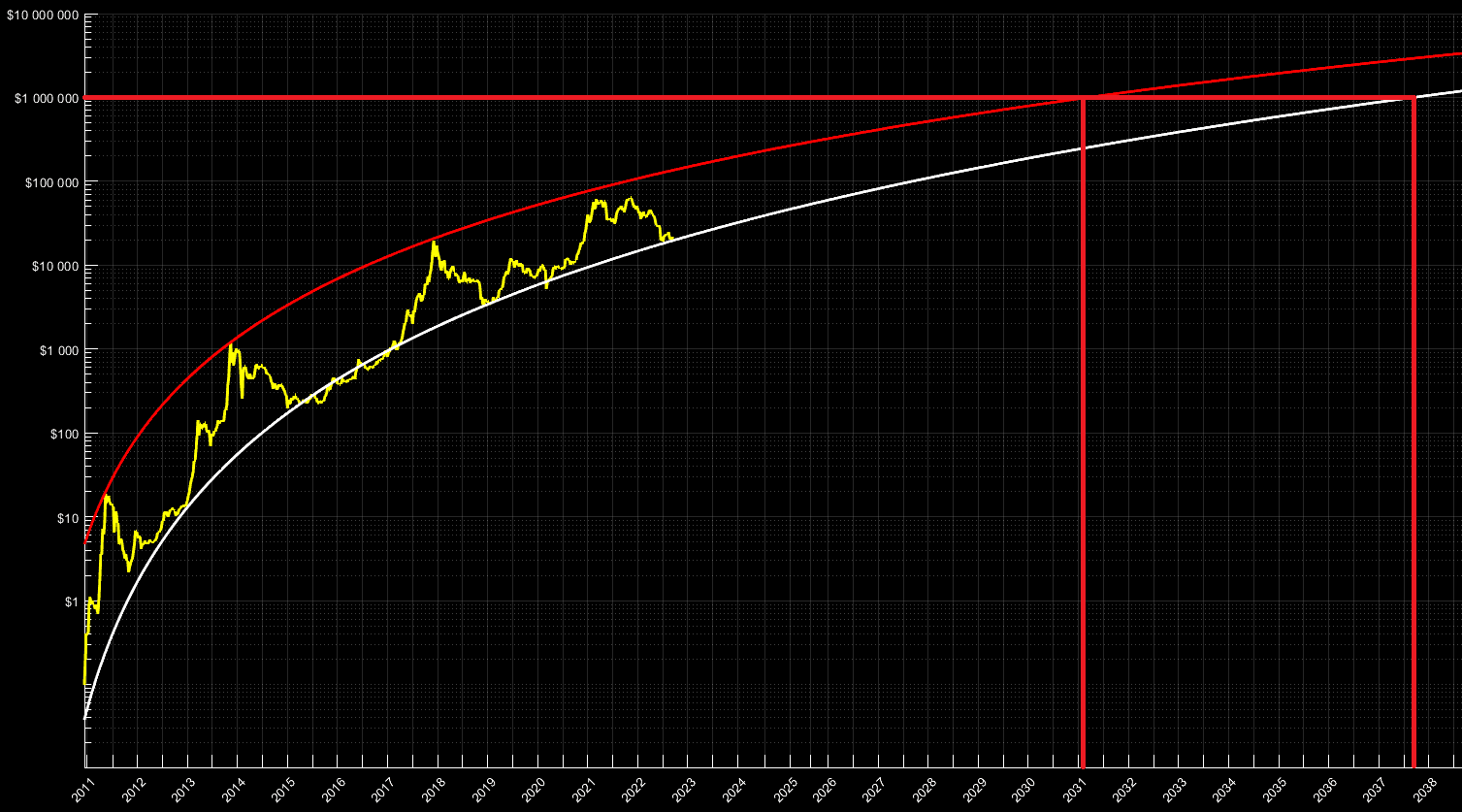
In this model, the earliest $1 million crossing was around 2031, while the lower trend path did not reach it until roughly 2037.
Conclusion: Yes Bitcoin Can Reach One Million Dollars
My conclusion was that rising demand for a scarce store of value could take Bitcoin to $1,000,000. In the LogFit scenario, the range was roughly 2031–2037.