


(Updated 18. September 2022)
Solana's main advantages are low transaction fees and high scalability. But exactly how low are Soloana's transaction fees? And why are they so low?
Let me get straight to the point:
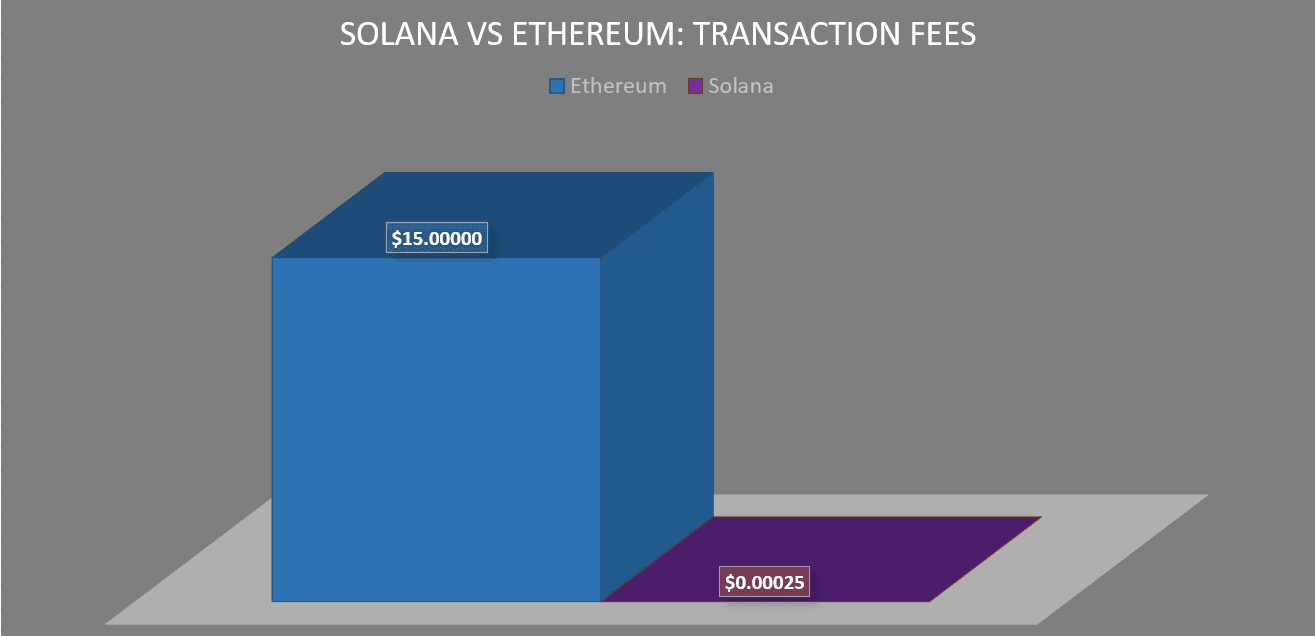
Solana fees are on average $0.00025 per transaction. The fees are set by the competition for block space, which increases when the traffic on the blockchain increases.
Solanas transaction fees are 60 thousand times lower than Ethereum's. This is because of the high scalability of Solana compared to Ethereum.
Below you see a chart visually showing the difference:
Does this mean Ethereum is dead? Not at all. I still preferred Ethereum as an "overall" blockchain despite the fee gap.
Why Solana's Transaction Fees Are So Cheap:
The reason for high transaction fees is too many transactions in too little time. In other words, it's a scaling issue.
If a Blockchain can do 10 transactions per second (TPS), and 5000 people try to transact the same second, the fees will shoot up, as the competition for "block-space" increases.
"Ehhh, what...?"
It's complicated, but here is the "skinny" explanation:
When you send crypto to someone, the transaction has to be placed in a "block". This block is basically a bundle of transactions.
After a specified time interval, which depends on which blockchain you're transacting over, the block gets added to the chain. The chain is basically a public database, or a ledger, where all transactions are logged.
Once the block that your transaction lies within gets added to the chain, your transaction is complete.
Here's the thing: A block can only carry a limited number of transactions!
If the block gets filled up, you have to wait for the block to be added to the chain and hope there's room for you on the next one.
"Okay, but what decides which transactions get to ride in the block?"
Whoever pays the highest transaction fee!
Transaction fees are the price you pay to gain a spot in the next block, which completes the transaction by adding it to the chain and making it official.
Therefore, there are two factors in the equation that decides the transaction fees: The time it takes to create new blocks, and the number of transactions that fit in one single block.
If blocks are created frequently, and tons of transactions can fit into each of them, the competition to get a spot in them will be low, resulting in low transaction fees.
Background: What is Blockchain Technology?
Great, now it's time to look at these two factors for each Solana and Ethereum and try to predict the future transaction fees:
The Transaction Fees Of Solana Compared To Ethereum
Below you see a table comparing the two factors for Solana and Ethereum:
| Solana | Ethereum | |
|---|---|---|
| Block Time (time to create new blocks) | 0.4 Sec | 13 Sec |
| Block Size (number of transactions per block) | 20 000 Transactions | 70 Transactions |
| Fees (per transaction) | $0.00025 | $15 |
Sources: solana.com, ycharts.com and bitsonblocks.net.
From the table above we see that Solana has superior block time and block size, which is why Solana has drastically lower transaction fees than Ethereum.
The published figures implied that Solana could theoretically scale to 50,000 TPS, roughly the stated capacity of VISA. (source: bitcoin.com)
In addition, Solana claims to be able to double its scalability every two years - increasing exponentially intact with developments in CPU technology.
If Solana continued scaling faster than demand, I expected fees to remain low and potentially decrease.
In Ethereum's case, it's no wonder why the fees shoot up when usage goes up. The scaling of the Ethereum m blockchain is terrible, leading to high competition for block space.
At publication, Ethereum's planned upgrades were expected to increase capacity and reduce fees.
To summarize:
My conclusion at the time was that Solana's fees were roughly 60,000 times lower because it had greater capacity and lower traffic. I expected Ethereum's planned upgrades to narrow that gap.