


These days there's a lot of hype around alternative layer one solutions like Solana and Avalanche. New crypto investors often feel like Ethereum is outdated, and that the tech is "old and slow".
After all, Ethereum is roughly 60,000 more expensive to transact on compared to Solana, and it's 40 times slower.
Nevertheless, my 2022 view was that Ethereum had a strong investment case. In this article, I'll explain why and show the reasoning behind its valuation.
The short answer to "Is Ethereum a good investment in 2022" is this:
In my 2022 assessment, Ethereum had a strong investment case because institutional adoption was accelerating, major upgrades were planned, its TVL was over 10 times that of its closest competitor, and its ecosystem led other blockchains.
Let's get into why Ethereum is a good investment and my largest altcoin position in the cryptocurrency market:
Why I Considered Ethereum a Good Investment in 2022:
First of all, let's establish what Ethereum and other layer one solutions like Solana and Cardano are, and what they are trying to achieve:
Ethereum is what we call a “programmable blockchain.” This means that programmers can make changes to the platform and make new applications. The Ethereum blockchain is often compared to "the internet" as it lets you build things on it and use it to store information.
The same is true for Solana, Cardano, Avalanche and all the other layer one solutions.
Basically, Ethereum and the other layer one solutions try to build a sandbox for developers to play around in and build awesome applications that people and businesses want to use.
For example, the popular DEFI application Uniswap is built on Ethereum. This means that all transactions done in the Uniswap application are in fact run on the Ethereum blockchain.
The more applications that are built on a given blockchain, and the more people that use these applications, the higher the value of the native token to that blockchain will be (in theory).
For example, if more people use applications built on the Ethereum blockchain, ETH will in theory increase in demand and therefore value.
Basically, the more a blockchain is being adopted/used, the more valuable the native coin gets. Got it?
Now, let's look at the adoption of the different blockchains:
TVL Ethereum vs Competition:
TVL means "total value locked", which means the amount of money locked in DEFI apps and such.
TVL is basically a number telling you how much money is floating around in the DEFI ecosystem of a given blockchain.
Oh, and this is important: High TVL - good. Low TVL - bad.
Below you find a chart showing the difference in TVL of some of the largest blockchains:
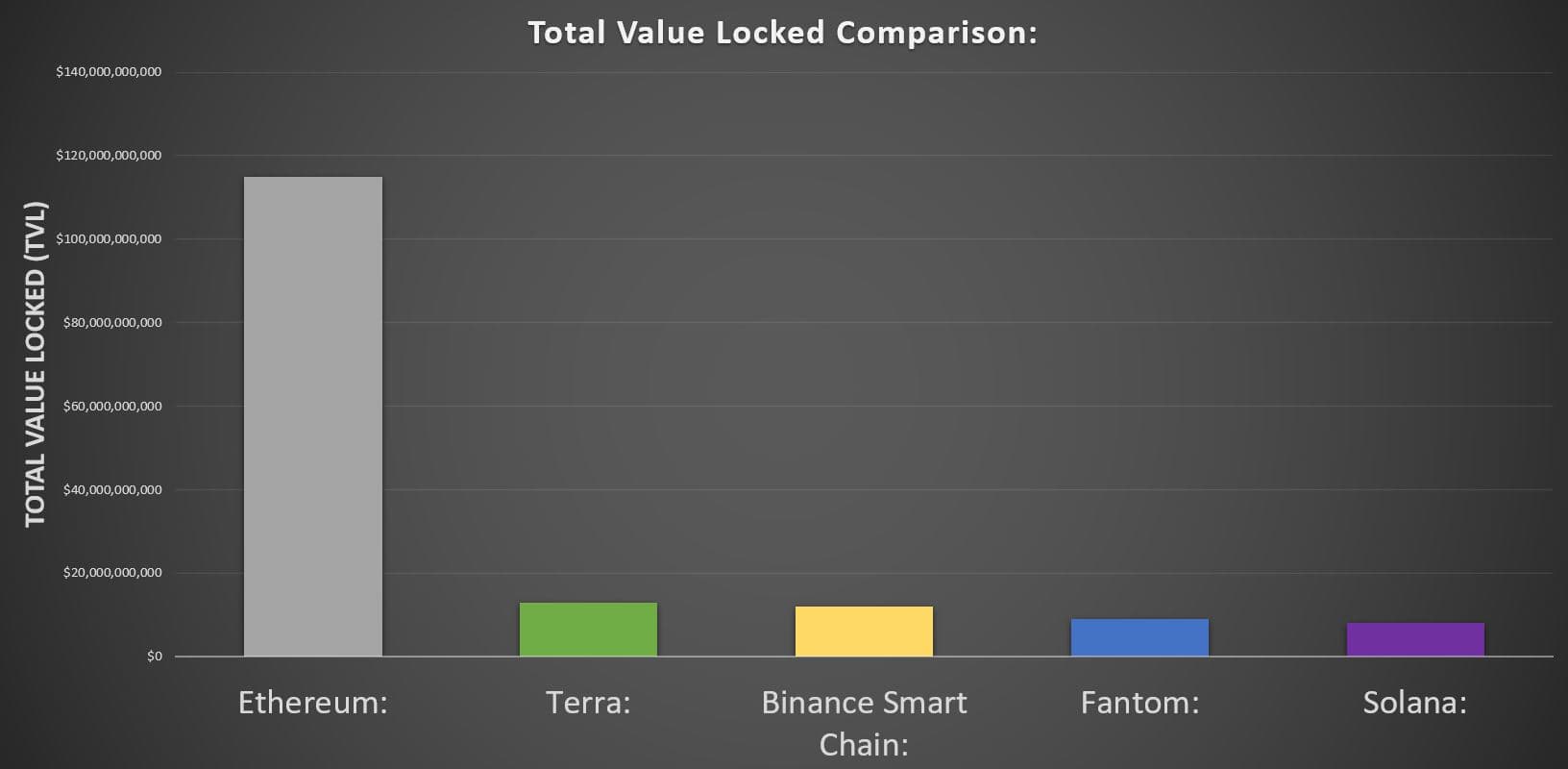
Do you see how much more money flows around on the Ethereum blockchain?
The TVL on Ethereum is almost 10 times higher compared to all its competitors.
Number of application on Ethereum vs competition:
Another way to get an idea of the adoption of a given blockchain is to look at the number of applications built on top of it.
The number of "protocols" is the right way to say it, but let's just stick with applications cuz it's easier...
Below you'll see a chart showing the number of applications built on some of the different blockchains:
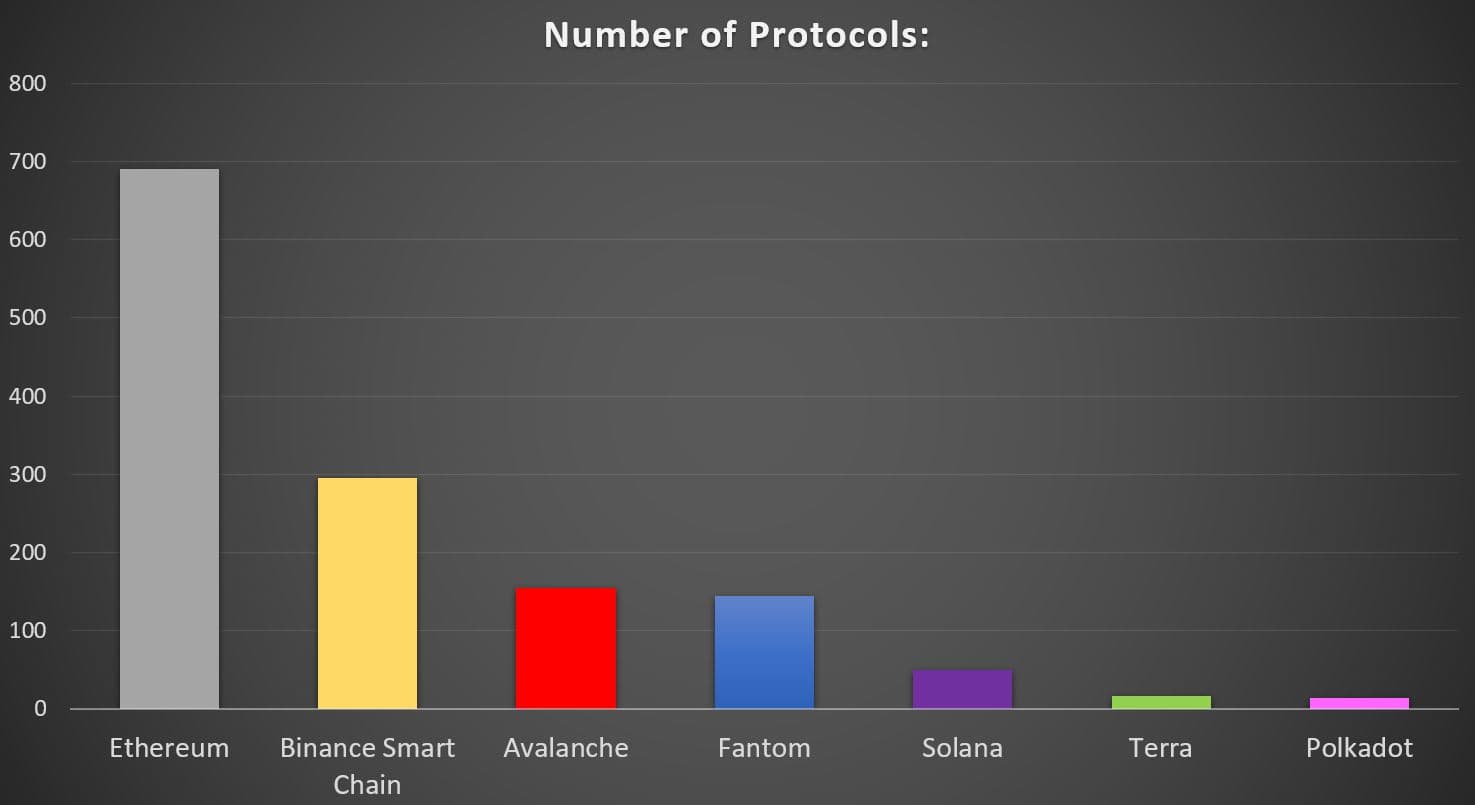
Once again, Ethereum is leading by miles. BSC (Binance smart chain) got almost half as many, but the applications on BSC are known to be "fishy", and lots of them are not serious projects. (At least at the time of writing! It might change)
The point is that Ethereum is miles ahead of its competition, just like it is in terms of TVL as well.
Now, remember how more applications and users leads to a more valuable native token/coin...?
At the time, I saw Ethereum as lower-risk layer-one exposure because it had the largest base of users and protocols.
Related analysis:
Why I Expected Ethereum to Remain Ahead in 2022:
By now you understand that Ethereum dominates the "programmable blockchain" sector (layer ones). It has way more applications and much higher TVL.
However, will this continue to be the case?
If that lead disappeared quickly, it would weaken my 2022 thesis.
Well, here's the thing: Ethereum has the network effect on its side!
Think about it:
The applications on the Ethereum network all feed off each other in a synergistic manner. If one protocol increases its userbase, other applications on the same network benefit!
A developer had reason to choose a network where existing users increased the likelihood of adoption. In many cases at the time, that was Ethereum.
Applications often needed to integrate with other protocols. Ethereum's larger range of existing applications strengthened its position.
Ethereum is time-tested, and people trust it. Projects based on BSC or other platforms are much less trusted. BSC in particular. This makes users prefer Ethereum based applications, which makes developers pick Ethereum as their platform. This makes Ethereum even more trustworthy, which creates an upwards spiral.
I'm sure there's more to add, but the network effect was central to my 2022 Ethereum thesis.
Institutions are Investing (a lot) in Ethereum:
I also tracked institutional holdings as evidence of adoption.
I'll give you a picture of how much ETH these guys are buying. Let's begin with Grayscale:
Grayscale manages over 7 billion USD worth of ETH:
Grayscale has an Ethereum Trust, which allows people to get exposure to ETH without actually buying it directly.
One can buy some stock in Grayscale Ethereum Trust, which gives you a claim to a certain amount of ETH indirectly.
The trust offered indirect exposure through a security, including via certain eligible accounts.
Here's the number of USD worth of ETH Grayscale is handling at the moment:
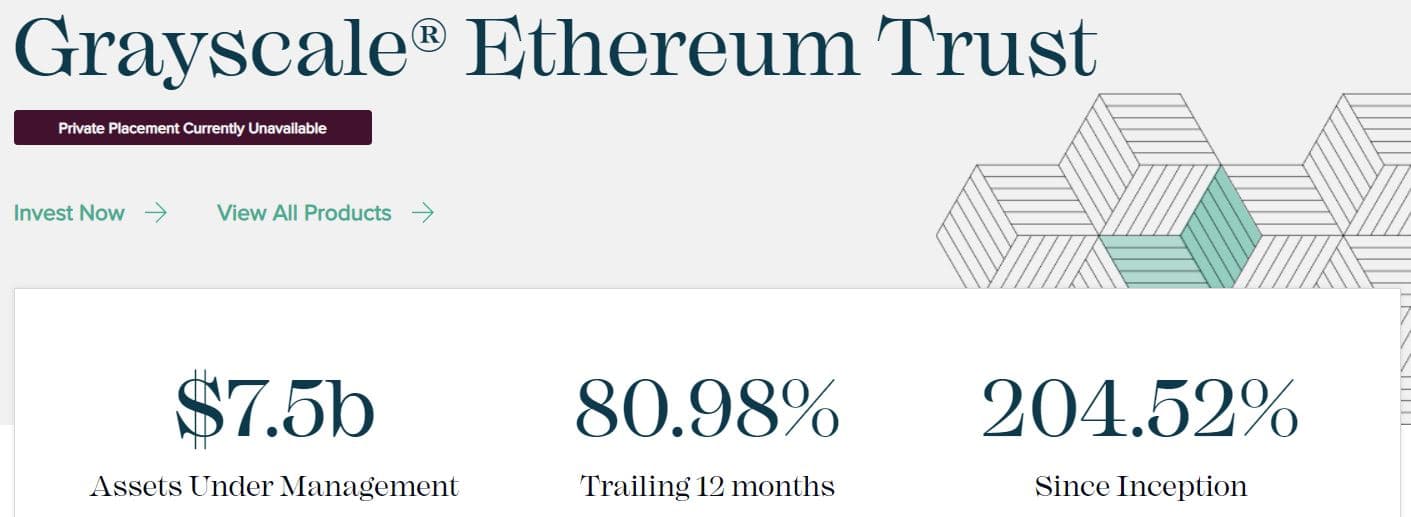
https://grayscale.com/products/grayscale-ethereum-trust/
Enterprise Ethereum Alliance
The Enterprise Ethereum Alliance included more than 200 institutions working on Ethereum standards and projects.
The board members of EEA include big names like these:
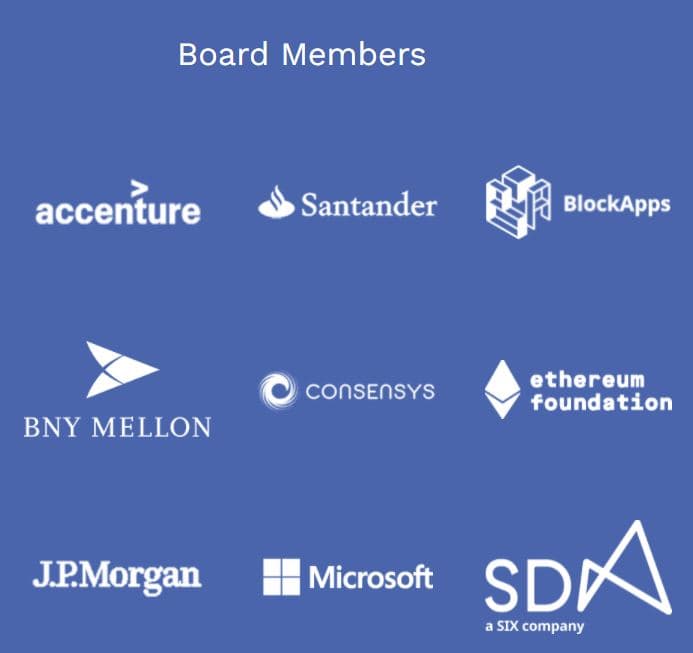
Source: https://entethalliance.org/
The involvement of J.P. Morgan, Microsoft, and Santander strengthened my adoption thesis.
Other big-name members in EEA:
FedEx Corporate Services, Inc (postal service)
Ernst and Young (Famous investment bank)
The Bank of New York Mellon (Huge bank)
Standard Chartered Bank (Huge bank)
Sberbank of Russia (One of the largest banks in the world, based in Russia)
Source: Enterprise Ethereum Alliance member directory
Their involvement supported my bullish view of Ethereum.
Ethereum's Planned 2022 Upgrades:
Ethereum is currently slow and expensive to use. It's got some major issues on the scaling front. Here's why:
The Current Problem With Etherem:
At the moment, Ethereum can handle between 7-15 transactions per second. This is really slow compared to other chains like Solana which can handle up to 50,000 transactions per second.
The high traffic, combined with the low scalability, makes the transactions fees on Ethereum high. The reason is this:
Fees are like a ticket into the block that miners will add to the chain of already approved blocks. Only a certain amount of transactions fit into the given block.
All the transactions in the block will go through with a few minutes, while the ones that didn't get a spot in the block have to wait for the next opportunity to get into a block.
The way to get your transaction into a block is to pay a transaction fee. If there's more competition for "blockspace", the fees naturally get higher (supply vs demand).
Every 14 seconds a block is added to the chain, and each block can fit roughly 70 transactions.
Now, think about all the things that are built on Ethereum - all the NFT stuff, all the DEFI stuff, all the Metaverses.
All of the transactions happening on these projects are competing about spots in the blocks on the Ethereum blockchain. This makes the fees EXTREMLY high when the hype is high.
Personally, I paid over $300 for a single trade on Uniswap in Q1 of 2021 - insane...
How the Roadmap Aimed to Address This:
The solution to high fees and slow transactions due to low scalability will (probably) come in 2022.
At publication, Ethereum planned to switch from proof of work to proof of stake and use changes such as sharding to improve scalability.
The roadmap aimed to:
Scale Ethereum up from 7-15 all the wat up to 100,000 transaction per second
Reduce the fee of transating on Ethereum from $15-$300 down to practically speaking nothing.
Allow Ethereum holders to "stake" ETH to earn a yield.
These planned improvements were central to my bullish case.
ETH Might Turn Deflationary in 2022:
You know how inflation is lowering the value of FIAT currencies like The U.S. Dollar?
ETH is likely to experience the opposite of that - deflation - in 2022, here's why:
In August of 2021, a network upgrade was uploaded to Ethereum - EIP-1559. This upgrade made some changes to the transaction fees on Ethereum:
Instead of miners receiving the majority of the transaction fee, a lot of the fees are now being burned (basically deleted from existence).
This burning mechanism is acting as deflationary pressure and increases with the number of transactions on the Ethereum blockchain.
Below you see a chart showing the amount of burned ETH per day since August of 2021:
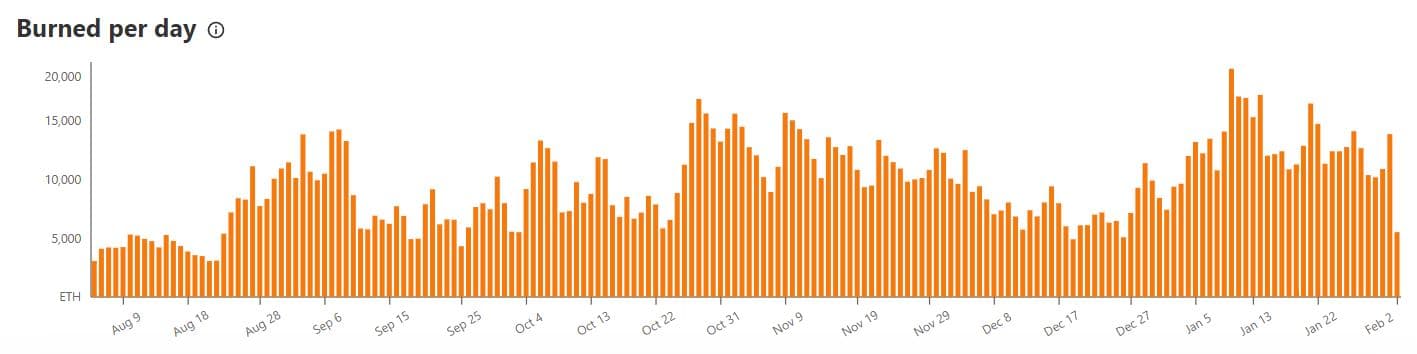
That's a lot of burning!
Now, the chart below this sentence is showing the "net issuance" per day, which basically equals the inflation/deflation per day:
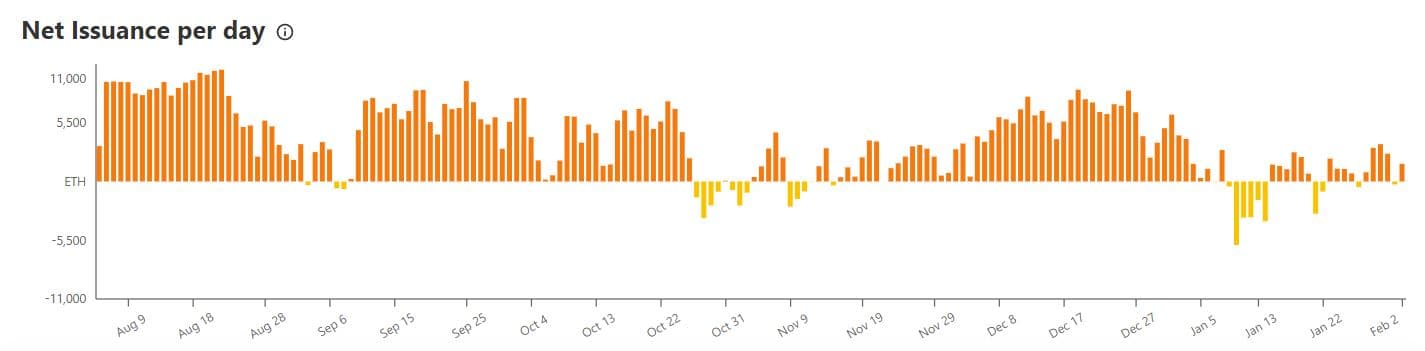
Notice that some of the days are colored yellow. These days the net issuance was negative.
This means that more ETH was taken out of circulation through burning that was put into it by mining!
That was a deflationary interval, which could put upward pressure on price if demand held.
I expected more Ethereum activity in 2022, which made a deflationary outcome plausible in my view.
Is Investing in Ethereum too Risky in 2022?
I separated Ethereum's risk into two categories:
There are two types of risks when investing in cryptocurrencies: Systemic risk and idiosyncratic risk.
The systemic risk is the risk of investing in the cryptocurrency market in general. The risk that the whole market dumps.
This risk follows any cryptocurrency investment, not just Ethereum.
Because Bitcoin is the market mover and the king of crypto, the systemic risk of investing in cryptocurrency is equal to the risk of investing in Bitcoin.
The idiosyncratic risk is the risk that Ethereum fails, regardless of what the market does.
This is the risk of the Ethereum blockchain being compromised, competitors like Cardano or Binance Smart Chain catching up, or implementing an upgrade unsuccessfully – making the blockchain obsolete.
In my opinion, the biggest risk of investing in Ethereum was competitors catching up. I considered the risk of the blockchain being compromised or failing to be relatively low.
Notice, however, that the idiosyncratic risk of investing in Ethereum is mostly a symptom of their success.
The risk of competitors catching up exists because Ethereum has the lead. For this reason, the idiosyncratic risk of investing in Ethereum is relatively low, in my opinion.
Conclusion on the risk of investing in Ethereum:
Investing in Ethereum carries the idiosyncratic risk of Ethereum failing, or being outcompeted, plus the systemic risk which is equal to the risk of investing in Bitcoin. In other words, it's like investing in Bitcoin, but with some extra points of failure.
In my opinion, the systemic risk of cryptocurrencies is high, and the idiosyncratic risk of investing in Ethereum is relatively low.
Therefore, investing in Ethereum is "high-risk" compared to investing in assets in other markets, like the stock market of real estate, but the risk is relatively low compared to other cryptocurrencies.
Other Use-Cases for Ethereum in 2022:
There are more ways to use Ethereum than just "building applications". In this section I'll tell you about a three of them:
Governments Can Use Ethereum
Did you know that the Ethereum blockchain can be used as an immutable "log"? This has use-cases far beyond just the login of financial transactions. For example, governments can write laws on the Ethereum blockchain!
We have already seen interest from some governments to write their laws on the Ethereum blockchain. Brazil is one of them.
Also, they have shown interest in storing information about who owns land/real estate on the Ethereum blockchain.
This could be useful in countries that struggle with corruption and poor record keeping.
There were many possible government use cases, but these were the two where I had seen interest.
Banks Already Use Ethereum
Here's one example of how banks already use Ethereum:
The European Investment Bank (EIB), the investment bank owned by the EU Member States, has announced the issuance of the organization’s first-ever digital bond built on a public blockchain. The bond was issued using Ethereum and the issuance invoked $121 million two-year bonds placed with key market investors.
That's right; a bank has issued a bond on the Ethereum blockchain!
This 2021 example strengthened my institutional-adoption thesis.
Know this:
The bond market is a $100 Trillion market. Suppose Ethereum becomes the go-to marketplace for bond issuing; that is a huge deal for Ethereum.
Tokenized Real Estate On Ethereum
Real estate is traditionally a "high ticket" investment, meaning that you need a lot of money to get started. Ethereum changes this:
Suppose you have a property that's 10 000 square feet big worth $1 million. Suddenly you need some cash, but you don't want to sell the property yet. What you can do is tokenize the property.
This is how: You create an ERC-20 token (token on the Ethereum blockchain) which derives its value from the property. For instance, you can create 10 000 tokens, one per square foot, and value them at $1 million / 10 000 = $100 each.
Then you can sell 2000 tokens to investors and keep 8000 of them for yourself.
This way, you keep 80% of the property while other investors own 20% of it.
If it's a rental apartment, the rent can be paid in Ethereum directly into a smart contract which automatically pays out the appropriate percentage of the rental income to the owners.
"How far away is this?"
It's already here!
Last week, a friend of mine actually talked to a Norwegian billionaire real estate guy looking to tokenize some of his properties.
A Cointelegraph report described Reinno launching a platform with more than $200 million of tokenized real estate.
My Ethereum Allocation at the Time
My Ethereum allocation depended on how strong I considered the investment case.
For me, a stronger Ethereum thesis supported a larger allocation.
I've been giving this a lot of thought, as this is a hard question to answer. It's highly dependent on the risk you're willing to take, as well as your goals.
**The rough allocation baseline I used was:
• I kept 50% of the cryptocurrency portfolio in Bitcoin.
• Ethereum was my largest altcoin position.
• I capped individual mid-caps at 15% of the portfolio.
• I kept the total small-cap and highly speculative allocation below 10%.**
Mid-caps and small-caps refer to medium and small-sized coins, measured by market cap.
In my beginner model, I stayed within those limits.
With more experience, I sometimes accepted a larger altcoin allocation.
The method is described in How Much Cryptocurrency Should You Buy?.
My 20%-25% ETH range reflected the strength of my Ethereum thesis at the time.
Conclusion: I Considered Ethereum a Good Investment in 2022
Given the reasons below, my 2022 conclusion was favorable.
Institutional adoption is ramping up
ETH 2.0 is getting close
The TVL is over 10 times as high as the closest competitor
Ethereum hosts over twice as many protocols as the closest competitor.
ETH might become a deflationary asset in 2022.
All of the points above work synergistically in a network effect kind of way to make Ethereum even better.