


When drinking my morning coffee, I often think about my investing strategy, and how to improve it. One question that used to bug me was "how much cryptocurrency should I buy?"
In the example I developed, a $100,000 target corresponded to 0.5747 BTC and 7.18 ETH under my price assumptions. The result depended on risk tolerance, goals, and whether those assumptions held.
These numbers came from the method below.
The calculation starts with planned selling prices and works backward to a position size.
How I Estimated a Cryptocurrency Position
To really answer this question, you need to do these two things first:
1) Figure out your selling points for the coins you own
2) Calculate the average selling price.
Example:
I'm going to sell my Chainlink gradually, at different price targets, with the average target of $125.
In that scenario, I would receive $125 for every LINK if the target was reached.
In my framework, I set price targets for Bitcoin and each altcoin, then calculated an average planned selling price.
The average sell price is dependent on two things:
**1) Price targets you'll sell at
How much you sell at each target**
I've created an excel document for my self, with all my price targets and how much I'm going to sell at each target. This document let's me plug in how much I have, and spits out how much I'll have in the future.
I can also plug in how much I want in the future, and it spits out how much cryptocurrency I need to buy.
The following numbers demonstrate the method I used to estimate a position size.
How do I Set Cryptocurrency Price targets?
I spent a long time thinking about this question. What is the best way to set my target?
What makes it hard is that you want to push it a little bit, to sell as high as possible, but if you push it too hard, you're done for it.
It's about finding the balance between pushing it, but not as much as the next guy. You want to sell just before the rest of the market does, at least if you want as much bang for your buck as possible.
What I'm going to do, is to stay conservative, and keep things realistic.
The thought of having price targets that are not met, resulting in me sitting with my cryptocurrency investments through the market crash we're going to get after this Bitcoin cycle, it terrifying.
Therefore, I came up with a system that recorded when I planned to sell and how much cryptocurrency fit the model.
First, you need a price prediction. This should be a conservative, data-driven price prediction.
I have made my own predictions on Bitcoin and Ethereum, and that's what I base this system/method on.
As soon as you have a price prediction, you can set price targets at percentages of this prediction.
Example:
I think Ethereum will reach $8000. My price targets are at 50%, 75%, 85%, 95% and 100% of that prediction.
In other words, I'm going to sell a portion of my Ethereum at $4000, $6000, $6800, $7600 and at $8000.
To calculate the average sell price, we need to decide how much we're going to sell at each point:
This depends largely on your risk tolerance. If you like to take risks, you might want to sell little on th lower targets, and more on the higher ones.
Personally, I like to keep things conservative and minimize the risk, as investing in cryptocurrency carries enough risk as it is.
Why gamble that you can "time the market", and potentially lose out on huge gains you've accumulated.
In Fact:
Most people set their price target way to high, and sell everything in one sale. This is not the best way to do it, in terms of risk/reward ratio.
What I did was the following:

How I Calculated the Example Position
Using the table above and the price scenarios, I modeled a hypothetical $100,000 goal, a risk-tolerance score of seven, and a portfolio split evenly between Bitcoin and Ethereum.
My price predictions are $100 000 for Bitcoin, and $8000 for Ethereum.
According to the table above, we see that with a risk tolerance of 7, the average selling point is 87% of target.
This means that I will be left with $87 000 per Bitcoin you buy, and $6960 per Ethereum.
With a $100,000 goal and a 50/50 split, the model assigned a $50,000 target to each asset.
The modeled quantities were calculated like this:
**Bitcoin: $50 000 / $87 000 = 0.5747 BTC
Ethereum: $50 000 / $6960 = 7.18 ETH**
This produced exact quantities only within the model's price and selling assumptions.
Why I Considered 0.28 Bitcoin a Notable Threshold
If you look at the maximum supply of Bitcoin, and the population of the earth, it's easy to see that there isn't enough Bitcoin for everyone.
There's only 21 million Bitcoin. That is the maximum supply. However, there are almost eight billion people, and they all have to fight for that Bitcoin.
Under the hypothetical assumption that Bitcoin became a global reserve currency, 0.28 BTC would place its holder among the top 1% of possible Bitcoin balances by supply.
This is simply because there's not enough Bitcoin for everyone.
It's not even enough Bitcoin for all the millionaires in the world:
There are 46.8 millionaires in the world today, according to "spendmenot" (source)".
If they decided to buy up all the bitcoin in circulation, they would each have 0.449 BTC each, on average.
However, people like you and me already have some Bitcoin. We also know that Tesla, and Micro Strategy has tons of Bitcoin.
Even more important, millions of Bitcoin has been lost, and will never be found again. This makes Bitcoin even scarcer.
According to Chainalysis, 20% of all Bitcoin, 4 200 000 BTC, is lost forever.
This means that the effective max supply is capped at 16.8 million BTC.
With only 16.8 million BTC in this estimate and millions already held, I expected scarcity to add upward pressure as institutions accumulated it.
This is why I regarded 0.28 BTC as a meaningful scarcity benchmark, rather than a guaranteed wealth outcome.
Below you see some of the largest accumulators of Bitcoin, and the total number that they have taken out of circulation.
This is on a logarithmic scale based on two, meaning that every tick up is a 2x. See the left vertical axis to understand it better:
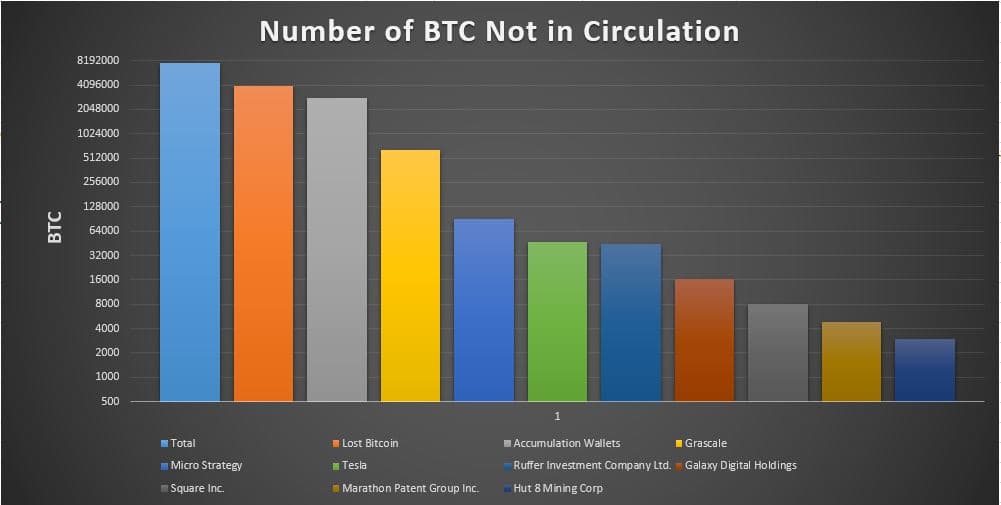
The total is north of eight million BTC. This means that the effective circulating supply of Bitcoin cut down to roughly 12.8 million BTC.
Remember, this are just some of the companies that we know of. There are lot's of more companies that have accumulated Bitcoin, and there's probably lots more that who have done it silently as well.
At the time, I wanted to accumulate 0.28 Bitcoin before the price rose further.