


Most Ethereum price predictions range from 2000$ all the way up to 20 000$. The problem is that data and sound logic do not drive them. They stick their finger in the air and make an "educated guess".
That's not the way we do it.
We look at historical data and use models to make the assumptions explicit.
My 2021 model produced an Ethereum price of $8,000 based on on-chain metrics, technical patterns in ETH/USD and ETH/BTC, Bitcoin dominance, and the BTC/USD chart.
I'm going to take you on a journey in this article. You'll not only be left with a price prediction, but also a new, more analytical way of thinking about them.
The same method can be applied to Ethereum and other major altcoins.
We're going to look at:
How to Predict the Price of Ethereum
The Total Market Cap of Cryptocurrencies
The Ethereum Dominance
The Bullish vs. Conservative Ethereum Price Prediction
The Fundamentals of Ethereum
Our Final Ethereum Price Prediction
A related article records my Ethereum investing and trading strategy.
How I Predict the Price of Ethereum
One of the key elements in our Ethereum price prediction is the Ethereum dominance. You've probably heard about Bitcoin dominance, which is the percentage of the total market cap of cryptocurrencies that Bitcoin holds.
BTC dominance and total crypto market-cap data came from CoinMarketCap.
In other words, if all cryptocurrencies combined have a market cap of one trillion USD, and Bitcoin has a market cap of 650 billion USD, the Bitcoin dominance is 65% because 650 billion is 65% of one trillion.
Ethereum dominance is the same thing. It's the percentage of the total market cap of cryptocurrencies that is in Ethereum.
Now, how can we use this metric to make a price prediction?
The way I make all my alt-coin price predictions is first to predict the combined crypto market cap and the dominance of that specific alt-coin.
Let's look at a practical example:
If the combined market cap hits one trillion dollars, and Ethereum dominance is 10%, we know that the Ethereum market cap is 100 billion dollars.
All we have to do now is to divide the market cap by the supply (number of coins in circulation). This leaves us with a dollar price per ETH.
In summary, my strategy for predicting the price of Ethereum and other altcoins is first to predict the combined market cap of all cryptocurrencies and then the dominance of the given alt-coin.
For this strategy, we therefore need two things:
A prediction about the total market cap of cryptocurrencies
A prediction about the Ethereum Dominance
Predicting the Total Market Cap of Cryptocurrencies
Predicting the combined market cap of cryptocurrencies might sound scary, but it's not that bad. As long as we start with Bitcoin, and remember this:
Bitcoin is the market mover
Bitcoin dominance usually drops at the peak of each cycle
My method estimated Bitcoin's price and dominance first.
Bitcoin Price and Dominance Prediction
I modeled Bitcoin at $100,000 within a few years. The supporting detail sits outside this Ethereum scenario.
The grounds on which my prediction stands are:
The ROI of previous cycles
The Logarithmic Growth Curves
The Stock to Flow Model
Related Bitcoin scenarios: Realistic Bitcoin Price Prediction 2021 and Is Bitcoin a Good Investment?.
Using the $100,000 Bitcoin scenario, the next input was Bitcoin dominance:
The Bitcoin dominance is usually high in bear markets, and lower in bull markets. This is great for those of us that hold Ethereum. Let's look at how the Bitcoin dominance has behaved in the past and try to predict the future:
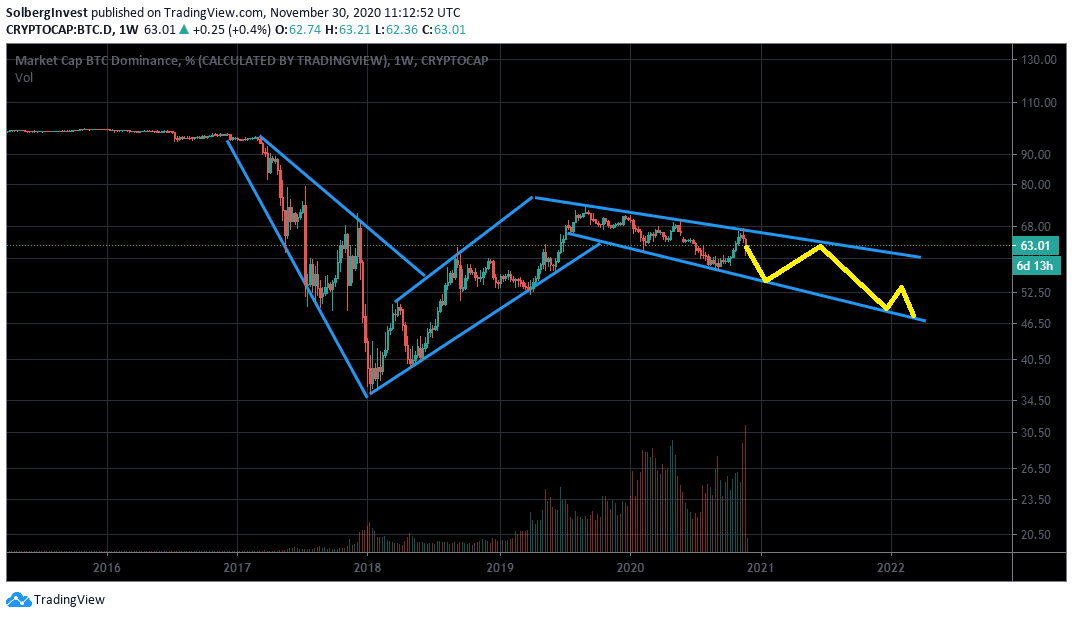
Below you see a chart showing the Bitcoin dominance. On the right vertical axis, you see the percentage that Bitcoin holds.
Notice how it trends downwards in 2017 (bull-market), upwards from 2018 to the summer of 2019 (bear-market), and has started a down-trend again?
BTC Dominance (Market share)
General trends are within the blue lines, and the yellow line is a possible future.
The exact value of the yellow line is not important; the point I'm trying to make is that it's trending downwards, meaning that alt-coins are gaining on Bitcoin.
The Bitcoin dominance went all the way down to 35% in 2017. It'll probably go just as low this time, but that's pure speculation and hard to predict.
According to the trend lines (blue lines), we'll see a Bitcoin dominance of around 50% at the end of 2021/the start of 2022. Most of the Bitcoin data seems to indicate that this is where we'll see a 100k Bitcoin as well.
Conclusion:
The data seems to suggest that we'll see a Bitcoin price of 100 000 USD, with a Bitcoin dominance of 50% at the end of 2021/beginning of 2022.
Related analysis:
Calculating the Total Crypto Market Cap:
Now we got all we need to run the calculation. We got a Bitcoin price of 100k, a dominance of 50%, and a circulating supply of 18 800 000 coins (18.5 million + inflation of ca. 2%).
Under these assumptions, the total cryptocurrency market cap equals Bitcoin's market cap (price * supply) times two:
100 000 USD * 18 800 000 * 2 = 3 760 000 000 000 USD (3.76 trillion USD)
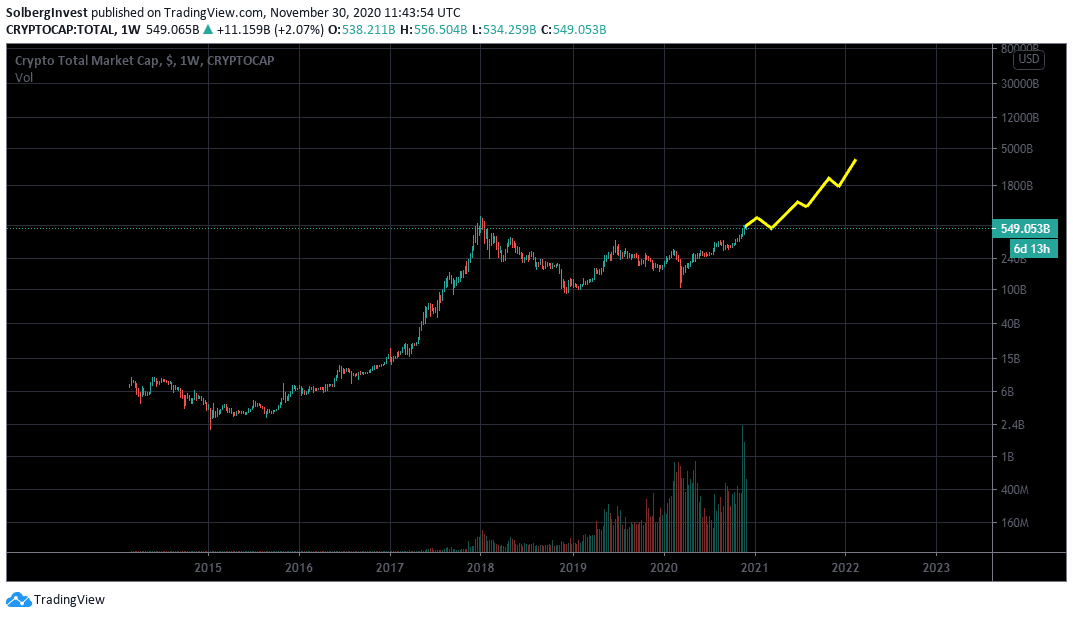
Below you see a chart showing the total crypto market cap, with a yellow line showing what our prediction might look like.
Again, the yellow line is not to be taken too seriously; it's just a possible outcome. The point is to illustrate what the general trend would look like:
Predicting the Price of Ethereum
Finally, we have everything we need to make our Ethereum price prediction. All we need to do now is to predict the dominance of Ethereum at the peak of the next cycle and multiply that percentage with the total market cap.
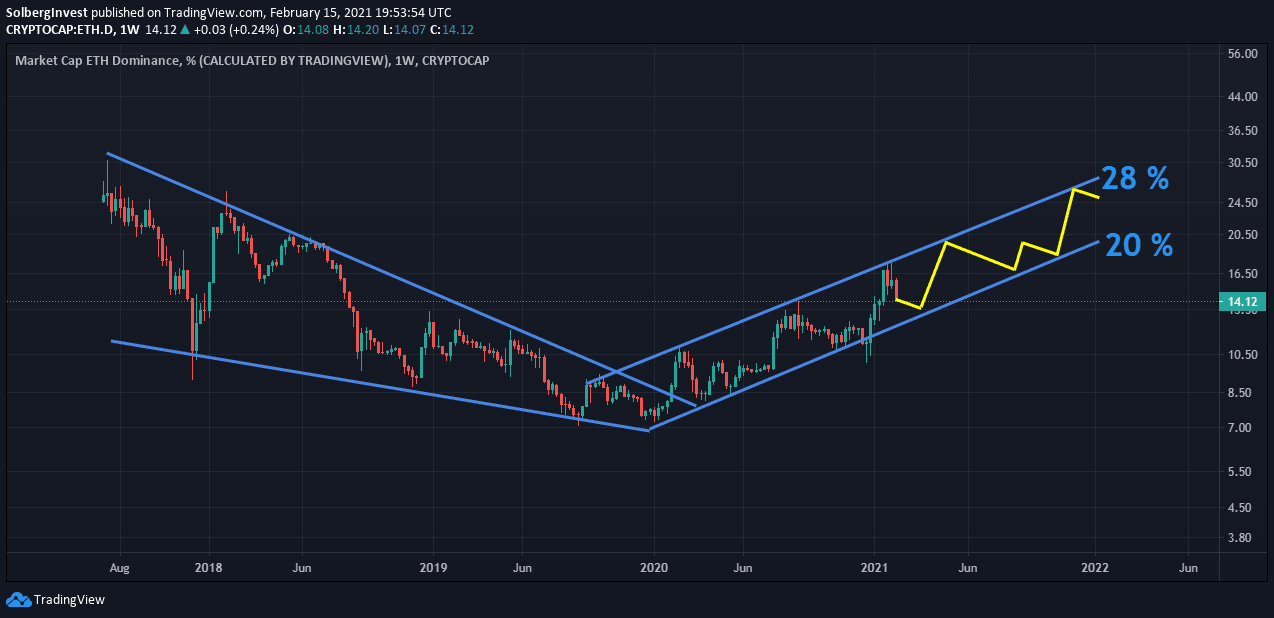
Let's look at what the Ethereum dominance has been in the past to see if we might find some general trends and patterns:
ETH Dominance
We see a solid trend reversal at the end of 2019. The Ethereum dominance is moving up again.
It looks like the opposite of the Bitcoin dominance chart you saw earlier. It trends up in the bull markets and down in the bear market.
The chart suggested a rising channel. If it held, the scenario implied 20-28% dominance at the cycle peak in late 2021 or early 2022.
Ethereum Price Prediction at 24% Ethereum Dominance
With a circulating supply of 118 180 000 coins and a market cap of 24% of 3.76 trillion, we can do the following calculation:
3 760 000 000 000 USD * 0.24 / 118 180 000 ETH = 7 635 USD/ETH
With a total market cap of 3.76 trillion USD, an Ethereum dominance of 24%, and a circulating supply of 118.18 million ETH, we end up with a price per ETH at 7635 dollars.
Let's run the same calculations, but change the Ethereum dominance to the most conservative number (20%) and to the most bullish (28%) we can derive from our prediction:
Bullish Ethereum Price Prediction
Let's run the numbers with a dominance of 28%:
3 760 000 000 000 USD * 0.28 / 118 180 000 ETH = 8 900 USD/ETH
The top of the dominance channel produced an Ethereum price near $9,000 in this scenario.
Conservative Ethereum Price Prediction
Let's run the numbers with a dominance of 20%:
3 760 000 000 000 USD * 0.20 / 118 180 000 ETH = 6 363 USD/ETH
The bottom of the dominance channel produced an Ethereum price near $6,500 in this scenario.
The Fundamentals of Ethereum - Icing On The Cake
So far in our Ethereum price prediction we've only been looking at historical data. In most cases this is the best way to go about it, but in Ethereums case it's not:
There's way too much bullish stuff going on with Ethereum not to consider it when predicting the future price.
On-chain Indicators are Extremely Bullish
Ethereum 2.0
Ethereum On-Chain Metrics
There are lots of on-chain indicators we can look at to gauge how Ethereum is doing on a fundamental level:
The total number of Ethereum addresses (source: glassnode.com): Tells us how many Ethereum wallets there are.
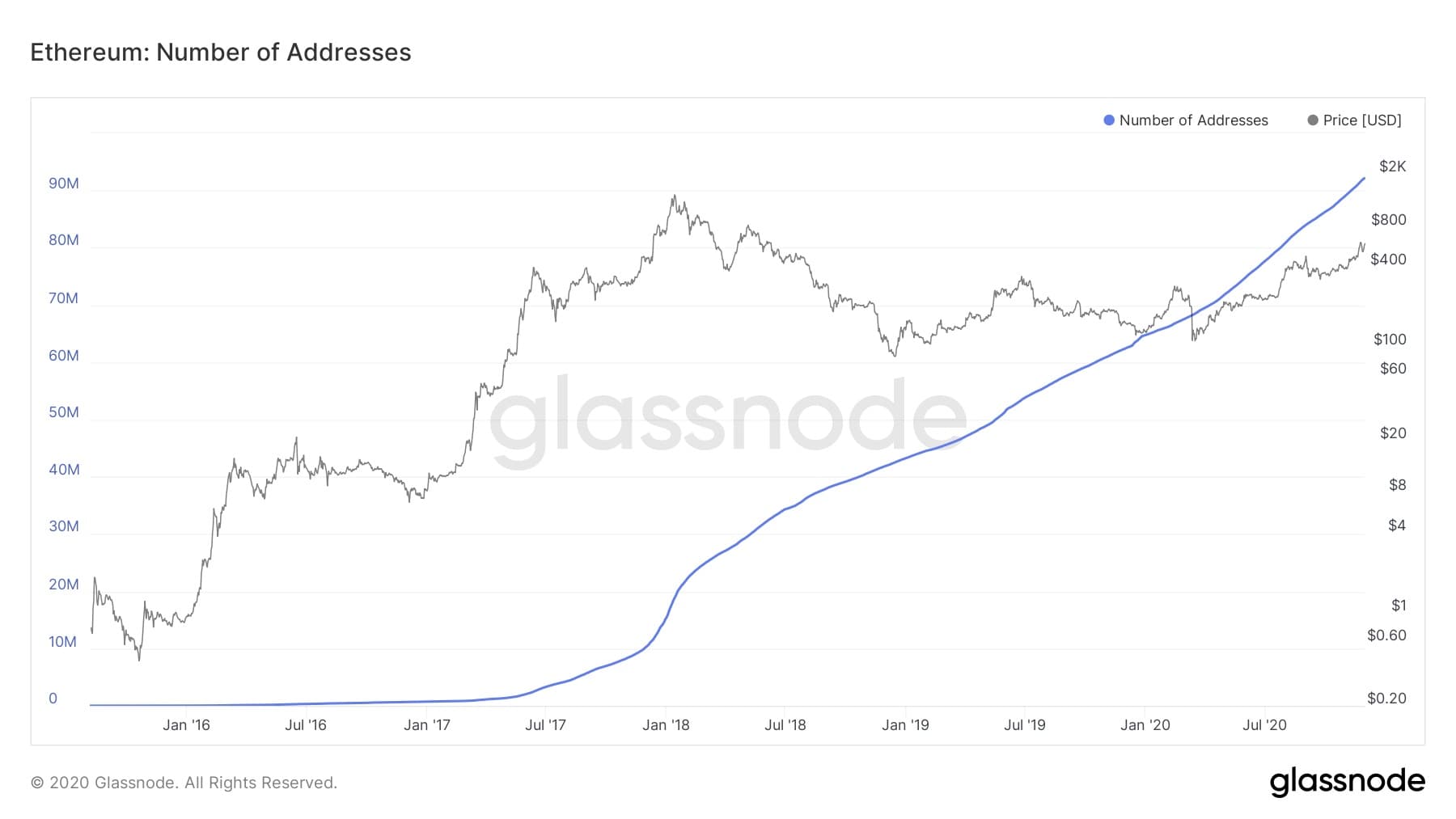
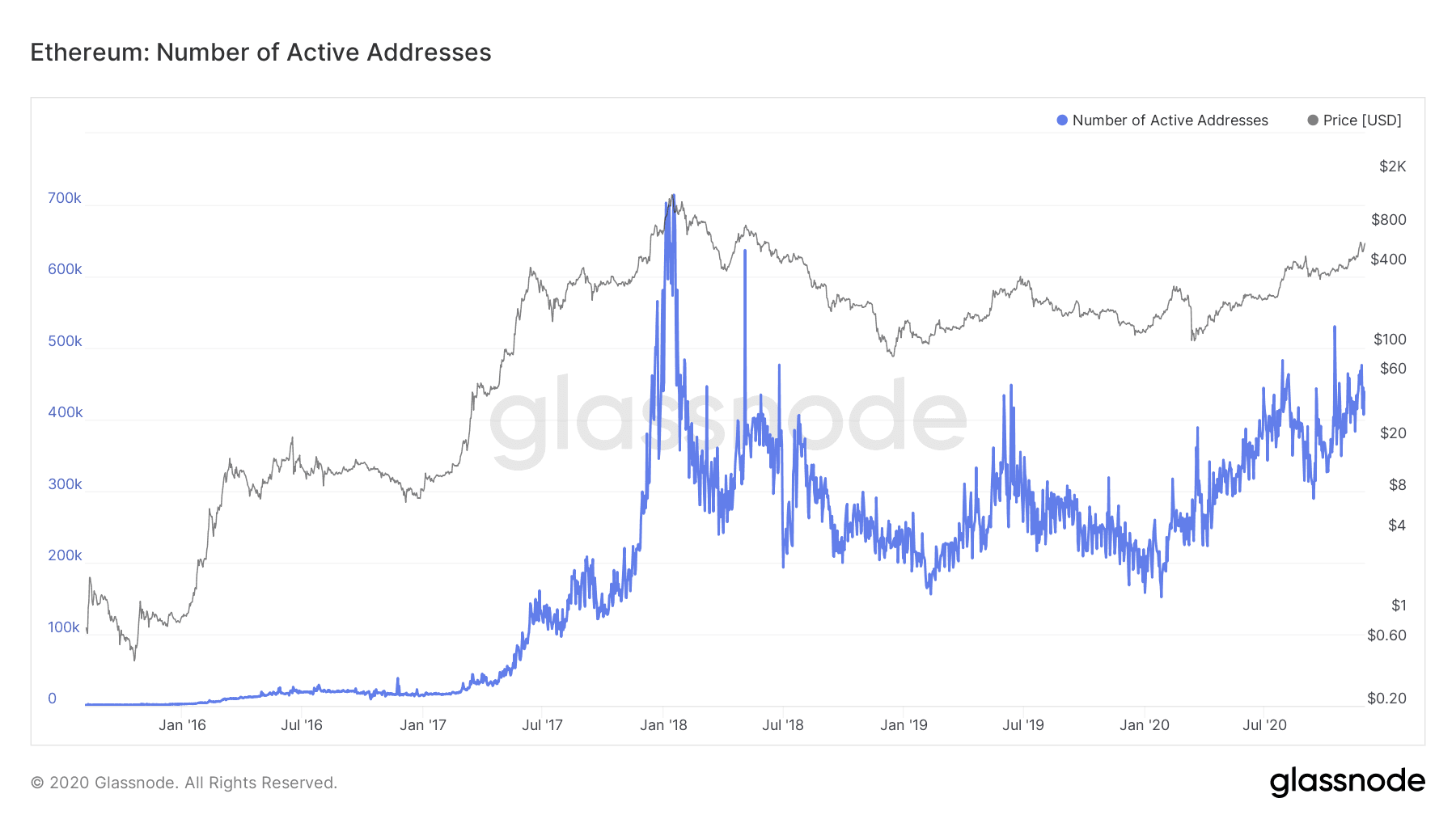
The number of active Ethereum addresses (source: glassnode.com): Tells us how many people are using/trading Ethereum.
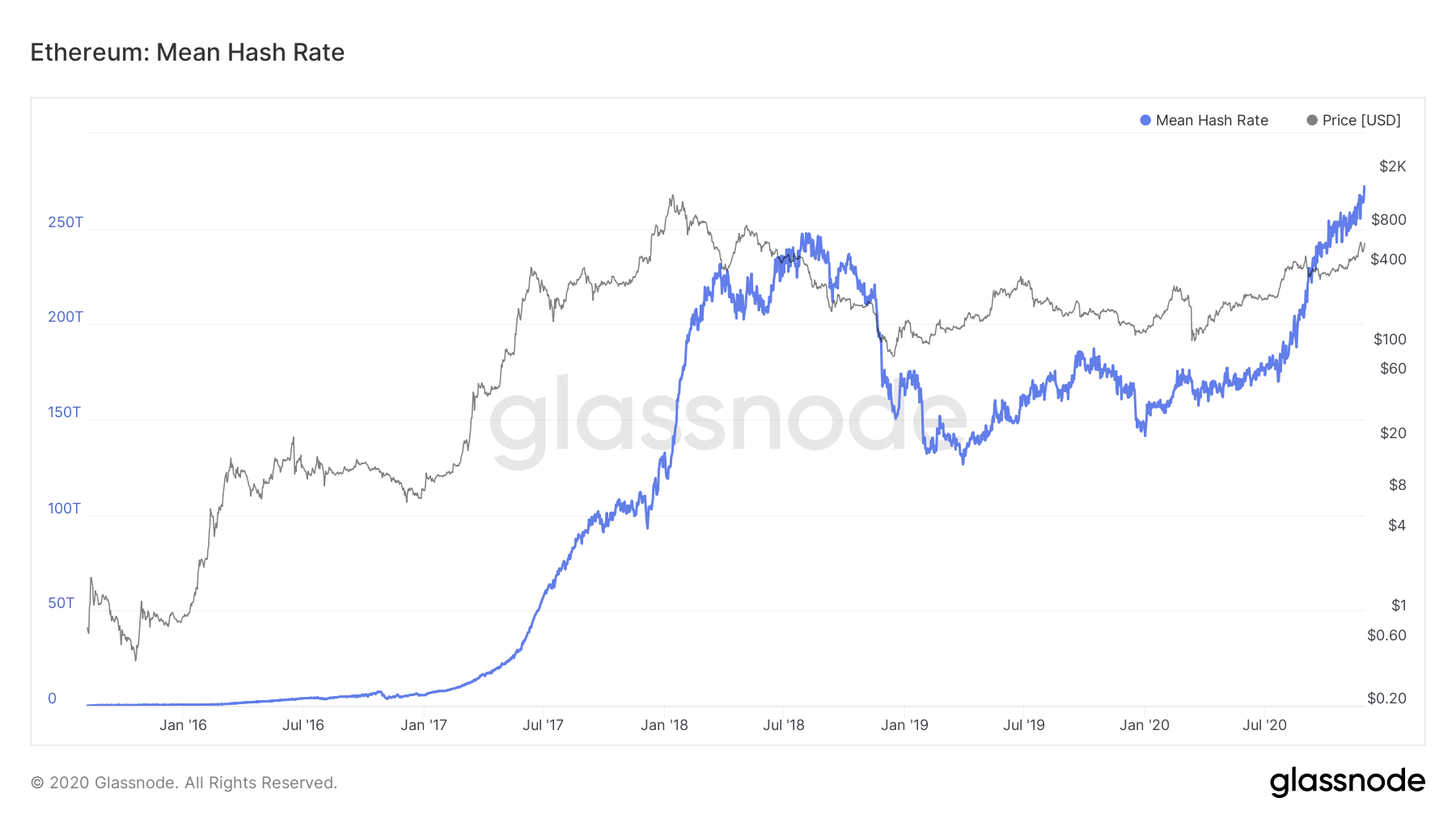
The hash rate of the Ethereum network (source: glassnode.com): Tells us how much computing power is working to secure the network.
Ethereum 2.0
Ethereum 2.0 will bring a lot of change to the Ethereum network. There are two changes we're going to take into consideration in this article:
Staking
Scalability
Staking
Staking basically means locking it up and receiving interest on it. Bitcoin Suisse's staking overview provides more background.
When you lock your Ethereum for a certain amount of time, you help secure the network and receive ETH as a reward. It's like crypto mining, without the insane electricity bill or the expensive equipment.
Staking will cause many people, including myself, to lock their Ethereum up and receive interest at ca. 4-6% p.a.
This effectively decreases the number of Ethereum in circulation, and therefore the number of Ethereum being sold/traded.
This would reduce liquid supply and, all else equal, support the price.
Scalability
Currently, Ethereum can handle 15 transactions per second. That's not all that impressive, and acts as a bottleneck when the traffic is high. This increases the fees for using the Ethereum blockchain, as well as slows it down.
At publication, the Ethereum roadmap aimed eventually to handle up to one million transactions per second.
However, the upgrade will not happen overnight, but step-by-step over a few years.
We'll probably see a few thousand transactions per second over the next couple of years, which is more than enough to handle the current demand.
This will improve Ethereum both in its capacity to handle traffic and lower the fees for using it. It's a huge deal, and it's finally happening. Phase zero will launch in December of 2020, kick-starting the move to Ethereum 2.0
Conclusion: My Model Produced $8,000
The model's assumptions produced an Ethereum price range of $6,500-$9,000. I calculated it by multiplying the total cryptocurrency market cap by Ethereum dominance and dividing by circulating supply.
The on-chain metrics, total addresses, active addresses, and hash rate were also increasing. They supported my bullish view of Ethereum.
Ethereum's upgrade had begun. Its staking mechanism was expected to reduce liquid supply and support scalability.
The scalability will improve the Ethereum network significantly, taking the transactions per second from 15 to a few thousand and eventually (hopefully) to one million.
At the time, I was extremely bullish on Ethereum. The historical data and fundamentals supported a price above its previous range in my model.
The conclusion of our analysis is this:
**_My model's range was $6,500-$8,900 at the peak of that cycle, with the fundamentals pointing me toward the upper part of the range.
Therefore, my modeled Ethereum price based on historical data, technical analysis, and on-chain metrics was $8,000._**