

I've been in this market for many years, and Ethereum is one of my favorite coins to trade. This article records the strategy I used to pursue long-term returns and compare my ETH performance with Bitcoin.
Keep in mind; This is not financial advice. It is purely educational and informational content!
Let's begin with the basics, and work our way towards a fully formulated Ethereum trading strategy:
How To Successfully Trade Ethereum
First things first: What does "successfully" mean in this case?
Trading ETH successfully means holding ETH when it performs better than Bitcoin and not holding ETH when it performs worse than Bitcoin.
Basically, you want to hold ETH when it goes up more than BTC.
"Why are you talking about Bitcoin...?"
A beginner often looks at the USD price of Ethereum when trying to trade, but that is a mistake...
You need to look at the BTC price of Ethereum! This is why:
If your altcoins do not outperform Bitcoin, the extra risk of holding altcoins is not justified.
Basically, there are two types of risks when investing: Idiosyncratic and systemic risk.
The idiosyncratic risk is the risk that the specific coin carries. For example, the idiosyncratic risk of investing in Ethereum might be the risk of something going wrong when ETH 2.0 is being uploaded and the Ethereum blockchain failing.
The systemic risk is (more or less) the same for all major cryptocurrencies. It is the risk that cryptocurrencies as an asset class carry. For example, one systemic risk is bad regulation. Another is that Bitcoin fails.
"Okey, sure. Why should I care?"
Do you know how altcoins follow Bitcoin? This results in altcoins gaining the idiosyncratic risk of Bitcoin in addition to their own two risks. In some sense, when investing in altcoins we also take on the risk of investing in Bitcoin.
For this reason, we need to justify holding ETH by getting higher returns than we would get by holding Bitcoin. As an investor, you want rewards for taking on the added risk.
A separate article records my Bitcoin investing and trading strategy.
Great, now we have a goal: Outperforming Bitcoin. Let's move on, and figure out how to reach it:
My ETH Trading and Investing Strategy (Part #1)
There are two parts to my Ethereum strategy: The active strategy and the passive strategy.
Let's begin with the passive Ethereum strategy, as it is the most important and easiest to start doing.
BTW, if you're a complete beginner, you should probably stick with this part only until you get some experience investing in crypto...
My long-term Ethereum thesis explains why I held it.
Anyways, let's get to it:
My Personal Passive ETH Investment Strategy:
There are two steps to the first part of the strategy for trading and investing in Ethereum. Step one is buying it, and step two is putting it to work.
Step #1 - Buying Ethereum:
At the time, I bought Ethereum through a cryptocurrency exchange before moving it into the rest of this strategy.
After buying Ethereum, the second part of my strategy was putting it to work.
Step #2 - Earning A Yield
At the time, I placed part of my ETH in an interest-bearing account. The return was paid in ETH, so its dollar value moved with ETH's price.
My ETH Trading Strategy (Part #2)
Let's get started with the active part of my strategy. This part involves actual trading and requires technical-analysis skill.
Let's get specific on what I do and how I do it:
I Mainly Trade The ETH / BTC Pair:
I do not care too much about the USD price of ETH, and therefore don't trade the ETH / USD pair.
I trade the ETH / BTC pair. Specifically, I "swing trade" it.
Basically, I look at the charts and buy ETH or sell ETH with a time frame of 2-12 months.
Let me give you an example of one chart that informed several of my trades:
Technical Analysis On ETH / BTC:
Below you'll see the ETH / BTC chart with a "trend channel" drawn on it. I have used this channel to guide my investing for over two years.
Important: When the chart below increases, it means that ETH is outperforming BTC. When it goes down, ETH underperforms BTC.
Red arrows: Places I sold ETH over to BTC. Green arrows: Places I bought ETH with BTC
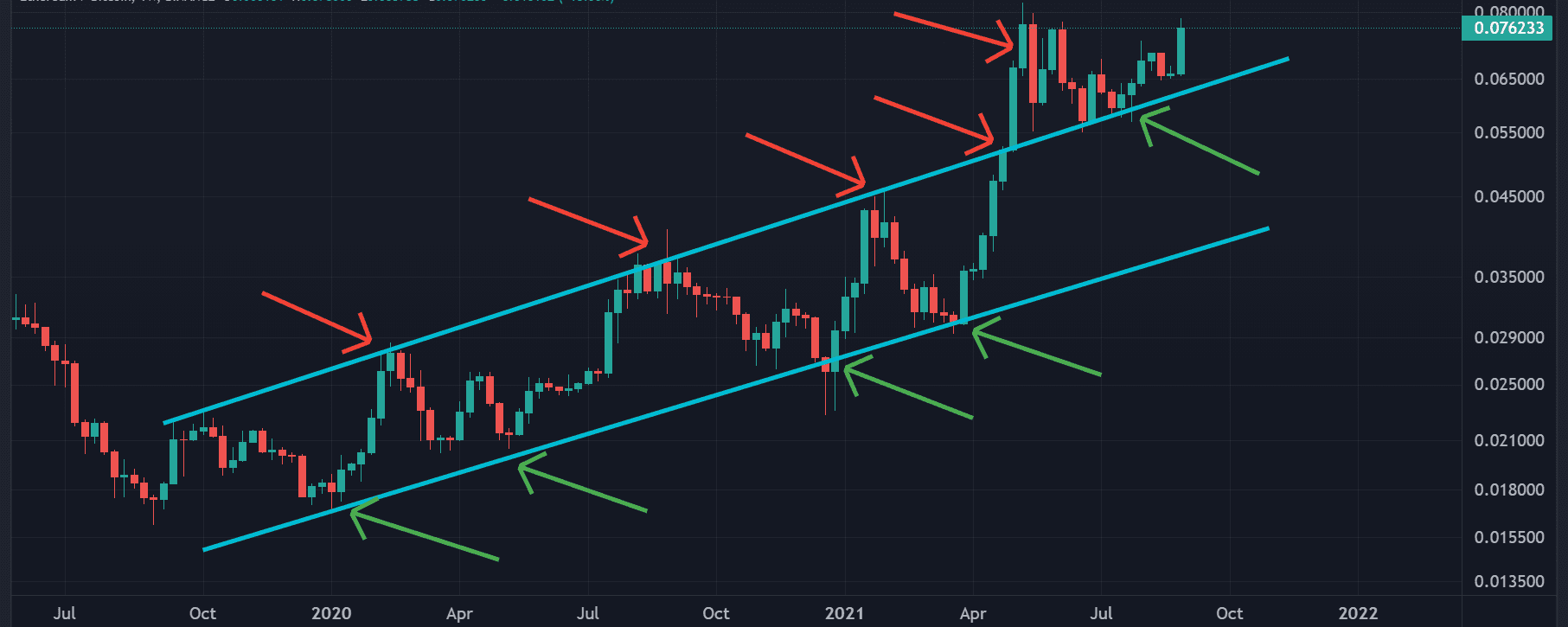
This channel held for multiple years. There were several months between buys and sells, and the approach produced gains over that historical interval.
Important: I do NOT sell everything at the top of the channel and go "all in" at the bottom.
The reason is that there's always the chance of the channel failing like it did in the summer of 2021. Had I sold everything at the top of the channel, I would have missed out on 65% of potential additional returns.
The active part of my Ethereum strategy was difficult and highly dependent on execution.
The technical-analysis guide explains the charting framework used here.
Should You Trade Ethereum, Or Just Hold Long Term?
At the time, I combined both approaches. Trading was riskier but offered more upside when executed well.
The chart below is a deliberately unrealistic upper-bound example that assumes every trade succeeds.
At each of the red arrows on the chart above, you sell all of your ETH and buy back at the green arrows.
Below you see the return you would produce, compared to the return you would have gotten by holding through it all:
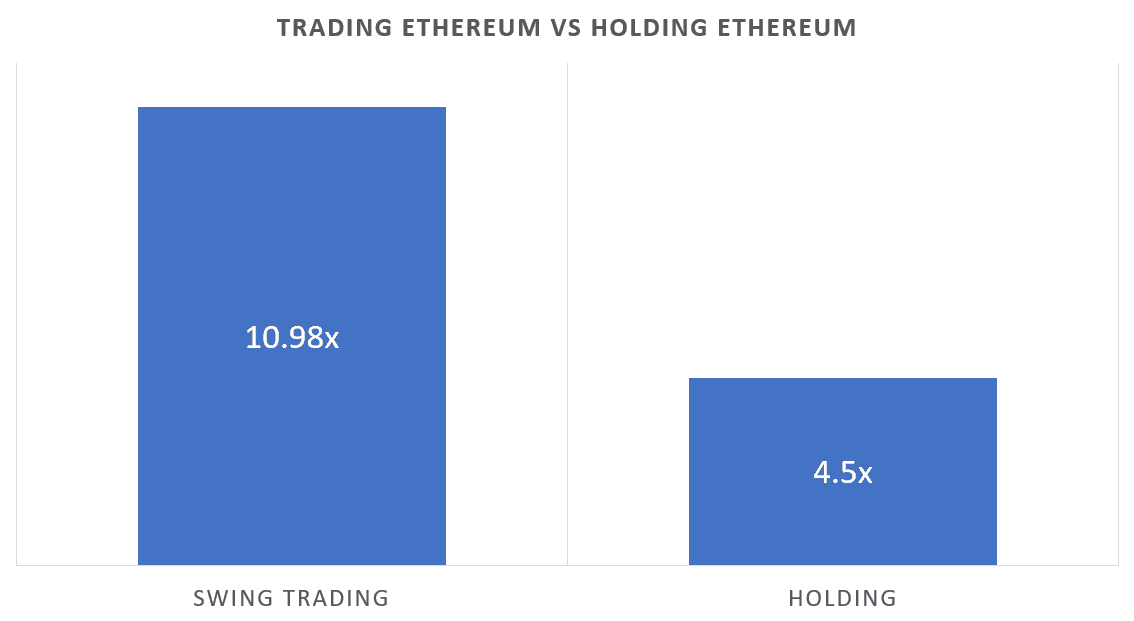
In this perfect-timing example, trading produced 11x while holding produced 4.5x, a 150% higher modeled ROI.
However, you will NOT perform this good. No one does.
My goal was not to hit 11x, but to outperform the 4.5x buy-and-hold result in this specific interval.
Once again, this was just an example. 4.5x and 11x are not general numbers; they are specific to this example. Also, none of this is financial advice, of course (as mentioned in the introduction.)
Example of How I Scaled an ETH Trading Strategy:
In a hypothetical $2,500 ETH portfolio, I would have scaled trading activity gradually:
When I started to recognize patterns, I made small trades, generally no more than 5% of the portfolio in this example.
As my pattern recognition improved, I allowed somewhat larger trades and monitored assets beyond ETH.
I booked profits rather than assuming every move would continue indefinitely.
Other Ways To Trade Ethereum:
Day Trading. Buy and sell ETH with high frequency - multiple times per day. This requires high skill, and extreme mental strength. NOT for beginners.
Futures Trading. Make bets on what the future price of Ethereum will be. This is NOT for beginners either. This is mostly used by "rich people" and institutions. However, for the right people futures trading offer a lot of upside (and risk management options).
ETHE. This offered indirect Ethereum exposure through Grayscale's Ethereum trust and was primarily aimed at accredited or institutional investors.
Summary: How I Split the Position
At the time, I kept half of my ETH in an interest-bearing account.
I swing-traded the other half against Bitcoin rather than the U.S. dollar.
My aim was to accumulate more ETH through both parts of the strategy and outperform Bitcoin.