

I see all kinds of Bitcoin price predictions for 2021 thrown around, but few of them have any substance.
I will do my best to keep things objective and level headed, and base my predictions on historical data and models.
My base case was that Bitcoin would reach $100,000 in 2021/2022. Four models and methods pointed to that scenario: the stock-to-flow model, logarithmic growth curves, the Fair Value S2F model and diminishing ROI from each cycle.
In this article, we assume that Bitcoin will peak at the end of 2021 - meaning that we subscribe to the four-year cycle.
Content:
What Institutional Investors Predict
What Retail Investors Predict
The Logarithmic Growth Curves
The Stock to Flow Model
The Fair Value S2F Model
The ROI of Previous Cycles
Predicting Bitcoin Using Gold and U.S. Dollar Market Cap
What Institutional Investors Predict
According to CNBC, JP Morgan has predicted a Bitcoin price of $146 000, and they're not alone.
I did some research and put together a table showing the different predictions made by authority figures in the financial markets:
| Predicted Bitcoin Price | Company / Person | Source |
|---|---|---|
| $146 000 | JP Morgan | CNBC |
| $300 000 | Citibank | Citibank |
| $115 000 | Pantera Capital | Cointelegraph |
| $100 000 | Anthony Scaramucci (SkyBridge Capital) | Marketwatch |
| "Bigger than Apple or Amazon" | Cathy Wood (Ark Invest) | Finance.yahoo |
It's eye-opening to see big institutions like Citibank think that Bitcoin will reach $300 000 within 2021. They actually sent out a report containing their research on Bitcoin. This report was intended for their clients - other institutional investors, but it got leaked to the public.
Also, the fact that JP Morgan, who for several years spoke badly about Bitcoin, came out with a prediction of $146 000, shows how much Bitcoin has changed in the eyes of institutional investors.
Their predictions vary quite a bit, making it hard to land on a specific price prediction. However, it tells us something about what's reasonable to expect, and what's within the realm of possibility for Bitcoin in 2021.
Surprisingly, retail investors (normal people like you and me) are more conservative than the big players:
What Retail Investors Predict
I asked around in a couple of Facebook groups, and my newsletter subscribers, and this is what the 200+ people who answered predict:
| Predicted Price | Percentage of Votes |
|---|---|
| Below $100 000 | 27.6% |
| $100 000 | 40.9% |
| Over $100 000 | 31.5% |
The predictions I got from retail investors ranged from $66 000 all the way up to $500 000.
However, we see that the most popular prediction from retail investors is that Bitcoin will hit $100 000 in 2021.
As we will see, this number is supported by several Data-science models and historical patterns from previous cycles:
The Logarithmic Growth Curves:
Below you see a chart of Bitcoins price ranging within a band. It shows the long term trend lines that all previous peaks have reached:
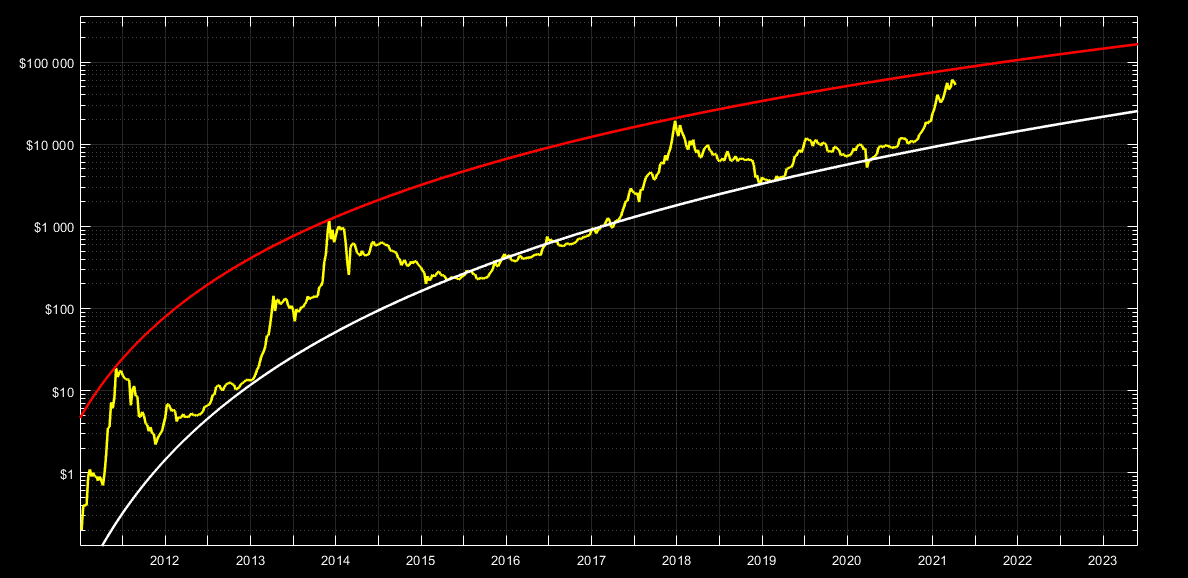
All prior Bitcoin peaks in the sample had reached the top of this band, so this scenario assumed that the next one would do the same.
If Bitcoin reached the top of the band at the end of 2021, the implied price was around $100,000, in line with the retail survey.
However, it's way to soon to draw any conclusion. Let's look at some more models:
The Stock to Flow Model (SF)
The Stock to flow model is one of the most popular models in the Bitcoin community. It was made by PlanB; a Bitcoin evangelist who has preached the Bitcoin gospel for years.
The Stock to flow is a metric usually used on stuff like gold and silver, but it's applicable to Bitcoin as well.
The Stock to Flow model predicts the price of Bitcoin based on scarcity. It looks at the market value of commodities like Gold, Silver and Platinum, as well as their respective stock to flow, and uses this information to model the price of Bitcoin, based on Bitcoins stock to flow.
"Ehhh, what...?"
I know this might sound boring, but hear me out:
Stock to flow is a number that tells us how long it will take to double the supply of Bitcoin, at the current rate of bitcoin mining.
Basically, it tells us how much new Bitcoin we mine vs. how much Bitcoin there already is.
It's tells you the ratio between how much new Bitcoin is being mined in a year and the already existing Bitcoin.
A Stock to Flow of 10 means that it would take miners ten years to double the number of Bitcoins in circulation.
A high stock to flow is good, as it means that the asset is more scarce, and scarcity drives the price up.
The good news is that the stock to flow of Bitcoin doubles every four years due to something called "the halving".
The halving cuts the number of Bitcoins that miners earn in half every four years, halving the production rate of Bitcoin, and therefore doubling the stock to flow.
The Bitcoin-halving analysis explains how stock-to-flow relates to Bitcoin's supply schedule.
PlanB tried to predict the future price of Bitcoin by modeling the price after it's stock to flow.
Below you see the model that PlanB made. It shows the price and the stock to flow (Source: lookintobitcoin.com):
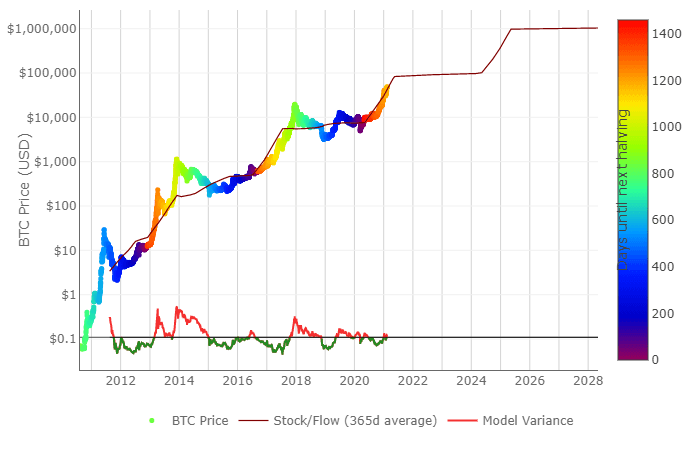
The colorful dots are the price of Bitcoin. The line is the predicted price based on the stock to flow. The color of the dots tell us how many days the next halving is into the future (right vertical axis). You see the price in USD on the left vertical axis, and the time measured in years on the bottom horizontal axis.
As you can see, the predicted price of Bitcoin by this model is 100 000 USD.
Both the SF and the logarithmic growth curves predict the same thing. This is great, but it's still to soon to draw any conclusions.
The Bitcoin-halving and stock-to-flow article explains that model in more detail.
Let's dive deeper.
The Fair Value S2F Model
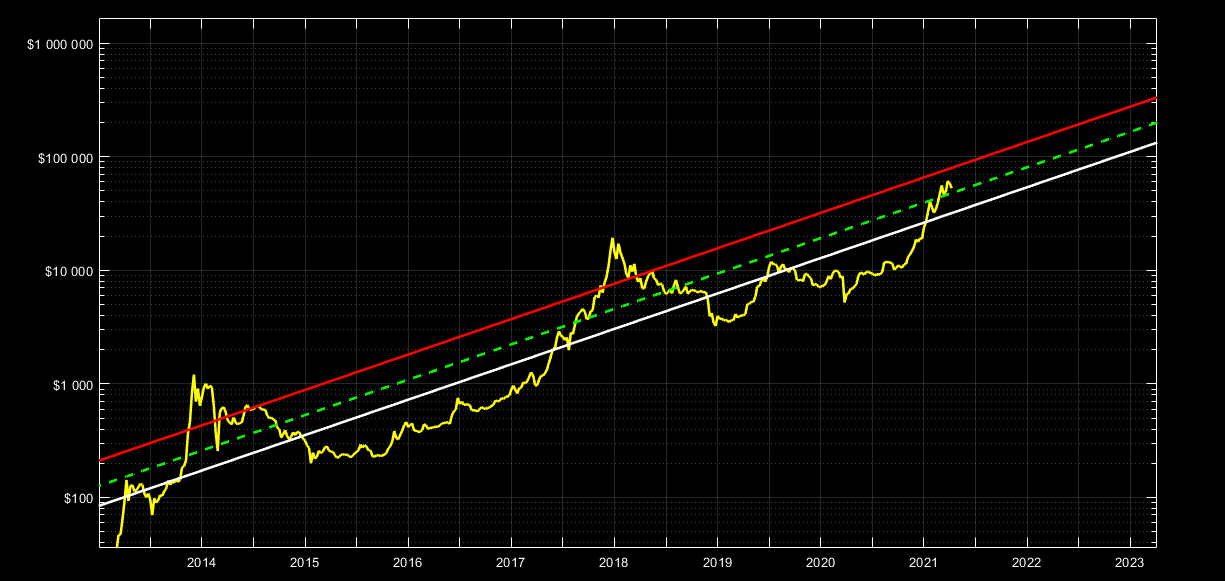
I modeled the fair price of Bitcoin based on it's stock to flow, and it's future halving. My work resulted in the model you see below:
How to Read This Model:
1) The green dashed line is the model's estimated “fair-value” line.
2) If the Bitcoin price is below the white line, the model classifies it as relatively cheap or oversold.
3) If the Bitcoin price is above the red line, the model classifies it as relatively expensive or overbought.
This model projected its fair-value line to reach $100,000 in the summer of 2022. Prior cycle peaks had moved above that line.
Under an end-of-2021 peak scenario, the model implied a range of $100,000-$150,000.
This model is actually useful for more than predicting the future price:
I used it to estimate relative market risk and how cheap or expensive Bitcoin looked against the model.
The Fair Value S2F Model article explains its construction in more detail.
The ROI of Previous Bitcoin Cycles
For those of you that don't know; Bitcoin moves in cycles. The price of Bitcoin has followed a pattern ever since it was created. This is largely due to the halving which happens every four years.
I used this recurring pattern to construct a scenario for the next cycle.
So what does the past tell us about the future?
In the sample I used, the ROI of each cycle had fallen to roughly one-third of the previous cycle.
If that pattern repeated, a 1,000x prior cycle would imply roughly 333x in the next one.
The return on investment, in this case, is calculated from the price of Bitcoin at the point of halving to the peak of the cycle.
The Bitcoin price did approximately 33x in the last cycle, from halving to peak. The price we had at the most recent halving was $10K. Given the ROI of 1/3 of 33 = 10, the predicted Bitcoin price is, you guessed it, 100 000 USD.
Below you see the Bitcoin price chart. The big yellow vertical lines are the halving events happening every four years. I've added a prediction of the ROI for this cycle, assuming that it will be 1/3 of the last one:
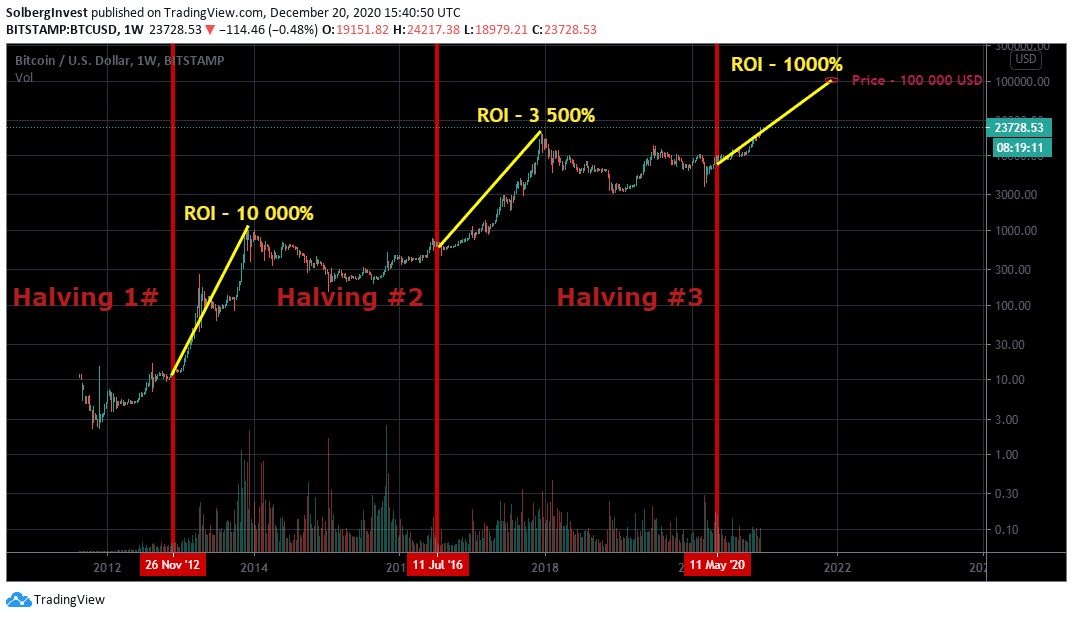
As you can see, this pattern predicts 100 000 USD.
We've now looked at four independent models/charts. They all seem to be pointing in the same direction. in addition, retail investors predict the same thing.
Related archived analysis: Ethereum Price Prediction 2021
Our Bitcoin Price Prediction for 2021
All the models we've looked at, as well as the pattern we see in the decreasing ROI from cycle to cycle, point to the same number - $100 000.
Also, retail investors think that $100 000 is the number we'll see Bitcoin climb to.
This gives the prediction weight, as they all strengthen each other.
None of the above methods of predicting the Bitcoin price are sufficient on their own to create a realistic Bitcoin price prediction for 2021, but together they are strong in a synergic way.
If our prediction relied on only one model, it would be pure speculation.
Having four different models and the retail survey point to the same price gave the scenario more weight in my analysis.
For this reason, I will conclude with this:
My conclusion was that the combined models and retail survey supported a $100,000 Bitcoin scenario by the end of 2021.
According to big institutions, this is rather conservative, with most of their predictions closer to $150 000 by the end of the year, some going all the way up to $318 000.
That made $100,000 my historical base case. There were also other ways to frame the future price of Bitcoin, including comparisons with similar assets:
Alternative Methods to Make Bitcoin Price Predictions
Creating our Bitcoin price prediction of $100 000 we looked at models and charts exclusively, however, there are other factors to keep in mind:
Institutional adoption and mainstream acceptance of Bitcoin.
We have seen companies like MicroStrategy and Tesla buy large amounts of Bitcoin. I treated that institutional demand as an additional bullish input, although it was difficult to quantify.
The problem is that it's hard to put a specific number on how high this pushes the bitcoin price in the future.
It's not like Tesla buying will "exactly double, or triple" the potential price peak. No one knows how to take events like these into consideration when making a price prediction.
However, I considered them bullish inputs that supported a higher-price scenario.
At the time, I considered the $100,000 base case relatively conservative against those additional scenarios.
One way people like to predict the price of Bitcoin, given the institutional adoption, is to compare it to other assets like gold:
Bitcoin Price Prediction by Comparison to Gold and USD:
Over the last few years, the "function" of Bitcoin has been discussed a lot. Is it e-cash? Is it criminal-cash? Is it e-gold?
Most people, together with major institutions like banks and hedgefunds, agree that Bitcoin functions best as a gold-like asset - a store of value.
In this thesis, Bitcoin functioned less as a payment method for groceries and more as a potential store of purchasing power over time.
Recently, we've seen a lot of "gold bugs" (people who love gold) move over to Bitcoin.
We have also seen a decrease in demand from normal people (retail investors) when it comes to gold, and an increase in demand for Bitcoin.
According to JP Morgan, institutions are also switching from gold to Bitcoin. (source: https://news.bitcoin.com/jpmorgan-gold-etfs-bitcoin/)
This has caused people to ask the question:
What if Bitcoin reached the same market cap as gold?
The same question can be asked in regards to the U.S. Dollar, let's explore this way of predicting the Bitcoin price:
Market Cap of Gold and U.S. Dollar Compared to Bitcoin
Below you see the market capitalization of Bitcoin, Gold and the U.S. Dollar. Bitcoin's market cap was smaller than both comparison assets:
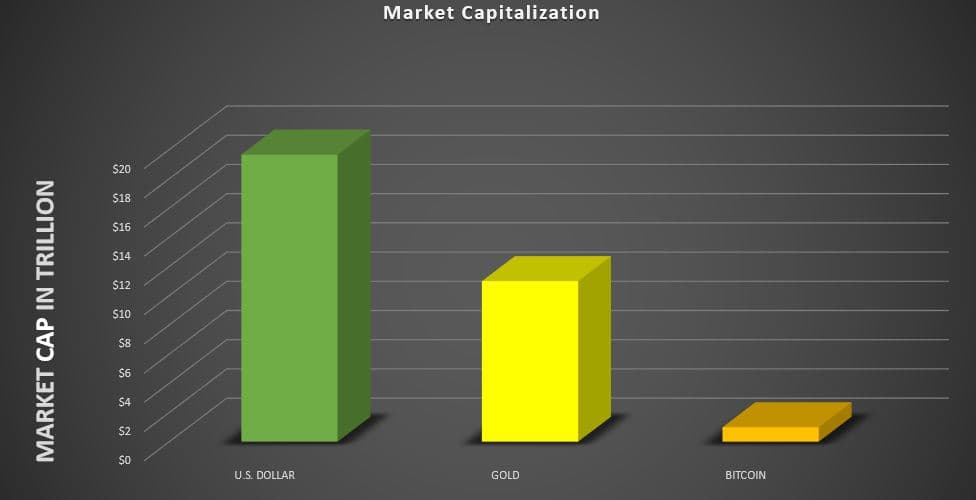
USD, Gold and BTC Market Capitalization
Bitcoin Price with the Market Cap of Gold
At the time of writing, the market capitalization of gold is $11 000 000 000 000.
If we want to calculate the Bitcoin price, given a market cap of 11 trillion USD, we need only divide the market cap by the circulating supply of Bitcoin:
$11 000 000 000 000 / 18 700 000 BTC = $588 235/BTC
In other words:
If Bitcoin reaches the same market cap as gold, the Bitcoin price will be $588 235
Bitcoin Price with the Market Cap of USD
The market cap of the dollar is currently at $20 trillion.
If we want to calculate the Bitcoin price, we need to do what we did with gold:
$20 000 000 000 000 / 18 700 000 = $1 070 000/BTC
In other words:
If Bitcoin reaches the same market cap as USD, the Bitcoin price will cross the million-dollar mark, and reach $1 070 000
A separate article explores the assumptions behind a $1 million Bitcoin scenario.