


(Updated 10. September 2022)
VeChain and Cardano grew to the forefront of the crypto market in the bull market of 2020-2021. I've been following these two for a long time and will summarize the similarities, differences, and gauge which of them is the better investment.
My conclusion in this 2022 comparison was that VeChain had a slight edge. I considered its supply-chain focus more differentiated, while Cardano competed directly with Ethereum; I also viewed their different issuance models as a factor in VeChain's favor.
The rest of the article explains the evidence behind that conclusion.
What are VeChain and Cardano?
Cardano is a competitor to Ethereum. It's what we call "a programmable blockchain". Cardano aims to attract developers to build stuff on top of it. Cardano aims to do this better than the current leader, Ethereum, by improving the technology and philosophy behind the development process. All Cardano's improvements/uploads are actually peer-reviewed, like science papers.
Cardano's mission is to improve on what Ethereum has done, and host applications in a safer, faster, more scalable and more decentralized manner, enabling more businesses, governments and people in general, to benefit from blockchain technology.
VeChain is also a blockchain, but with different functions and goals than Cardano. It was designed to help businesses count inventory, trace goods back to producers and manage logistics. I viewed that supply-chain focus as one of blockchain technology's clearer business use cases.
VeChain's mission is to decrease regulatory burdens and enable businesses to use blockchain to address actual financial and logistical challenges. They enable proof of authenticity for brands, helping the fight against counterfeit goods.
How are VeChain and Cardano similar?
Marketplaces. Users can buy, sell, trade, and stake both of these coins on cryptocurrency exchanges around the world.
Native coins backed. Both VeChain and Cardano have their native cryptocurrencies, VET and ADA respectively.
Limited Supply. Both of these tokens have a limited maximum supply, 86.7 billion for VET and 45 billion for ADA.
Staking. Both of these tokens can be staked to earn a reward for helping secure and run the blockchain.
Smart Contracts. In Q3 of 2021, Cardano finally enabled smart contracts. VeChain supports them as well.
How are VeChain and Cardano different?
Consensus Protocol. VeChain uses the Proof of Authority consensus system whereas Cardano utilizes the Proof of Stake consensus.
Market Capitalization. At the time of writing, Cardano is roughly nine times bigger than Vechain in terms of market cap. (source)
Burning. VeChain burns 70% of the transaction costs in VTHO, not VET. The VeChain token-burn article explains the mechanism. Cardano burns none.
Tokenomics and Price History of ADA and VET
Both VET and ADA have surged in the past few years, but which has the best historical performance? Also, how are the different inflation rates, and general tokenomics compared to each other?
Historical Performance
Let's zoom out and look at the price movements from January 2020 to the summer of 2021. This will give us a good view of the two coins' long-term performance and which has done better.
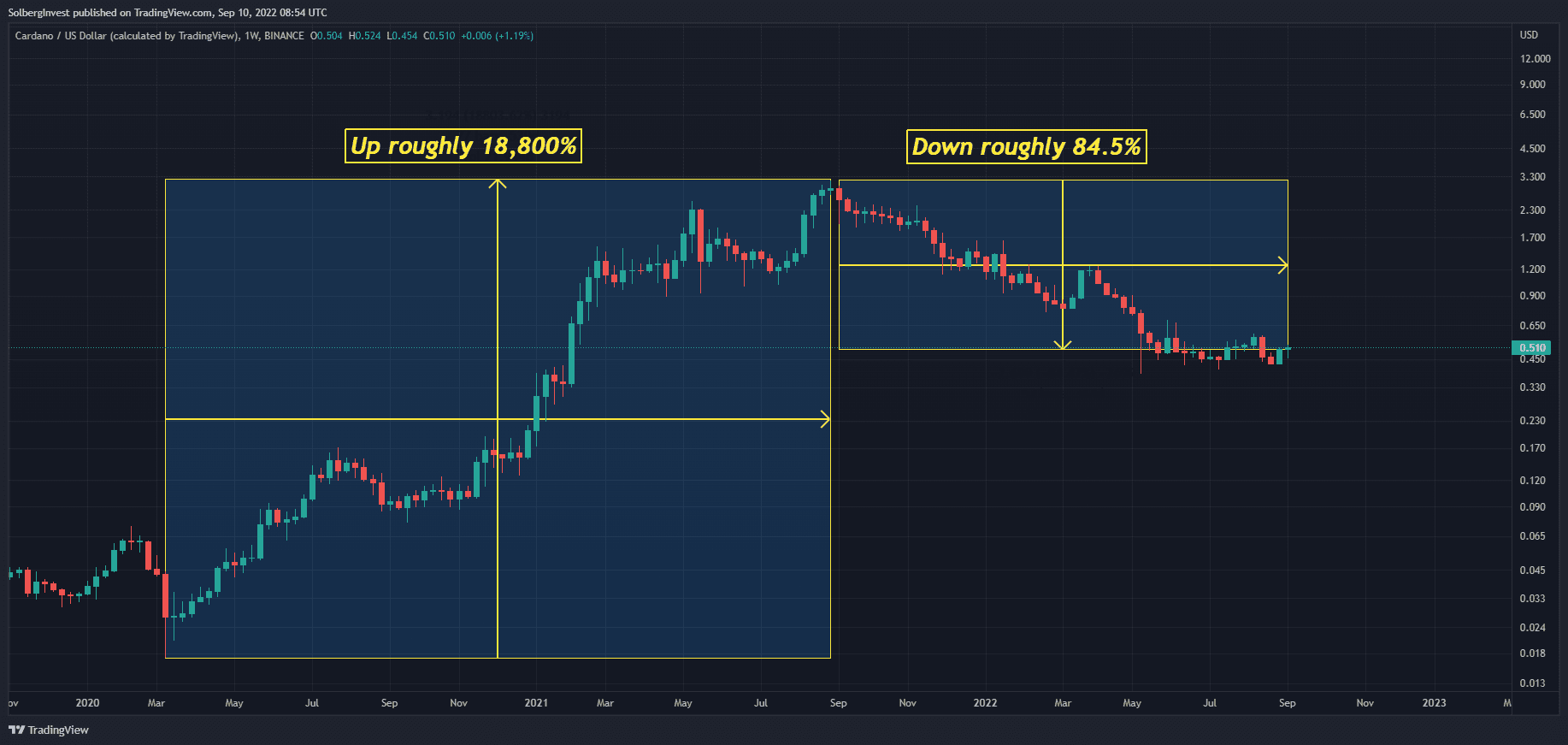
Historical Performance of Cardano (ADA):
Historical Performance of VeChain (VET):
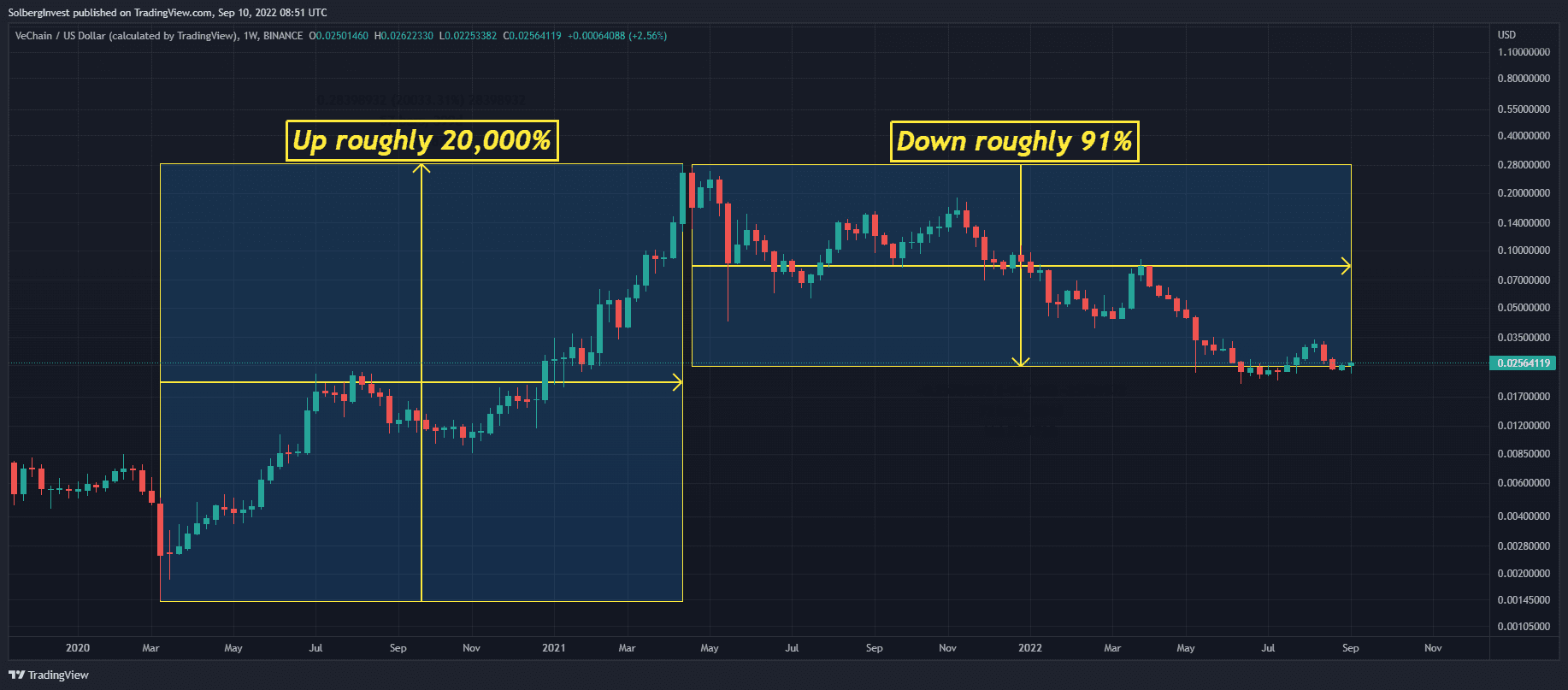
They have performed rather similarly. In the bull market of 2020-2021, they both surged massively. Vechain did better, with over 20,000% returns. Cardano followed closely with almost 19,000%. In the bear market, Vechain has fallen over 90%, while Cardano is currently 85% below the ATH of 2021.
Looking at the two charts above, we can say that Vechain is a tiny bit more volatile, in both directions, historically speaking.
Difference: Inflation/Deflation Rate
VeChain did not issue VET as staking rewards because those rewards were paid in another token. Lost wallets could gradually reduce the liquid VET supply, which I treated as lower supply pressure relative to an inflationary token.
Cardano has inflation. The Cardano inflation article explains its planned rate over time.
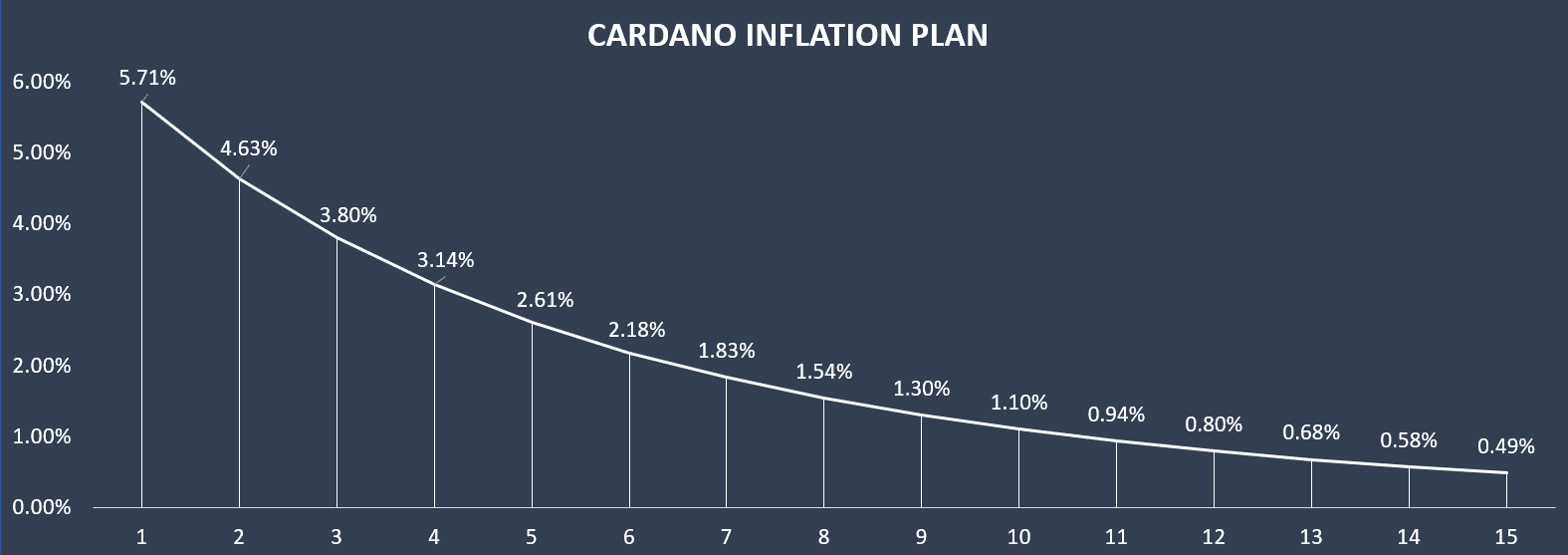
I treated the difference between ADA's issuance and VET's fixed supply as one factor in VeChain's favor.
The positive side of inflation is that it can incentivize use and development through staking rewards. Some people argue that this can be preferable to deflation if adoption increases demand faster than issuance increases supply.
Future Outlook for Vechain vs Cardano
At the time, I saw a stronger relative case for VeChain for two reasons:
I viewed VeChain's supply-chain focus as more differentiated, while Cardano competed directly with Ethereum and other programmable blockchains.
VeChain listed more large corporate partnerships in the sources I reviewed; I found Cardano's comparable adoption evidence less developed at the time.
I still considered Cardano a strong project, but preferred VeChain. Its smaller market capitalization also gave it more room to grow in my historical scenario.
Separate articles explore price scenarios for each asset:
Conclusion: Why I Preferred VeChain
In this historical comparison, I preferred VET for long-term exposure. I considered its supply-chain focus more differentiated than Cardano's position among programmable blockchains, and its fixed supply strengthened that conclusion for me.