

(Updated 13. September 2022)
There's a lot of hype around token burns in the cryptocurrency market. When tokens are burned, increased scarcity can support the value of the remaining tokens. This leads to the question: Does Vechain burn tokens?
Yes, Vechain burns 70% of the transaction costs, which is paid in VTHO, their "utility token". VTHO is not the same as VET, which is their "store of value and smart payment currency". However, the VeChain Foundation exercises buybacks of VET, which effectively works as token burns.
Let me give you a quick rundown of the two tokens on the VeChain blockchain:
While VET is the governance token on the Vechain blockchain, VTHO is the utility token. VTHO is what you pay transaction fees with. 70% of the transaction fee is burned, and the remaining 30% is rewarded to nodes for adding new blocks and validating transactions.
VET itself is not burned; a separate article examined VET's investment case. However, the VeChain Foundation did exercise buybacks of VET, which functioned similarly to token burns.
For example, in 2019-2020 the Vechain foundation bought $25 million worth of VET in a buyback program. This was to celebrate their one-year independence from Ethereum, as they started out on the Ethereum blockchain as an ERC-20 token.
At the time, holding the governance token VET generated VTHO, which could be sold or used to pay transaction fees.
Why Vechain Burns VTHO Tokens
As mentioned above, VTHO is the utility token of Vechain. This token is used to pay transaction fees and is not meant as a speculative investment.
It is constructed to remain relatively flat in terms of price movements, giving businesses predictable costs for running their programs on the Vechain blockchain.
Why then, wouldn't the supply of VTHO gradually go to zero if the token burn is 70% of the transaction fees? What do we do when we run out of VTHO?
This is where VET comes in:
All wallets holding VET are rewarded with VTHO every single day. Nodes receive an extra reward on top of the basic rate of 0.000432 VTHO per VET per day.
So there you have the answer - Nodes receive extra VTHO. This way, the supply of VTHO avoids its apparent convergence to zero.
Let's get more specific: Exactly how much VTHO is burned vs. created?
The Four Ways VTHO is Distributed, And How Much Is Being Burned
Essentially, there were four ways VTHO was distributed:
1) Holding VET in a wallet: This generates 0.000432 VTHO per day, per VET token in the wallet. This is the basic generation rate of VTHO. This rate might increase in the future, but can never be decreased (According to the Vechain foundation)
2) Becoming an authority node: Authority nodes add new blocks to the chain and validate transactions. They make sure the blockchain runs smoothly and in a safe manner. For this, they are rewarded with 30% of the transaction costs paid in VTHO by the users of the blockchain.
3) Having an authority, economic or X Node: The Vechain foundation has a large pool of VET, generating tons of VTHO. The VTHO generated by this pool is distributed amongst the nodes mentioned above. This pool was initially at 15 billion VET, but decreases over time (2.5 billion every 6 months).
4) Being an authority node or X economic node: The Vechain foundation has another pool of five billion VET. The generated VTHO is distributed to the nodes mentioned above.
The table below summarizes VTHO generation:
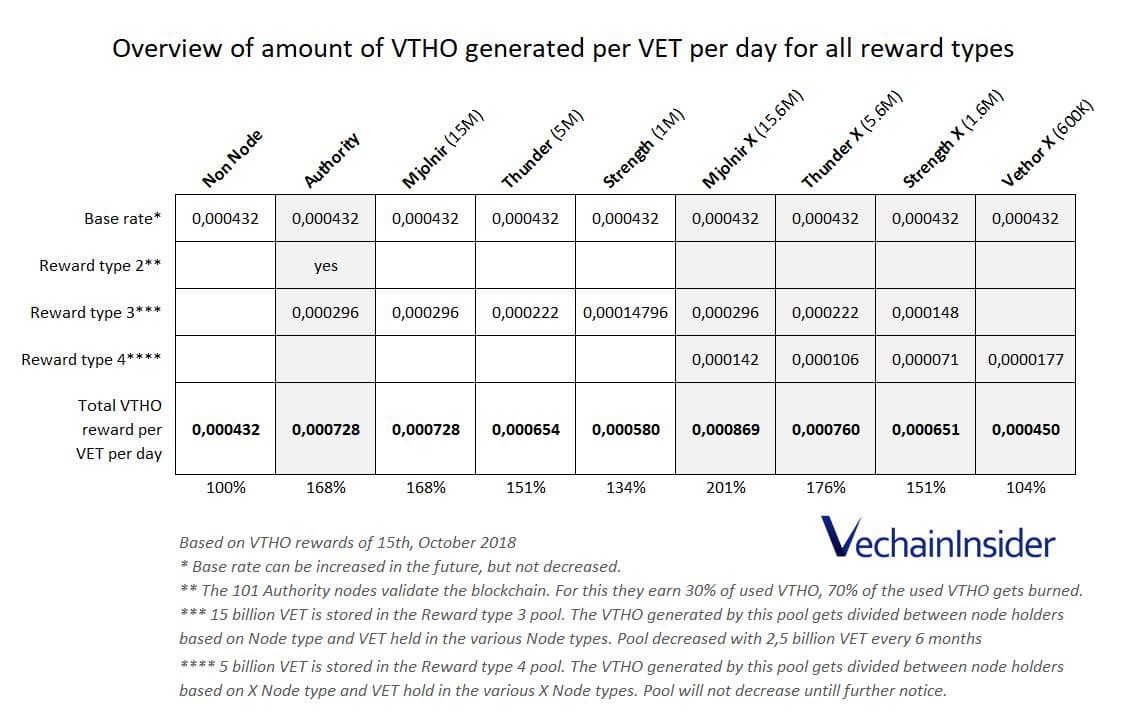
Source: https://vechaininsider.com
This means that the generation of VTHO is more or less decided by an algorytm, and can be expressed as a function of time.
On the other hand, burning of the VTHO token is based on the usage of the vechain blockchain - 70% of the transaction cost.
This makes the circulating supply of VTHO fluctuate, as the traffic on the blockchain fluctuates.
In periods of high usage, the burning of tokens can exceed the generation of new ones - deflating the supply.
Below you see a chart showing how much VTHO has been burned:
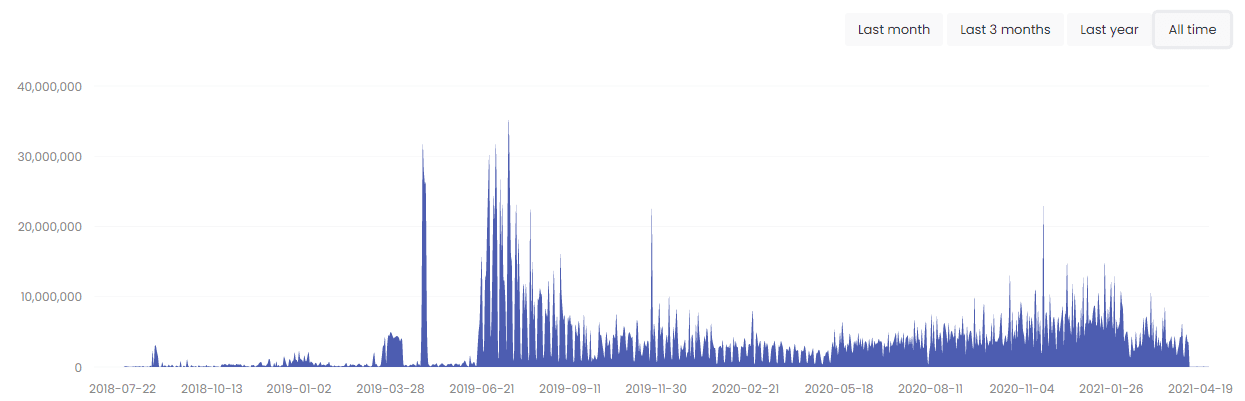
Source: https://vechainthorscan.com
VTHO Rewards for VET Holders
The VeChain Foundation worked to reduce VTHO price fluctuations, keep utility costs predictable, and reward nodes and VET holders.
Think about it:
Usually, when staking coins, you receive rewards in the same coin. For example, when you stake ADA, the native token of Cardano, you receive ADA as a reward. If the ADA price crashes, both the staked amount, and the rewards you receive will crash with it.
On the other hand, the model aimed to keep VTHO relatively stable even when VET moved sharply. This made the rewards less directly tied to VET's price.
Because the rewards were paid in a different token, their price exposure differed from VET's.
Conclusion: Vechain Burns Tokens (VTHO)
Vechain does burn tokens, but only VTHO, not VET. The amount they burn is 70% of the transaction fees paid in VTHO, which naturally fluctuates over time, as the traffic on the blockchain fluctuates.
However, they do exercise buybacks of the VET token, which kind of works as a token burn, but the tokens are not destroyed: The VET tokens acquired with buybacks are used to generate more VTHO for the Vechain foundation, which they use to incentivize developers to grow the ecosystem and distribute as a reward to nodes and holder of VET.