

Vechain increased by more than 5,000% in 2020-2021. This archived analysis asks whether the technical and fundamental evidence still supported the investment case in 2022.
In this 2022 analysis, I concluded that Vechain was a good investment. The technical setup looked bullish relative to Bitcoin and Ethereum, while the fundamentals included useful technology, an experienced team and real-world use cases.
Let's get into the what, why and how to analyze Vechain, both technically and fundamentally, as a potential investment in 2022:
Technical Analysis Of Vechain As An Investment In 2022:
To be fully transparent; I'm actively swing trading Vechain. I buy Vechain when it's cheap, hold for a few months, then gradually sell it.
Let's look at what the charts tell us about the future of Vechain, both in terms of USD, BTC and ETH.
(For background, this article explains how I read price charts.)
Vechain / USD
This chart shows the USD price of Vechain:

In April of 2021, Vechain saw a correction of 85%. I interpreted the reset as potentially bullish rather than automatically negative.
A correction like that acts as a cleansing both of weak hands and of leverage.
Vechain also seems to have stabilized in the $0.6 - $0.9 range, which seems healthy (roughly 70% down from the ATH in 2021).
I interpreted the sideways consolidation, or slow decline from May 2021 to Q1 2022, as a potentially bullish base for Vechain.
Vechain / BTC
This chart shows the BTC price of Vechain. If this chart moves up it means that Vechain is doing better than Bitcoin. If it moves down, it means that Vechain is doing worse than Bitcoin.
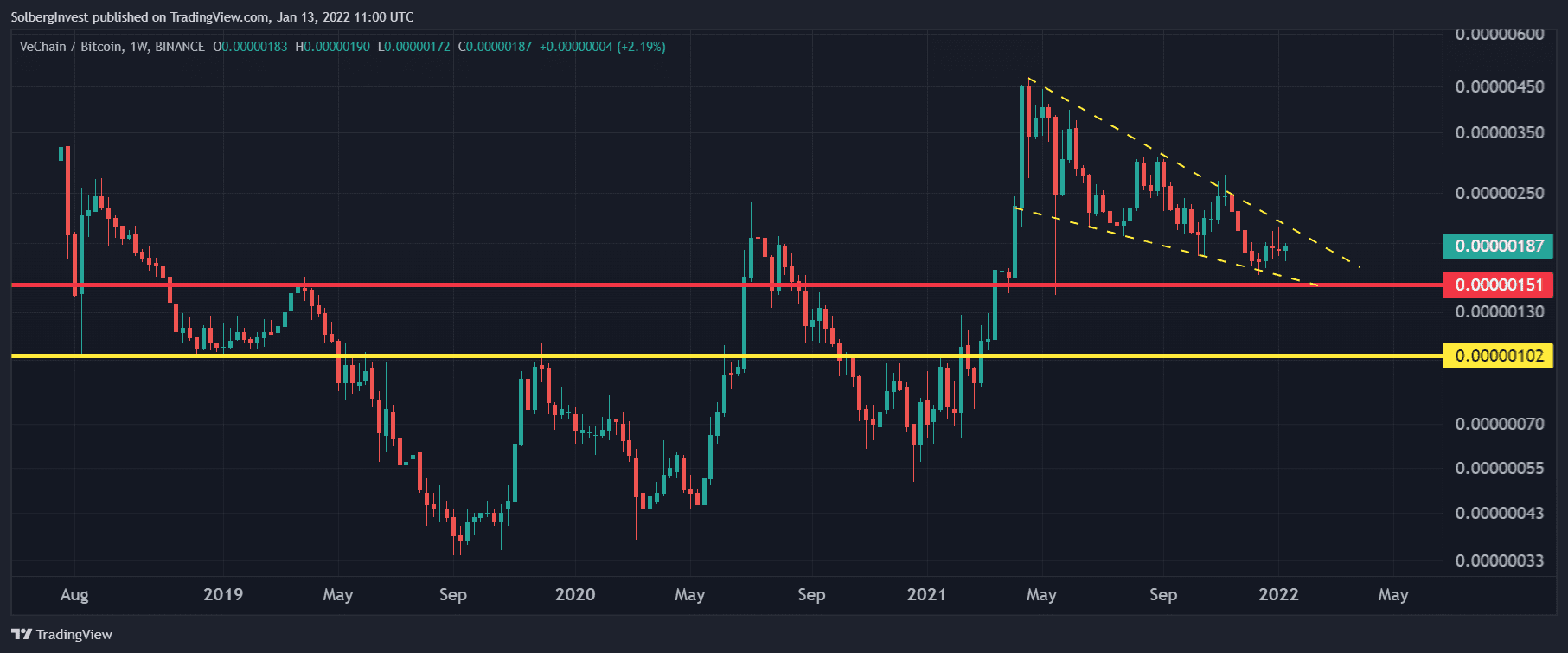
The red horizontal line is a long-term trend line we were approaching and that I expected could act as support.
The yellow line marked the next level I was watching if the red line failed.
The yellow dashed lines indicate a "falling wedge" - a bullish reversal pattern.
In 2022, I interpreted the combination of a major support line and a falling-wedge pattern as bullish.
Let's look at one more chart, the VET / ETH:
Vechain / ETH
This chart shows the ETH price of Vechain. If this chart moves up it means that Vechain is doing better than Ethereum. If it moves down, it means that Vechain is doing worse than Ethereum.
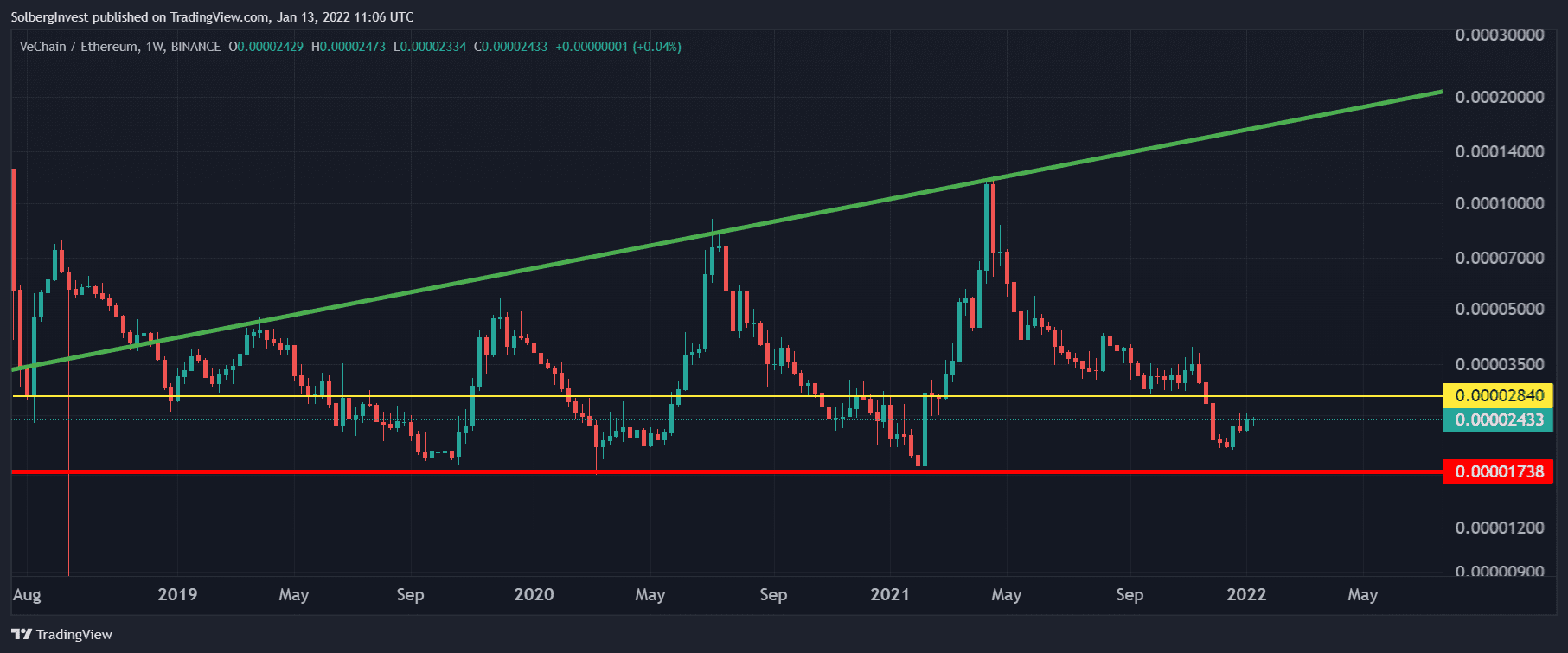
In conclusion, I read the 2022 Vechain charts against USD, BTC and ETH as bullish.
Let's move on from the charts, and look at the fundamentals and the functions of Vechain:
The Fundamentals of Vechain in 2022
When analyzing an investment opportunity in the cryptocurrency market, it's important to understand what it is, how it works, and if it has potential for future growth.
From the technical analysis, we've seen that Vechain has great potential, but to understand why and how likely it is that it fulfills this potential, we have to look at the fundamentals of Vechain.
What Does Vechain do?
Vechain started in 2015 and focuses primarily on helping businesses in the logistics field. They do this through supply chain management; tracking, quality control, inventory management, and much more.
In other words, Vechain makes it easier for businesses to count their inventory, track goods all the way back to the producer, and stay on top of all the logistics.
Other traditional companies were developing blockchain-powered products in competition with Vechain, including IBM, SAP and BMW. At the time, I thought Vechain had a lead among crypto-native supply-chain projects.
Does Vechain Have a Future?
Think about it, how many "brand-focused" businesses would love to have the ability to provide proof of authenticity?
Vechain had established itself as a leading supply-chain cryptocurrency project. I considered this one of blockchain's stronger use cases and expected the sector to grow.
Vechain Uses Proof of Authority (POA) to Achieve Consensus
For background on the terms used below, see blockchain technology.
Let's get into it:
To achieve consensus, and verify transactions, Vechain uses "Proof of Authority" (POA).
The most popular consensus mechanisms are proof of work (POW) and proof of stake (POS), let's compare them:
The drawback with these two, that POA solves, is that POW and POS lead to competition between nodes, as the nodes with more resources control the majority of the network and receive more rewards as a consequence.
POA is designed to limit resource-based centralization and monopoly.
Vechains unique proof of authority does not favor the nodes with more resources, but weighs them all equally.
For a node to join the network and verify transactions, it has to be authorized by the Vechain Foundation first.
This leads to a network of authorized nodes with (theoretically) good intentions, who use fewer resources - saving the environment from unnecessary harm.
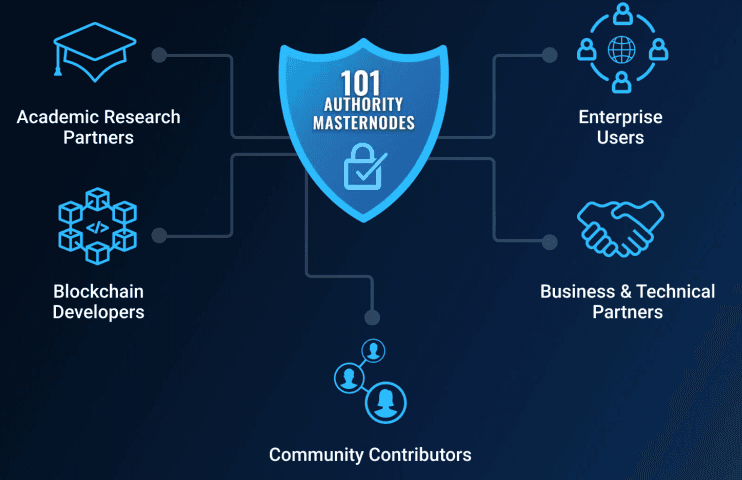
For Vechain to add new blocks to the chain through POA, an algorithm chooses a random node to do it. This is why, contrary to POW and POS, more resources do NOT equal more network control. No matter how much money you throw at your node, it doesn't increase your chances of being chosen to add new blocks (adding new blocks pays rewards).
The downsides of POA:
1) There's no way of preventing a node from behaving badly after the algorithm picks it to add a new block.
However, there are ways of proving this in the aftermath of the bad behavior, which incentivizes nodes to behave good, but if a node actually chooses to mess things up it might be too late.
2) The fact that all nodes must be authorized by the Vechain foundation makes it "meta centralized". The blockchain itself runs in a decentralized manner, which is of the highest importance, but the fact that you have to get authorized to run a node makes it sort of centralized on a meta-level.
This is probably not a big deal, as the blockchain itself is decentralized, but it may raise concerns in the future if some of the node operators disagree with the Vechain foundation, and start threatening them with bad behavior.
This had not happened at the time, but it remained a hypothetical risk worth considering.
The upsides of POA are that transactions are quick, the resources used are low, and the scalability is good.
When it comes to transactions per second, I didn't find any hard numbers. However, I did find the "record of number of transactions in 24 hours".
The source reported a high of 115,893 transactions in a 24-hour period. That observation did not establish a verified network capacity in transactions per second.
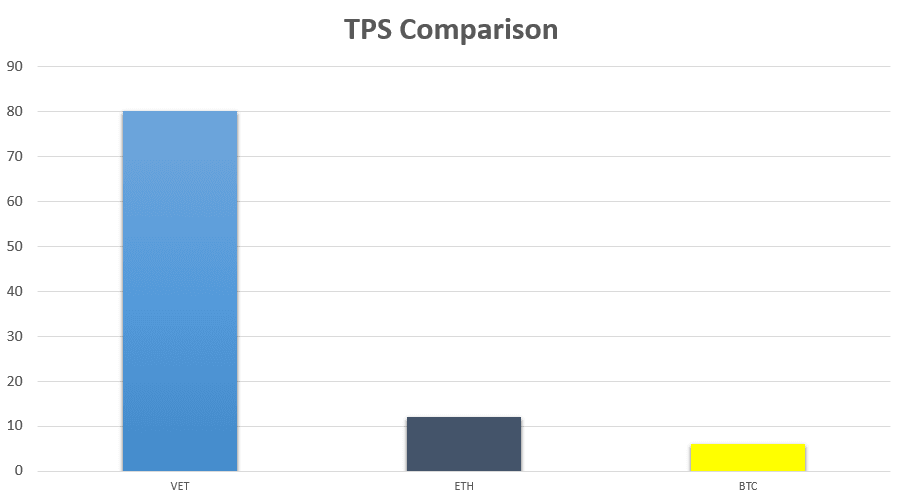
I considered Vechain's fundamentals strong and expected its industry to grow. That supported my 2022 case for VET.
Let's take a closer look at the on-chain metrics of Vechain:
On-chain Metrics of Vechain
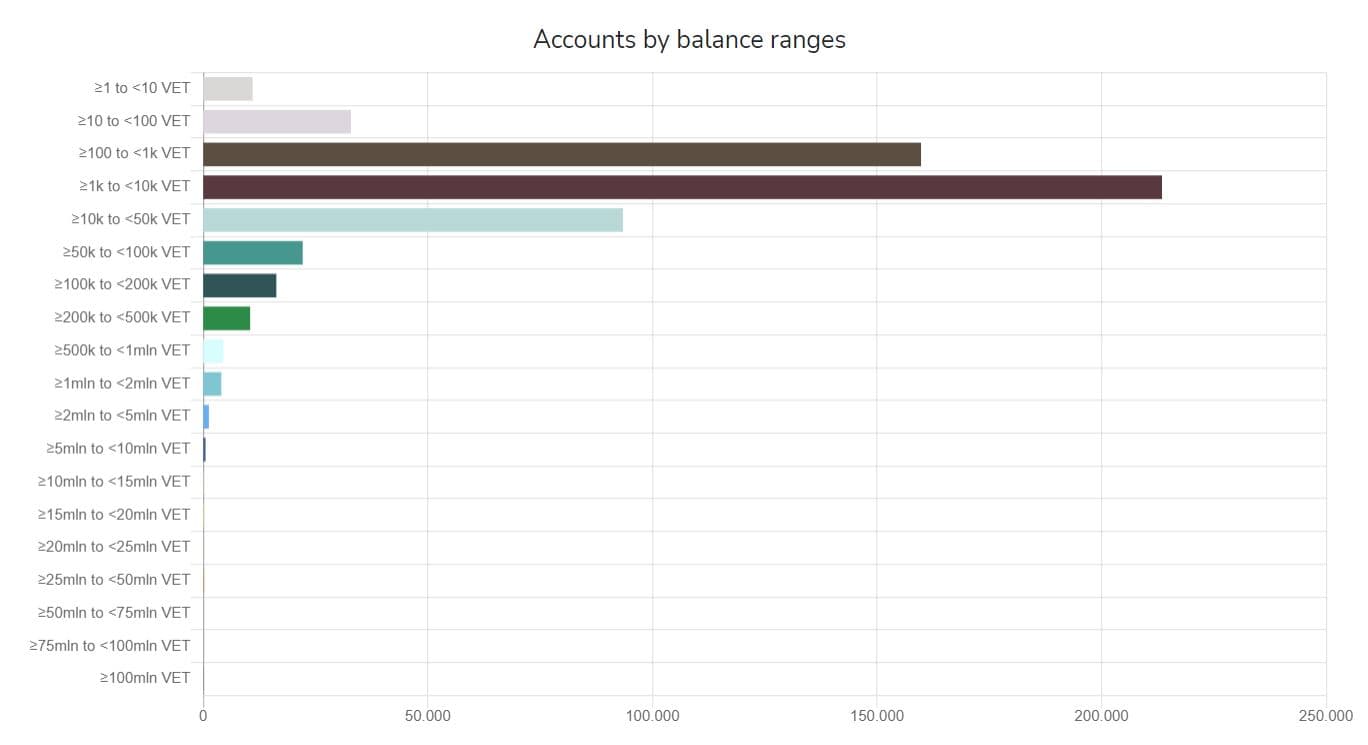
Below you see the number of wallets grouped by the amount of Vechain they held. Most wallets fell into the lower balance ranges shown on the chart.
That's a good thing, as a well-distributed token indicates more decentralization, and prevents "dumps" by large token holders to manipulate the price.
Source: https://vechainstats.com/charts/
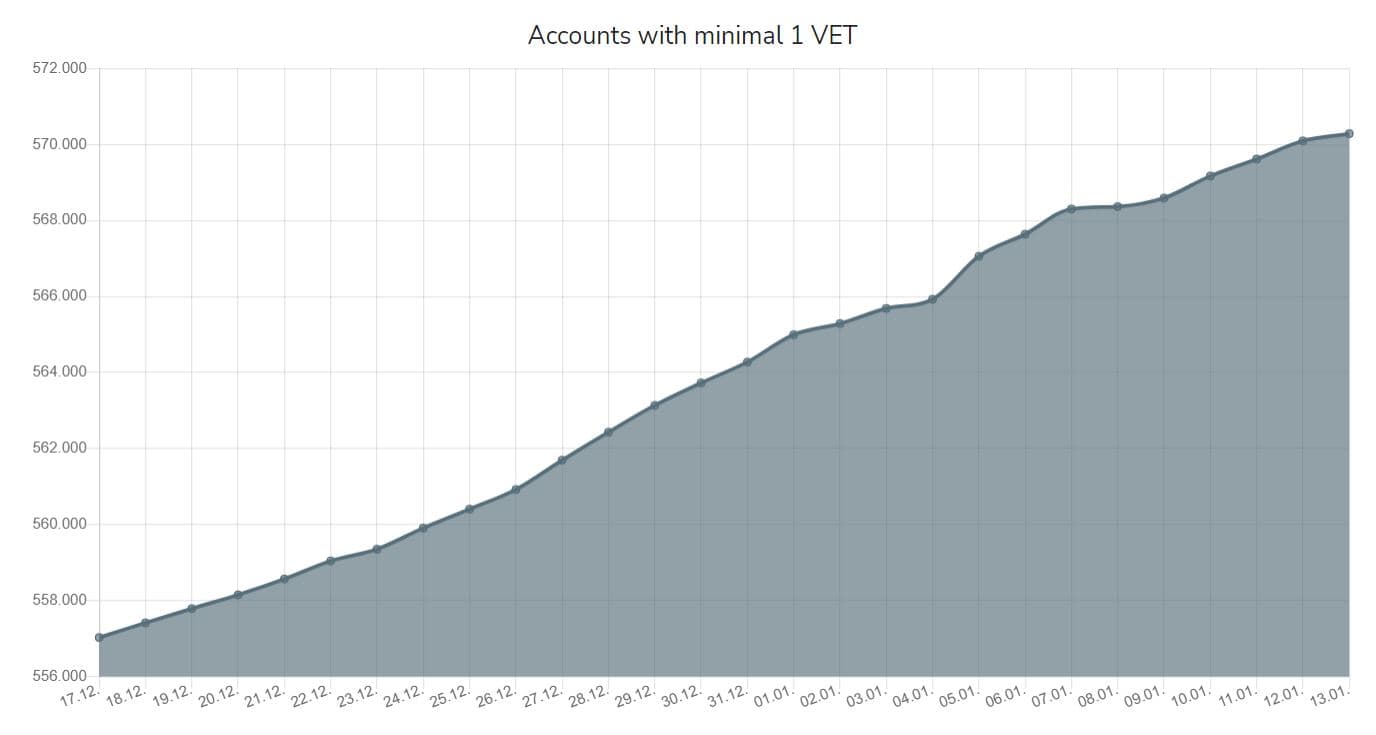
Another interesting statistic is the number of non-negative VET addresses. The chart below shows you the growth of this metric in the last 30 days:
Source: https://vechainstats.com/charts/
Almost exactly one year ago, the number of non-zero wallets (wallets with one or more VET) was 250K.
At the time of the chart, it was 570K, more than double the prior-year figure. I interpreted that as evidence of growing adoption.
Vechain Partnerships
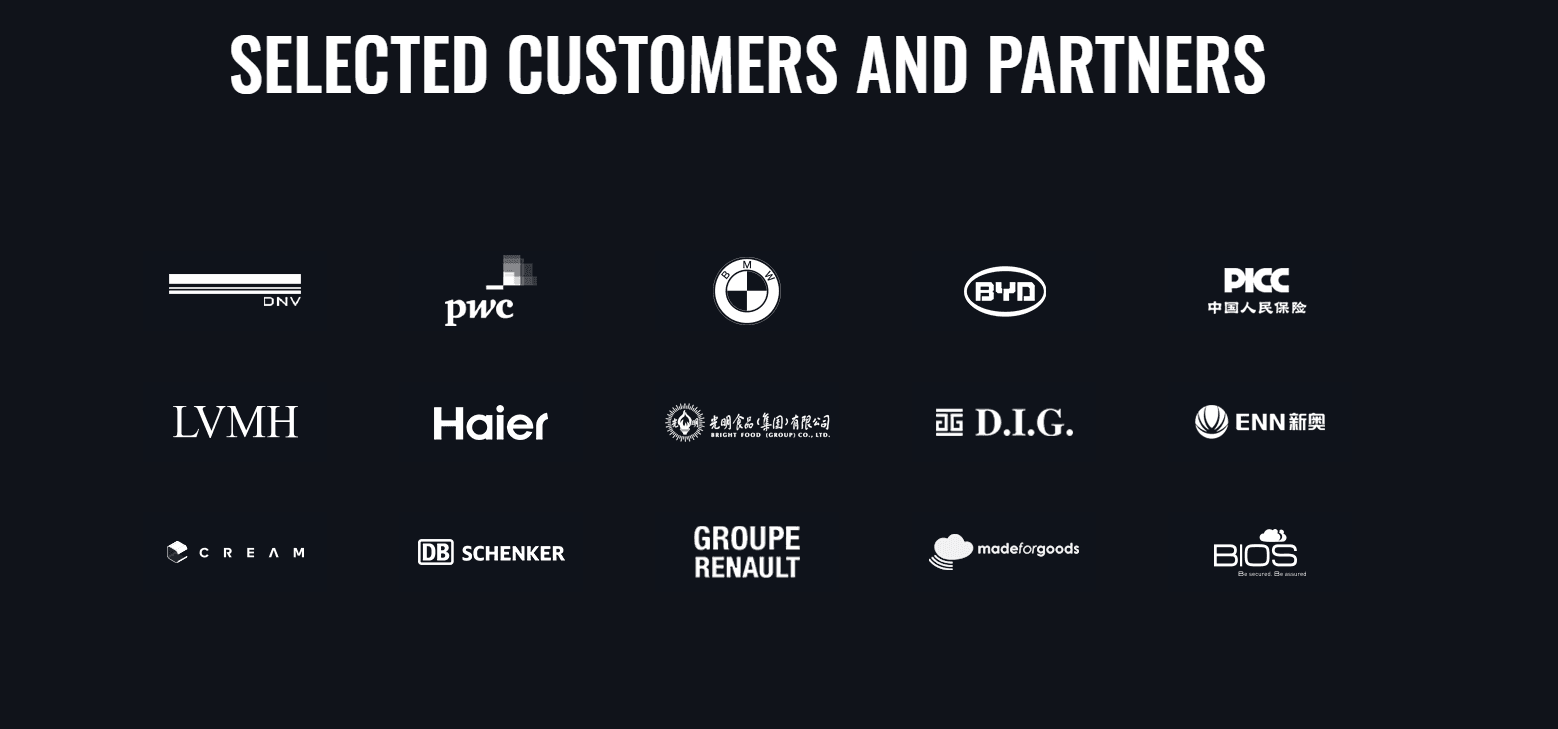
Vechain has a lot of strong partnerships with big companies. This gives them an edge against the competition.
Below you see some of their partnerships:
Source: https://www.vechain.com/
These partnerships ingrain Vechain deep into the industry and give them a good reputation among other businesses, which is key to success as a blockchain tech organization.
These partnerships supported my bullish view of Vechain in 2022.
All things considered, I thought Vechain had strong fundamentals and further room for adoption. That supported the higher scenarios in my 2022 analysis.
Conclusion: Why I Considered Vechain a Good Investment in 2022
Vechain had strong fundamentals and a bullish setup on the major charts. All things considered, I concluded that Vechain was a good investment in 2022.