


(Updated 17. September 2022)
ADA, the native cryptocurrency of the Cardano blockchain, is an exciting crypto with a strong following. In this article, I'll look into the economics of this token and figure out if Cardano is deflationary or not.
Here's the short answer:
Cardano was not deflationary at publication. In my model, its 4.72% inflation rate declined toward 0.9% in 2030; assuming 1% of supply was lost each year, net supply became deflationary around 2030.
Let us get deeper into the economics of ADA and figure out how the supply will change in the future.
The Circulating and Max Supply Of ADA:
First of all, Cardano has a circulating supply of 33.8 Billion ADA and a max supply of 45 Billion. That's approximately 2000x the supply of Bitcoin, and the main reason behind the "low price" of ADA compared to other coins like Bitcoin and Ethereum.
To illustrate, I made this chart showing the difference in supply between a few coins:
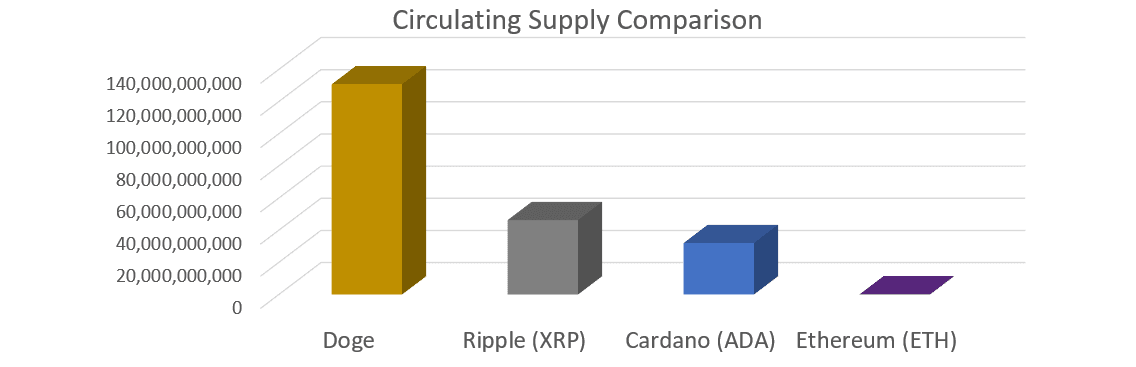
data source: CoinMarketCap
Notice how the coins with high supply are priced low. For example, Doge, XRP, and ADA are priced relatively low, while ETH is priced in the thousands of dollars.
This constraint is central to the Cardano $1,000 price scenario: Price per token = Market Capitalization / Circulating Supply.
From this equation, a larger supply means a lower price per token at the same market capitalization. If supply increases while market capitalization stays constant, price per token decreases.
About 75% of the coins are in circulation, while the rest is waiting to be released.
The way the remaining 25% of the supply is released will decide the inflation/deflation mechanics of Cardano and affect the price of ADA.
Let's get into the details, and try to figure out how the inflation/deflation will change over time:
The 2 Types of Inflation for Cardano (ADA):
In this section, we will do some good ol' math to estimate the true inflation rate of ADA.
For simplicity, I'll define "inflation rate" like this:
"Number of coins taken from the locked supply into the circulating supply (including treasury), as a percentage of the number of coins already in the circulating supply, per year."
It's also helpful to distinguish between absolute and relative inflation:
Absolute inflation is the number of coins added to the circulating supply every year. Relative inflation is the percentage these new coins make out of the total circulating supply.
Basically, we're trying to figure out the number of coins taken from the reserves per year and calculate the ratio between that number and the circulating supply.
The Long Term Inflation/Deflation Of Cardano (ADA):
The absolute inflation of Cardano depends on 2 things:
The percentage of the circulating supply that is currently staked.
The number of coins in the reserve. The reserve is just the ADA not currently in circulation (Max supply - circulating supply).
Here are the rules governing the inflation rate, simplified a bit of course:
At any time, no more than 0.3% of the reserve ADA will be released every Epoch (5 days)
The released ADA equals 0.3% multiplied by the percentage of the circulating supply of ADA being staked.
About 71% of the circulating ADA is currently being staked (source), and the reserve holds about 11.2 Billion ADA (source).
This gives us everything we need to calculate the absolute inflation rate:
0.3% * 0.71 * 11.2 Billion ADA = 23 856 000 ADA Every Epoch (5 days)
After messing around with the numbers in Excel, I made a chart showing the absolute inflation together with the total number of ADA added to the circulating supply x years after 2022:
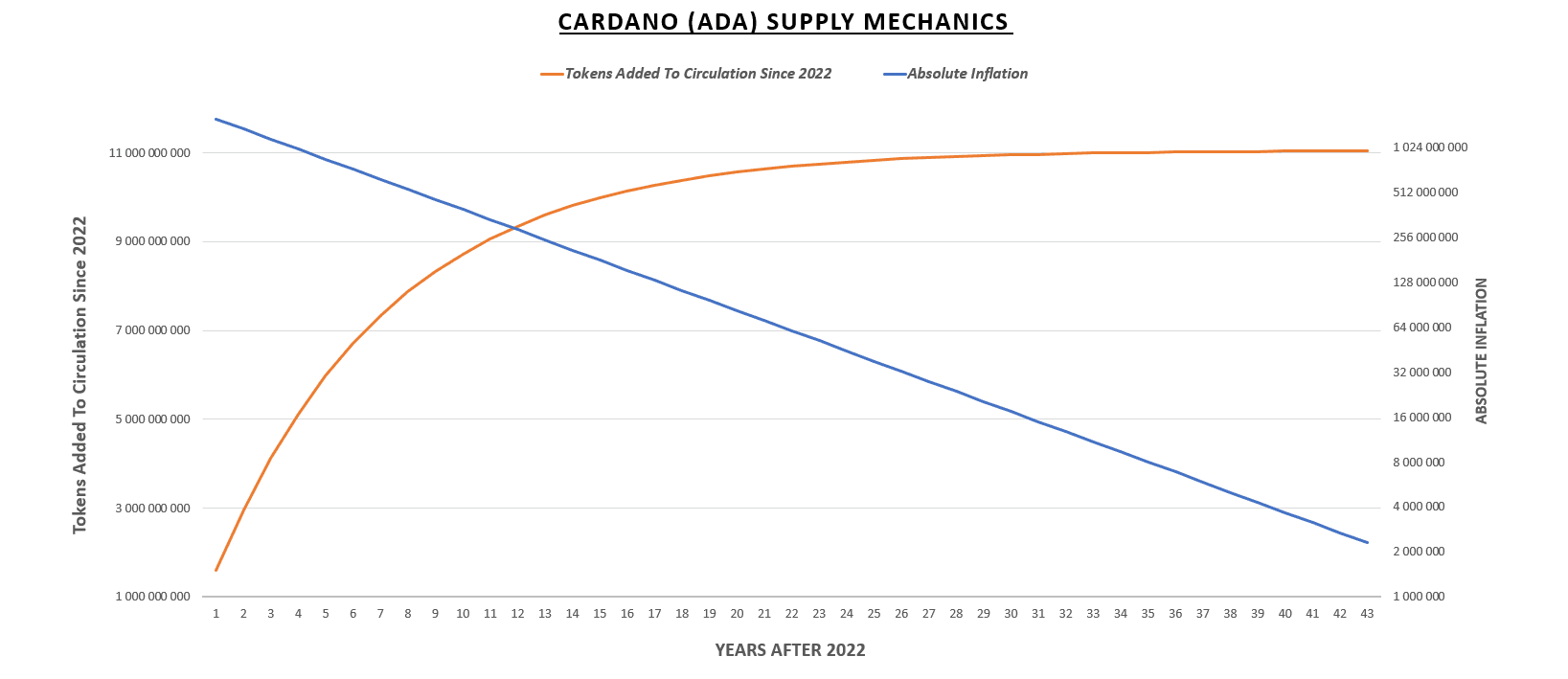
(data used in calculations are taken from Cardano Docs)
Observations based on the chart above:
Given the rules above, the reserve will never be empty, and there will technically always be some inflation. However, the absolute inflation converges to zero at an exponential rate (slower and slower).
It is likely that at some point in the future people will lose more ADA in faulty transactions, forgetting private keys, etc., than the absolute inflation is adding ADA to the supply, effectively making Cardano deflationary.
Lower inflation could make ADA's long-term supply dynamics more stable and support its value if demand held.
To get the inflation in relative terms, i.e., as a percent of the circulating supply, I've made this chart showing how it evolves for the next 30 years:
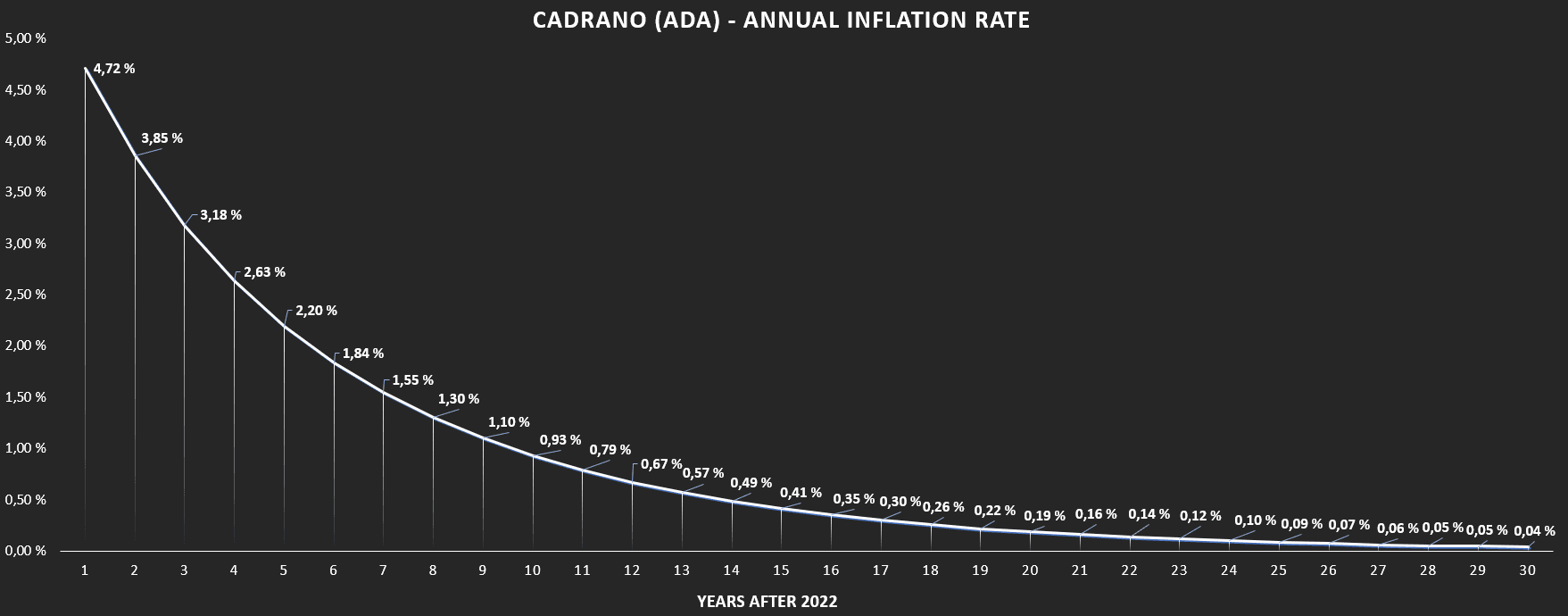
It starts at 4.72% in 2023. After five years it's 2.2%. After a decade, it's 0.93%. After 30 years, the inflation is 0.04%.
The inflation rate of Cardano converges to zero. It decreases exponentially, but will never actually hit zero.
This looks like the inflation rate of Bitcoin, which is also decreasing exponentially. The inflation rate is more choppy in Bitcoins case, due to the halvings every four years, but it's built on the same principle.
This is a key quality of "hard money", and I really like the planned inflation for the ADA.
Related: How Bitcoin halvings affect its supply and price.
Related: Why is Algorand so cheap?
Conclusion: Cardano Was Not Deflationary Under Current Issuance
The modeled inflation rate began at 4.72% per year and declined over time. I assumed 1% of supply was lost annually to human error, which produced net deflation after about 10 years.
In other words:
Cardano was not deflationary at publication. Its supply inflated at 4.72% per year in the model, declining below 1% after a decade. Under my 1% annual lost-supply assumption, net supply became deflationary around 2030.
Related: Cardano fee mechanics.