


(Updated 21. September 2022)
This archived comparison examines Theta and Ethereum by use case, adoption, historical volatility and market size.
Here's the short answer:
At the time, I preferred Ethereum for a lower-risk long-term position and viewed Theta as the more volatile trading asset. Ethereum was also much more established and roughly 160 times larger by market capitalization.
Before getting into the meat of the article, let's begin with a short introduction of the two cryptocurrency projects:
Ethereum is an open-source, decentralized project responsible for the smooth running of several smart contracts and decentralized applications (called DApps) in a safe manner without depending on a third party. Ether (ETH) is the cryptocurrency native to the Ethereum blockchain.
"Ehhh, what?"
Basically, Ethereum is like the internet: People can build stuff like apps and protocols on Ethereum, giving the "stuff" benefits of blockchain technology like decentralization and trustlessness.
I explored a $100,000 Ethereum scenario separately, while another article documents the Ethereum strategy I used at the time.
Theta is a similar blockchain project, but it's built to disrupt video delivery/streaming networks. It's a platform for streams, vloggers, etc. to publish content.
Theta’s innovative platform has been active in the crypto industry since 2017, and aims to be a competitor to various streaming services available today.
One difference between Theta and traditional video platforms such as YouTube was that viewers could earn token rewards for contributing network resources.
The token connected to The Theta Network is called Theta Token (THETA) and is actually an ERC-20 token built on Ethereum.
Related historical analysis: Theta and TFUEL comparison
As mentioned, Ethereum is 160 times larger than Theta in terms of market cap:
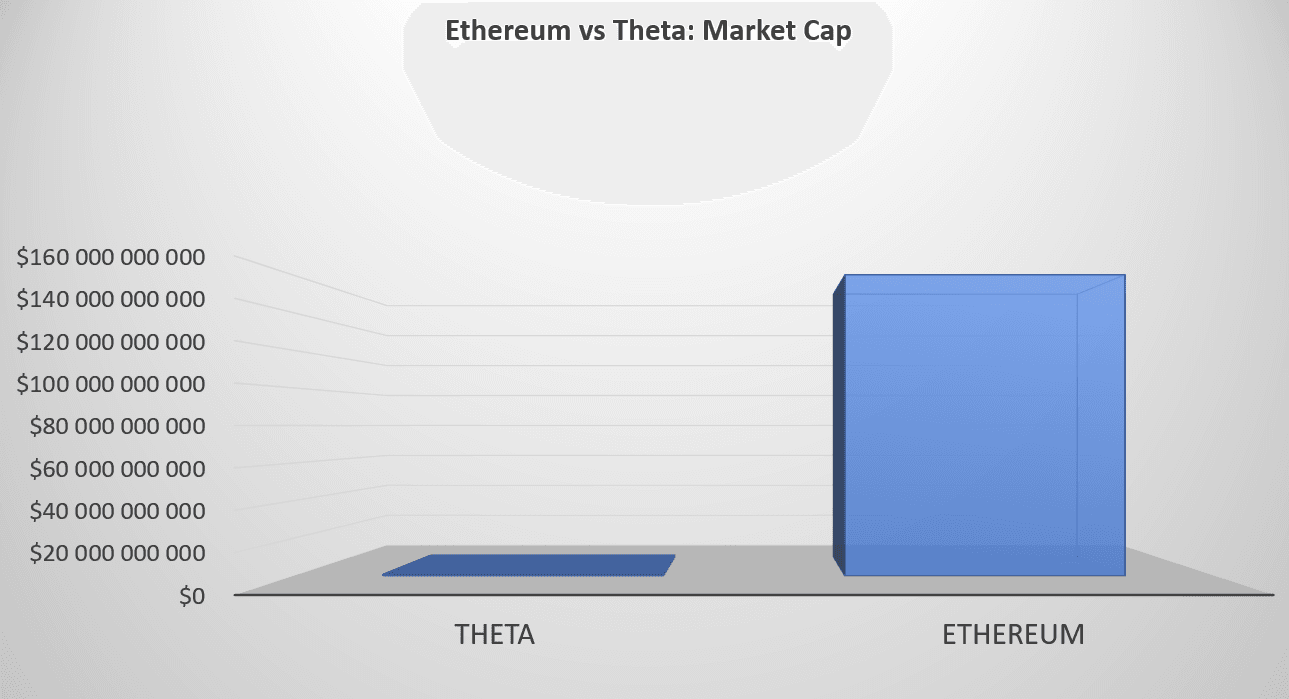
(source: Coinmarketcap)
Theta vs Ethereum – Use Cases and Objectives
Theta and Ethereum differ greatly in terms of use cases and the problems they aim to solve.
Theta's Use Case:
The Theta blockchain rewards users who watch videos on the Theta network for sharing their left-over resources such as bandwidth and computing capabilities. As a consequence, when more people join Theta, the video streaming quality improves. In exchange, viewers receive tokens (Theta Fuel) as incentives.
Theta listed several large organizations as partners, some of which appeared in this historical screenshot from its website:

One piece of partnership evidence was this quote:
“We’re impressed by Theta’s achievements in blockchain video & data delivery. We look forward to participating as an enterprise validator, and to providing Google Cloud infrastructure in support of Theta’s long-term mission & future growth.”
— Allen Day, Google Cloud Developer advocate
Theta's Objectives:
The current scenario of online video streaming has several limitations such as third-party control over all content delivery pipelines. A decentralized project like Theta improves the situation by breaking the traditional and centralized approach.
Geographical limitations make video streaming a hassle for consumers around the world. Theta network’s model is designed to be free from such restrictions and allow people from any corner of the world to partake in its global infrastructure.
Nowadays, different types of video content are available on different platforms; for example, Netflix, the video streaming giant does not support esports, conferencing, etc. But with Theta’s open-source project participants could access not only TV or movies but also peer-to-peer streaming, and education.
Theta’s open-source platform relied on participants contributing resources. This differed from centralized video platforms such as YouTube, Netflix and Amazon Prime Video.
Ethereum's Use Case:
Ethereum is the base layer for other cryptocurrency projects. It is like the internet for websites or the iPhone for mobile apps.
Basically, Ethereum allows developers to build applications on top of it, giving them benefits of blockchain technology like decentralization, resistance to censorship and trustlessness.
For example, almost 60% of the entire DeFi market is built on Ethereum, and 75% of all NFT sales have been done on Ethereum.
For this reason, my thesis was that Ethereum could benefit if the broader crypto market increased in value. I viewed it as indirect exposure to much of the application ecosystem.
With Ethereum 2.0 underway, I expected the network to scale and fees to fall. I thought that could weaken some competitors and reinforce Ethereum's position with developers.
Ethereum's Objectives:
The Ethereum platform is useful for developers who want to build decentralized applications to cater to a wide range of purposes such as digital currency swapping, wallets, etc. Ethereum’s main goal is to facilitate various functionalities by hosting them on its versatile and secure blockchain.
Through DApps, Ethereum could lead several next-generation programs that could function in a decentralized network like Distributed ledgers and Tor. These applications open a world of opportunities and are considered to be the most popular in the blockchain sector.
Ethereum and Bitcoin share some features that have been modified in the Ethereum blockchain prior to implementation. Ethereum also has a strategy (shared by BitTorrent) of having a decentralized OS for the sole reason of creating DApps.
Ethereum exists as a system that gives all of its users total control over their data while also developing and running various applications on its blockchain. Ether (ETH) exists to power these applications.
Theta vs Ethereum – Historical Performance
I'll look at Theta and Ethereum's performance in the last bull market and the current bear market. The examples compare a hypothetical $1,000 purchase in March 2020 with later historical values.
Ethereum's Historical Performance:
Ethereum surged 5,550% in the previous bull market, and it has (so far) crashed 72% in the current bear market:
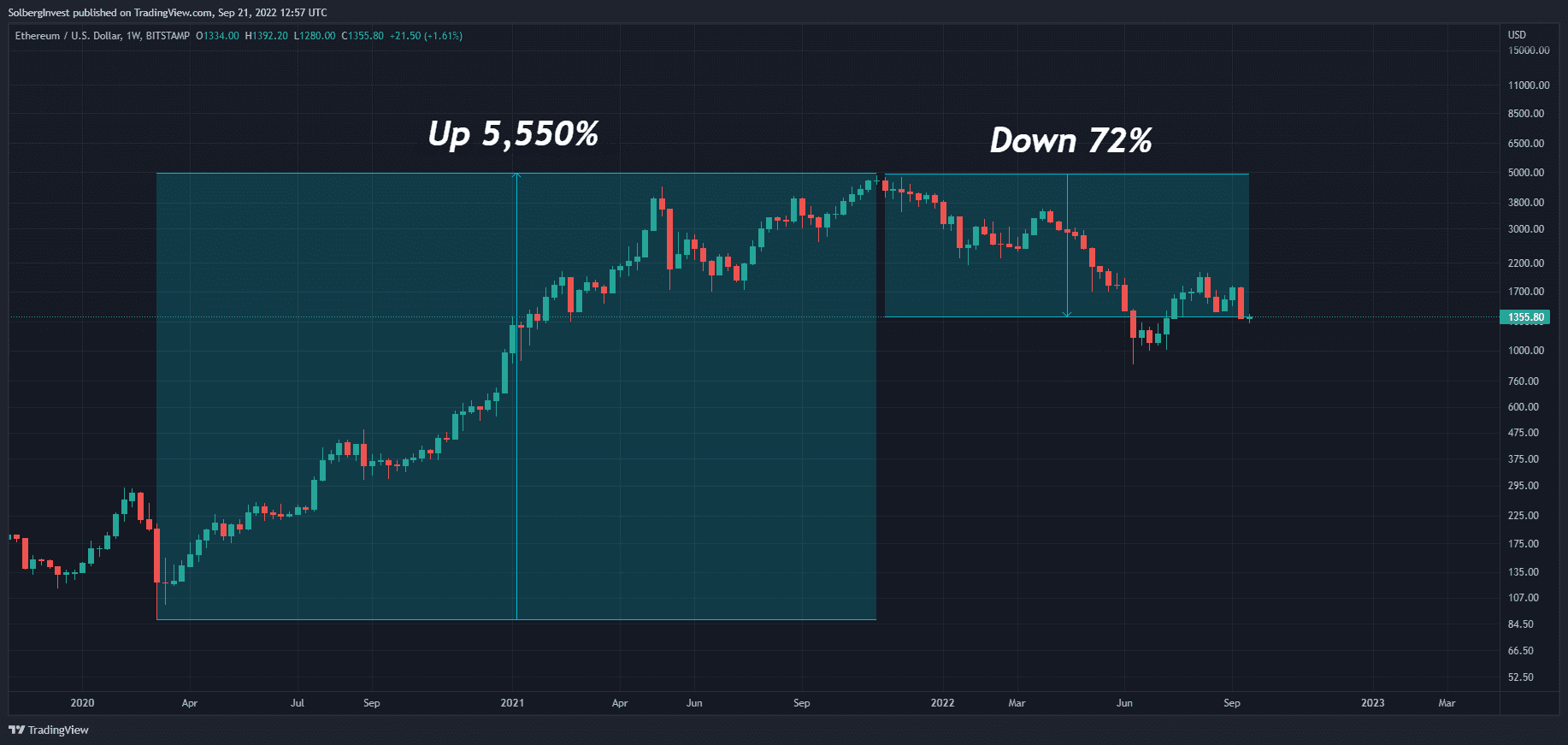
A hypothetical $1,000 Ethereum purchase in March 2020 would have reached $56,500 in November 2021. After the subsequent 72% decline, it would have been worth about $15,800 in September 2022, a 1,480% gain from the starting point.
Theta's Historical Performance:
Theta surged 47,750% in the previous bull market, and it has (so far) crashed 93,5% in the current bear market:
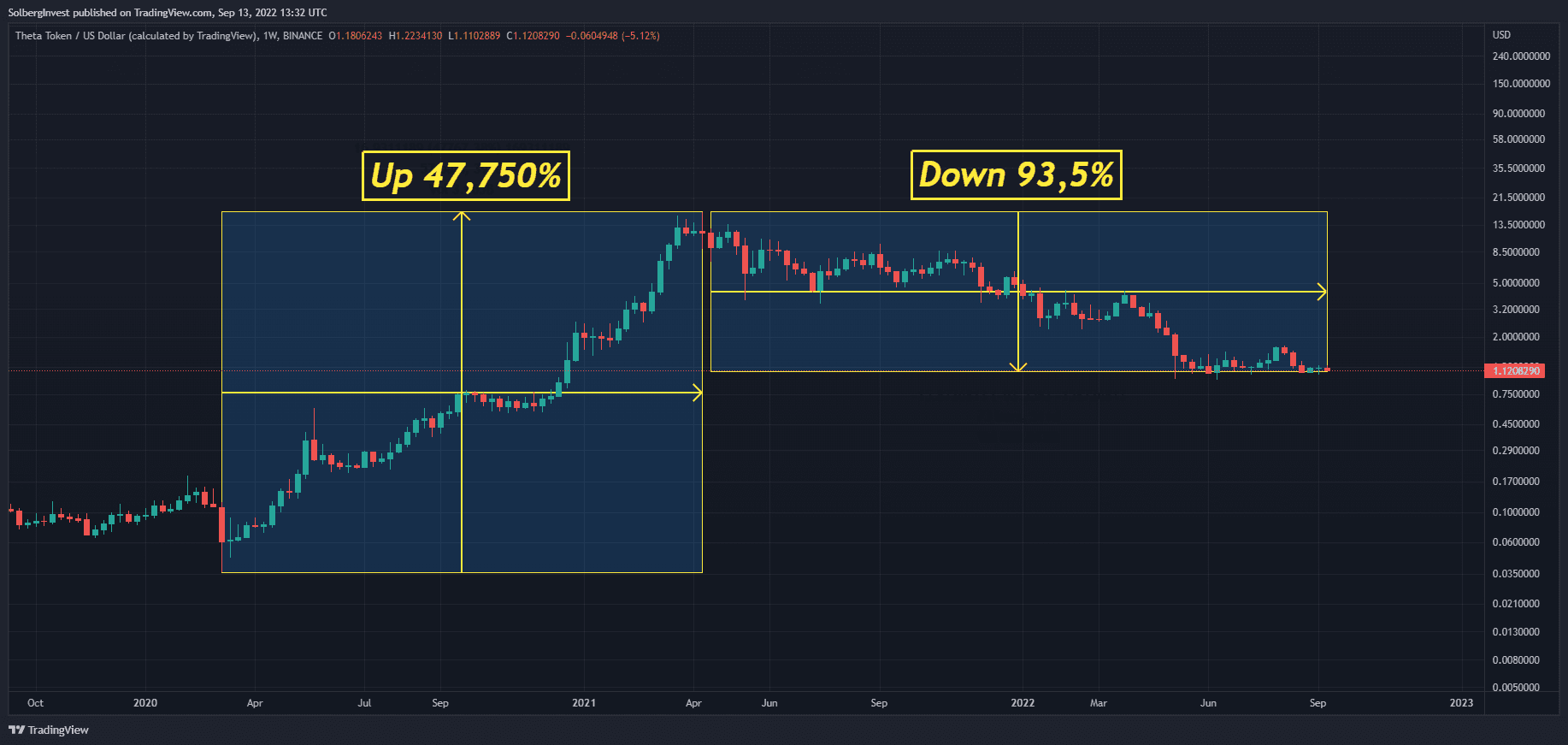
A hypothetical $1,000 Theta purchase in March 2020 would have reached $478,500 in November 2021. After the subsequent 93.5% decline, it would have been worth about $31,100 in September 2022, a 3,010% gain from the starting point.
In this sample, Theta was more volatile than Ethereum. Ethereum was much more established and roughly 160 times larger by market capitalization at the time.
Ethereum had the smaller drawdown in this sample, while Theta had both the larger gain and the larger drawdown.
Future Performance of Theta and Ethereum
Ethereum was supported by a large community that contributed to network development and governance discussions.
The latest hard fork is another example of how Ethereum continues to proceed with a string of improvements in its ecosystem to benefit all users. Ethereum is only overshadowed by the cryptocurrency mammoth Bitcoin that drives the entire market.
If Ethereum 2.0 and sharding delivered the expected scaling gains, I thought many competing blockchains would face greater pressure. Projects like Cardano and Solana still needed to establish large ecosystems of applications, developers and users.
Theta, however, will likely not be negatively affected by the 2.0 upgrade to Ethereum. Theta is not a direct competitor to Ethereum and might actually benefit from the general adoption of blockchain tech that Ethereum 2.0 brings.
In addition, the market that Theta is trying to capture is growing at an accelerating pace, which in turn increases Theta's potential.
It's hard to make future claims about anything, but it's even harder when it comes to cryptocurrencies...
The market and the specific coins move so fast and are highly unpredictable. The only thing to do is to understand the potential pitfalls and the potential of the different coins.
My general thoughts:
Ethereum was well established and had less to prove than Theta. The main risks I saw were a failed or severely delayed upgrade. In that scenario, developers and applications could migrate to another blockchain and weaken Ethereum's position.
The risks for Theta are that it's still relatively new and that anything can happen to this project. They are beginning to establish themselves, but still have a long way to go before reaching "Ethereum status", if we can call it that.
Theta's lack of establishment also created more potential in my view. It had more room to grow than Ethereum in market-cap terms, but carried substantially higher risk.
Conclusion: Why I Preferred Ethereum for Long-Term Exposure
Personally, I preferred Ethereum for a lower-risk, long-term position. I saw Theta as the more volatile candidate for shorter-term trading.
In terms of use-case and objective, they're both fascinating. Theta has more to prove and is not as established as Ethereum, but as a consequence, has more potential as well.
I had invested in both but held substantially more Ethereum than Theta.