Chainflip has a real, growing business and the token has fallen way more than the business deserves. But the risks are big enough that I want to see the TRON hack closed out and FLIP 2.1 live before I consider a small position.
The answer in brief
$FLIP looks like a cheap micro cap with a real business behind it.
Swap volume tripled since January 2025, while the token lost 72%, and the fees buy and burn the coin every day.
In my opinion, it has overcorrected.
But I haven't bought any. A handful of companies control the vaults, the burn is scheduled to end, and insiders can sell into any rally.
If the TRON hack gets fully closed out and FLIP 2.1 ships with clear numbers for stakers, I'll consider a small position.
What Chainflip does
Chainflip lets you swap between native tokens of different blockchains, without wrapping tokens.
"eeeh, what...?"
Most of you 🫵
You see, different blockchains like Ethereum, Bitcoin and Solana are incompatible.
You can't simply swap ETH for SOL.
ETH is a token that only works on the Ethereum blockchain.
SOL is a token that only works on the Solana blockchain.
To solve this, we have "wrapped tokens".
This is essentially like stablecoins, but instead of being pegged to a fiat currency, it's pegged to a token from another chain.
For example, BTC cannot be used on the Ethereum blockchain, so someone made "Wrapped BTC" ($WBTC), which is an "ERC-20 token" pegged to BTC.
You can use WBTC on Ethereum-based applications, like Aave, or Uniswap.
Why would anyone wanna do this?
Because Ethereum has tons of DeFi applications, and Bitcoin has almost none.
So if you wanna lend out your BTC, or swap it for something else, you need to "wrap it" first to make it Ethereum compatible, before using a DeFi application to do it.
The problem with wrapped tokens is that someone has to hold the real BTC behind the WBTC.
If that someone messes up, your WBTC is worth nothing.
Chainflip skips the wrapping.
It holds real BTC, ETH, SOL, USDC and USDT in vaults, and swaps between them.
You send real BTC to an address, and real ETH shows up in your wallet on the other side.
No wrapped coins, no minting, no burning.
(The vaults are controlled by Chainflip's validators together, so there is still someone holding your coins for a moment. I'll get to who those validators are further down.)
Why is this valuable?
Because going from one native token to another is a nightmare involving centralized exchanges, multiple transactions, significant slippage, and tons of fees.
Think about it. To go from BTC to SOL the old way, you send your BTC to an exchange, wait for confirmations, sell it, buy SOL, and withdraw it again.
Four steps, four waits, and the exchange knows who you are the whole time.
Chainflip does it in one step, fast, cheap and without KYC.
(Cheap means the 0.1% network fee plus the normal gas on each chain and whatever spread the market makers take. So 0.1% isn't your whole cost, but it's close.)
Now, bridges are also used for hiding money, because moving funds across chains makes them harder to track.
In the recent hack of Binance, the stolen money was pushed through cross-chain swaps to make it harder to follow. Elliptic traced part of it going through THORChain, which is Chainflip's closest competitor.
Chainalysis and Elliptic followed that money across chains within days.
Still, who knows... there might be some regulatory challenges here down the line.
As far as I can tell, MiCA (the strict crypto regulation we have in Europe) leaves out services that are fully decentralized with no company in the middle. Whether Chainflip counts as that is an open question, and I'd guess it'll be years before regulators bother with it.
They also have permissionless lending, and some other "side hustles" or early-stage products/experiments they've launched.
But the business is swapping. That's where the money comes from.
Their business is swapping native tokens
They charge a fee on each swap.
Every swap pays a 0.1% network fee.
In October that fee added up to $403K, a record month.
Multiply by twelve and you get about $4.8M a year.
The whole coin is worth $27M.
So you're paying less than 6 times the yearly fees for the whole business.
Two things to be clear about here.
First, the fee is the whole revenue. There's no cost line below it that I'm hiding. 100% of the 0.1% goes to buying $FLIP on the market, every day. More on that below.
Second, this is one record month times twelve. The chart below shows the fees jump around a lot from month to month, so the honest range is somewhere between $3M and $5M a year, depending on which months you pick.
Even at $3M, you're paying 9 times the fees. For a growing business, that's still cheap.
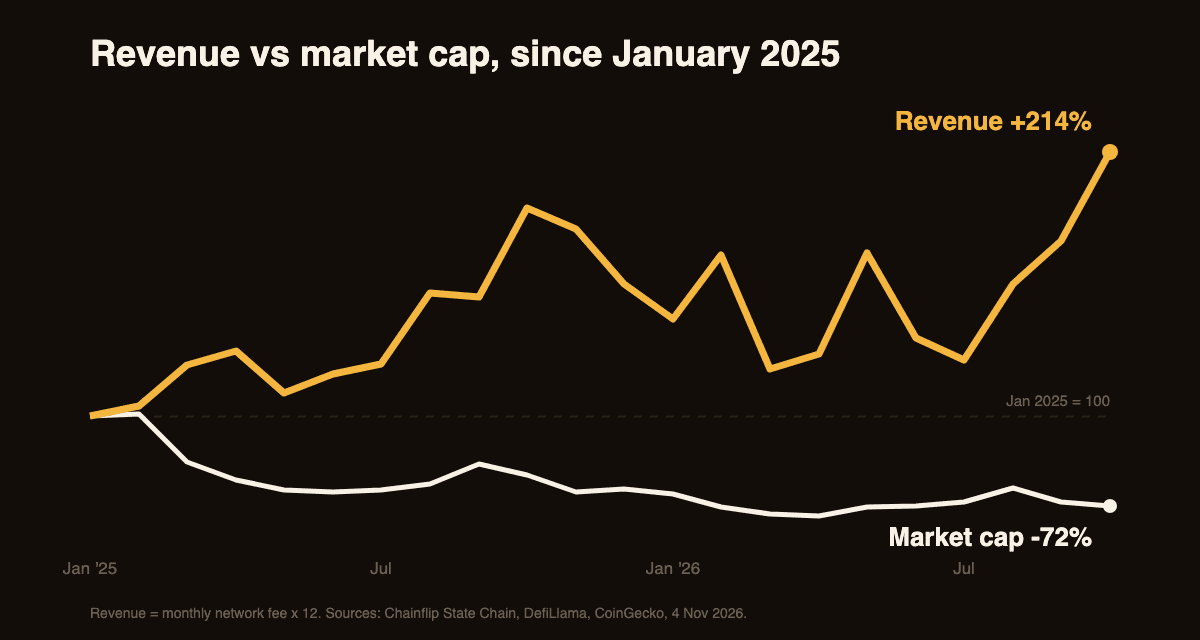
Here's the revenue vs market cap since January 2025:
Look at that chart for a second.
In January 2025 the market cap was $95M and the fees were running at $1.5M a year.
Now the market cap is $27M and the fees are running at $4.8M a year.
The two lines are going in opposite directions.
In January 2025, you paid 63 times the yearly fees.
Today, you pay less than 6 times.
... why?
Why the price fell 72%
I dug into this, and the bear market is only half the answer.
First, the chart starts in January 2025, which is kind to the token.
The real top was December 2024, at $238M market cap.
FLIP went up 63% in seven days, together with basically all other altcoins at the time.
30 days after the peak, it had lost 60%.
So a big part of the "crash" was just a hype spike getting unwound.
We also need to remember that 2025 was a bear market for altcoins, even though Bitcoin went up.
Especially the first half, when Trump started talking about implementing tariffs.
From January to June of 2025, the average altcoin fell 46%.
Bridge tokens, the sector $FLIP sits in, fell 63%.
$FLIP fell 68% during that time, roughly aligned with the sector.
So during the worst stretch, FLIP didn't do anything special. It fell with everything else.
Part of the fall comes from the bear market, and the rest comes from selling by people who got in early.
In November 2024 the investor lockups ended.
Over the next six months, 16M $FLIP came out of vesting contracts, and about 8M of that went straight to exchanges, probably to be sold.
8M coins is almost 10% of the whole supply, dumped into a market that trades a few hundred thousand dollars a day.
The team saw it too.
In May 2025 they wrote that "the market now isn't responding to the buy and burn", and announced a redesign.
That redesign is the FLIP 2.1 I'll get to further down.
(2.1 still isn't live.)
The best summary came from one of Chainflip's biggest liquidity providers, on X in April 2025:
"Cool protocol, I like using it, works very well, but don't want to own the token."
This was after an 80% crash, investor offloading after vesting, and a bearish quarter (due to Trump's trade wars) in general.
So... it kinda makes sense the price fell 70%+ since January 2025.
A hype top, a sector-wide bear market, and 16M coins unlocking at the worst possible time.
None of that has anything to do with how the product is doing.
Why I think it has overcorrected
The business tripled while the price fell 72%.
As mentioned, Chainflip is in the swapping business.
The main metric of success (and driver of revenue) is swap volume.
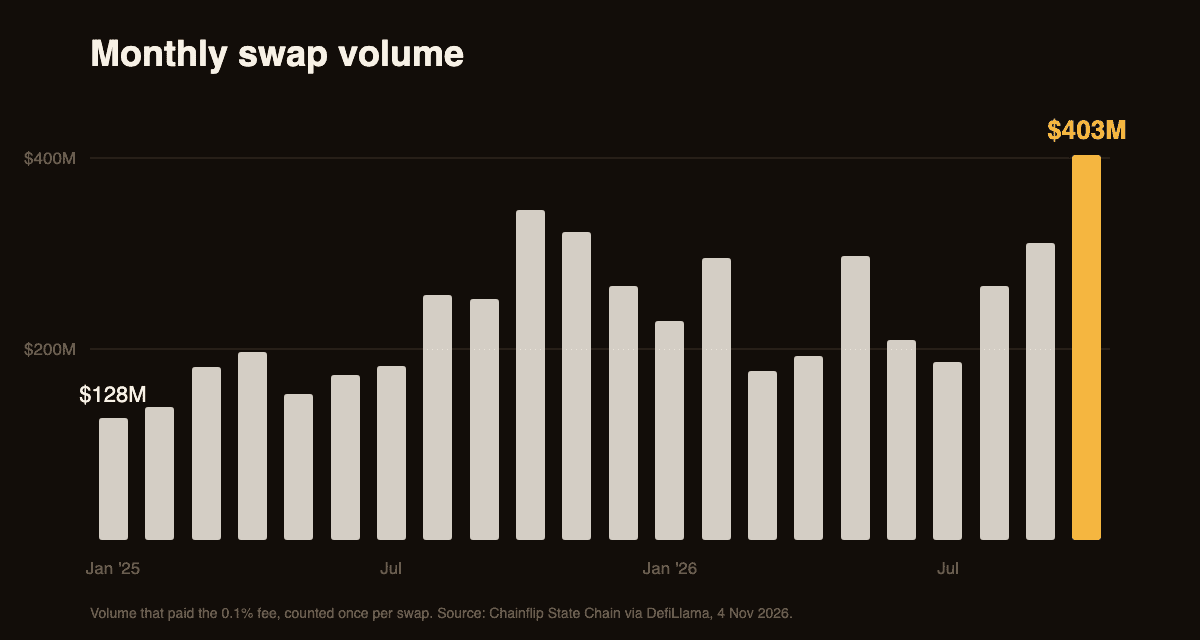
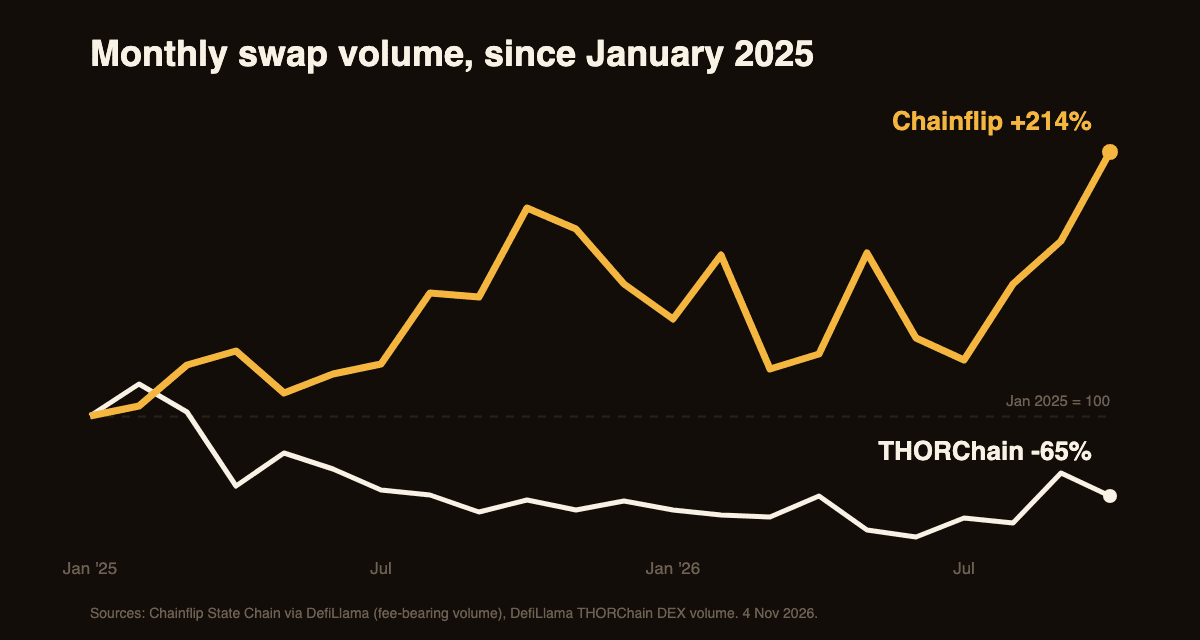
Here's the volume that paid that fee, month by month:
It's up roughly 3x since January 2025, and put in a new ATH in October.
Just the last three months it grew from $266M, to $311M and $403M.
Not "rocketship" growth, but considering the general sentiment in the market, this is WAY above the norm.
Remember, this was a bear market for altcoins. Most protocols in the sector saw volume fall by half or more (I'll show you below).
Chainflip's went up.
That means people kept using it when they had no reason to speculate on it.
(btw, DefiLlama shows almost double these numbers, because it counts both halves of every swap. I'm using the half that paid the fee. Chainflip's own quarterly report also counts per routing leg, so be careful comparing numbers from different places.)
Now, the counter argument.
The vesting is done. The hype is gone. The selling from early investors should mostly be over.
So why hasn't the price responded to the growth yet?
I think the liquidity provider's quote above is still the answer. People like the product and don't trust the token.
The reasons they don't trust it are the four risks at the bottom of this article.
The business is clearly cheap. What I need to figure out is whether the risks are big enough to justify a $27M price tag on a business doing almost $5M in fees.
Before we get to the risks, let's see how the competition is doing. Because "cheap" only means something compared to the alternatives.
How Chainflip compares to the competition
THORChain is the closest competitor.
It does the same thing, native swaps including real Bitcoin, with its own vaults.
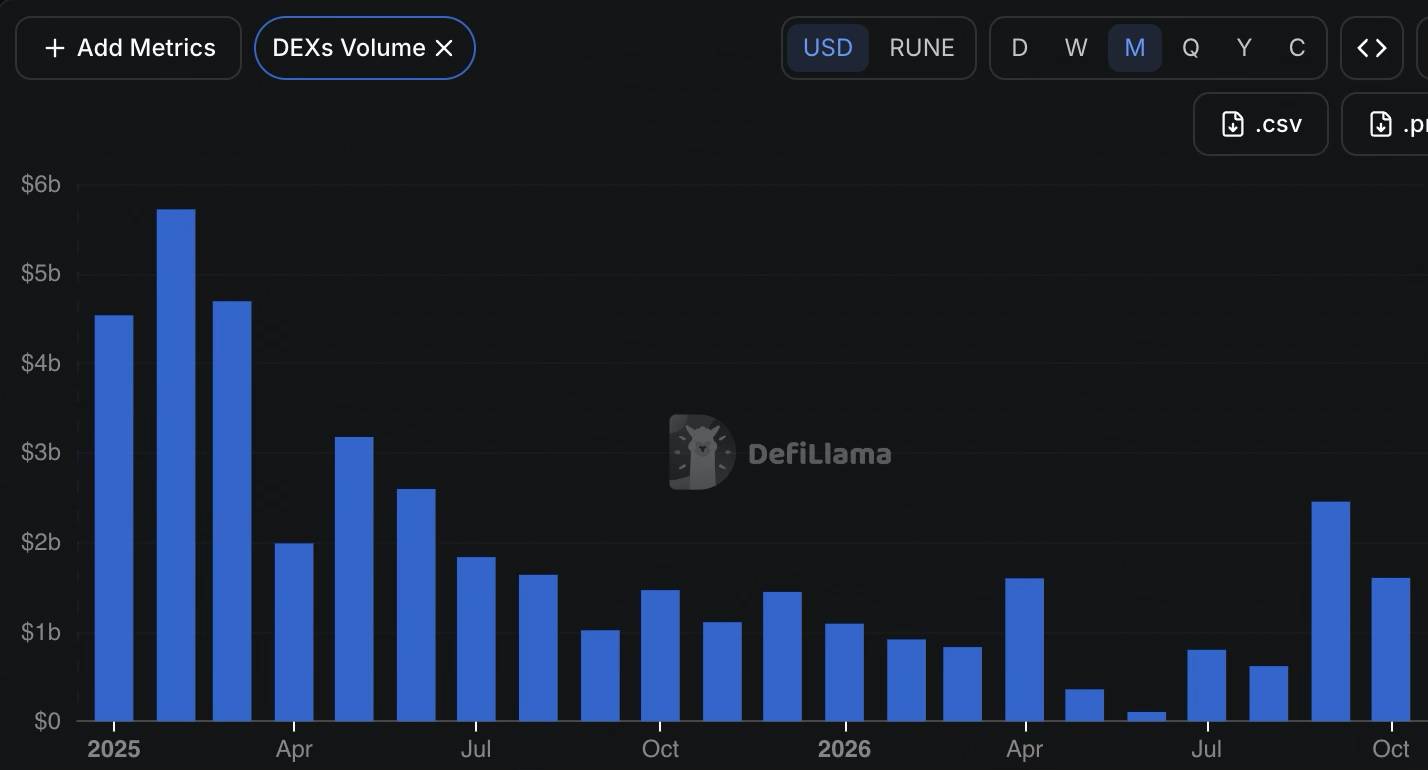
THORChain did $4.5B of swaps in January 2025.
In October 2026 it did $1.6B.
Chainflip went from $128M to $403M in the same period.
And the market values THORChain at $208M, almost 8 times Chainflip.
So THORChain is still bigger in volume, 4 times bigger. But it's shrinking, while Chainflip is growing.
Then there's LayerZero, the biggest name in the sector.
It's the plumbing behind USDT0 and PayPal's stablecoin, and its market cap is roughly $750M.
Over the last twelve months, LayerZero spent $3.7M of bridge fees buying $ZRO (their token). The coins are sitting in a company wallet.
Chainflip's token got $3.2M of swap fees, and every coin it bought was burned.
Roughly the same buy-backs, but $ZRO is 27x more expensive.
So why is Chainflip so cheap...?
Because LayerZero and Chainflip aren't really the same business.
LayerZero doesn't hold any coins.
It passes a message between chains, "100 USDT was locked or burned on Ethereum, mint 100 on Arbitrum", and the issuer does the minting.
That's why it works on 160 chains, and why its customers are Tether and PayPal, not traders.
It's also why it can't touch native Bitcoin.
There's no company behind BTC to receive the message and mint you a new one. LayerZero can move wrapped versions of BTC, but then you're back to trusting whoever holds the real BTC.
Chainflip is the opposite.
It holds real BTC, ETH and SOL in its vaults.
There's no wrapping, burning, or minting of coins. It simply swaps between the tokens using their vaults as liquidity.
If LayerZero is the postal service, Chainflip is an exchange desk with the cash in the drawer.
The only place Chainflip loses to competition is moving stablecoins between chains.
Circle (company behind USDC) does it with no protocol fee on standard transfers.
But if you want to turn BTC into ETH, SOL or dollars without a custodian in the middle, Chainflip is the way to go.
To be fair, THORChain can also do that, and its usage is shrinking.
(THORChain also burns some of its token from system income, so Chainflip isn't the only one burning. But THORChain's burn sits on top of a shrinking business.)
And then there's deBridge, which I've used a lot myself.
It's faster than Chainflip, and it works on 18 chains.
But it can't touch real Bitcoin either.
It's a "solver model", and there's nothing on Bitcoin for a solver to plug into.
Furthermore, its cross-chain volume is down 80% in a year, from $1.5B a month to $311M.
In October, Chainflip did $403M.
So Chainflip moved more cross-chain volume than deBridge.
Oh, and $DBR also buys back tokens with 100% of its fees.
But the coins just sit in a foundation wallet (not burned), 707M of them so far, while 618M new ones unlock every quarter.
So the buybacks don't come close to keeping up with the unlocks, and $DBR hit an all-time low today...
Which leaves Chainflip as the only one in this group that's growing, and the only one that burns everything it buys.
So compared to the alternatives, you're paying the least for the only business that's getting bigger.
You've just seen why a 6x fee multiple only means something next to THORChain, LayerZero and deBridge, and why "same buybacks, 27x the price" is the comparison that actually matters. That way of lining up a token against the alternatives, business model first, is how Oskar approaches every fundamental write-up, not just this one. The Solberg Invest community is where he keeps that work going between articles, so the people following along see how a thesis like this holds up as the numbers move. If you found the competitor breakdown useful, that's the part worth following over time. See how the Solberg Invest community works
How much $FLIP are they burning?
This is the part that makes FLIP different from most coins with revenue.
The 0.1% fee doesn't go to a treasury or a team.
It buys FLIP on the market and burns it, every single day.
Validators get paid in new FLIP, so there's some inflation on the other side.
But for the last twelve months, burns were three times bigger than the new coins.
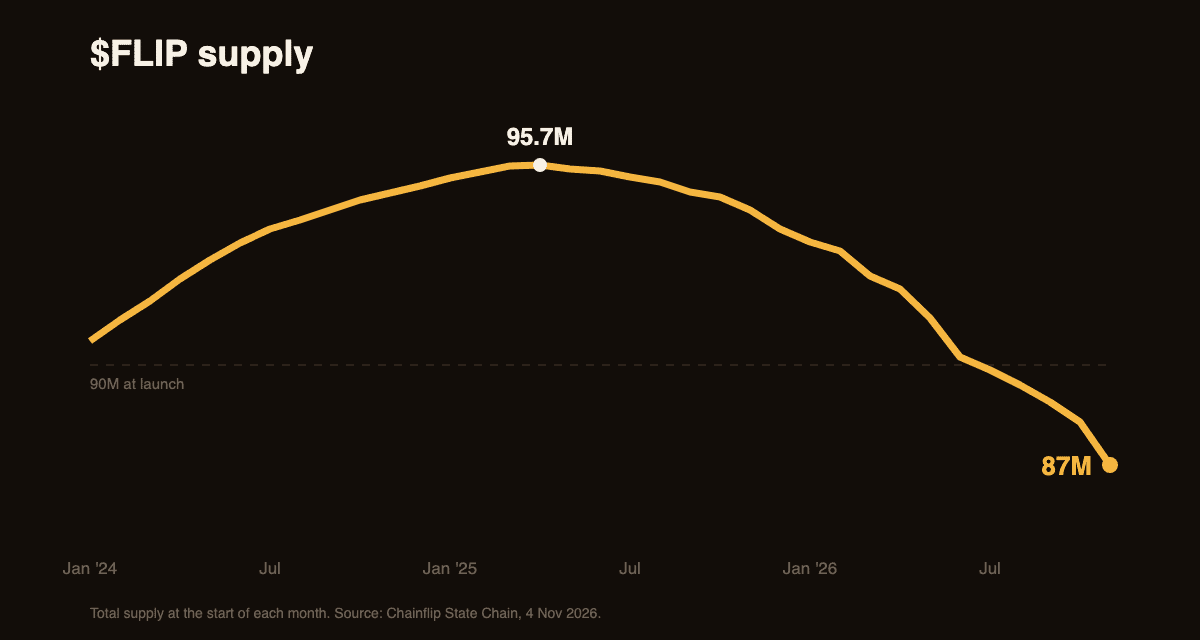
The supply peaked at 95.7M FLIP in April 2025.
There are 87M today.
Over the last year the supply is down 7.6%, which is good for holders. In June it dropped below the amount it launched with.
Look at the shape of that chart.
The supply went up for a year after launch, because validator rewards were bigger than the burn.
Then the fees grew, the burn overtook the rewards, and the line turned down.
And the line is getting steeper, because the fees keep growing.
So fewer coins, and more fees per coin.
This matters for how you should think about the price.
If the business stays flat from here, you still own a bigger piece of it every month.
If the business keeps growing, you own a bigger piece of a bigger business.
... which is why it's a problem that they're planning to change it.
Risk 1: the burn is scheduled to end
Four risks, read all of them before you do anything.
Chainflip announced FLIP 2.1 in March.
It will stop printing new tokens (good)
But it will stop burning the tokens they buy back (bad, kinda)
They WILL keep buying back tokens (good)
But instead of burning them, they'll pay it to stakers (neutral)
(The team also says the change is reversible. If network security needs it, they can turn emissions back on.)
Choosing to pay buy-backs to stakers is a rich-get-richer mechanism if the ownership is concentrated...
But the fact that it's funded by buy-backs instead of newly issued coins makes it ok.
Think about it:
If they printed new coins to send to stakers, a few things happen:
Casual holders that don't stake get diluted over time, owning less and less of the total supply.
The large stakers get more and more of the supply.
So issuing new tokens to fund participation in the system makes the rich richer and the poor poorer.
It leads to concentration of wealth.
(does this spiral remind you of something? hint: the fiat system)
But since Chainflip funds this with real buy-backs, casual holders won't get diluted.
The yield would likely be in the 10% range, at current burn rates.
"10% is nothing, lol"
Some of you, maybe?
Well, you have to remember the 10% is "multiplicative" not "additive".
You get paid in $FLIP, not in cash like a regular dividend.
And with $FLIP being a micro cap, everything can happen price wise.
Say $FLIP goes 5X over the next two years.
If you get a 10% APY, paid in $FLIP, that gives you a 21% yield over two years (1.1^2 = 1.21).
Since it's paid in $FLIP, the price of your 21% payout has gone 5x.
So the cash yield you get is 21% * 5 = 105%.
An investment of $5,000, with a 10% yield, therefore gives you $5,250 just from the staking.
After the 5X rally, your $5K investment turned into:
Without staking: $25,000
With staking: $30,250
(btw, staking is often taxed as income, instead of capital gains, so check your local rules if you wanna stake)
One thing to keep in mind with that math. The buy-back is a fixed dollar amount, the fees. So if the price goes 5X, the same fees buy 5 times fewer coins, and the yield in FLIP terms drops. The example works if the fees grow with the price, which they should if the volume keeps growing.
"Wow, ok staking seems more interesting than I thought!"
You, hopefully!
Oh and it gets better.
There are ways to boost your yield, especially on more established coins like Solana and Ethereum.
I won't get into it here, but I'm formulating my own yield strategy behind the scenes these days.
I'm focusing on BTC, ETH, SOL, TAO and USDC.
I'm aiming for long-term, safe ways to boost yield on the above.
And know that I'm coming from a conservative space when it comes to yield.
I chased yield on BTC in Celsius, which went bankrupt in 2022 due to mishandling of user funds, which led to a personal loss of 2.5 BTC.
Serious capital for a 24-year-old.
It got even more serious when I got a tax bill of $25K on the gains I made the year before, which regrettably I planned to pay with funds in Celsius (rookie mistake... don't risk your tax money!!!!!!!!)
Thank God I took profits along the way, enough for the down payment on a rental apartment I bought in February of 2022.
Anyways... back to Chainflip!
The day that switches on, the supply chart above stops going down, and the reason to own the coin changes.
Right now you own FLIP and benefit from the shrinking supply automatically. After 2.1, you only benefit if you stake it, since that's how the buy-backs get paid out.
If you don't stake, you get nothing. The supply stays flat and the buy-backs go to other people.
So if 2.1 goes live, holding FLIP in a wallet and forgetting about it stops being a strategy.
Risk 2: who controls the vaults
Chainflip says 150 validators hold the funds.
100 of them need to sign before anything moves out of the vaults.
I had a look at who runs them.
13 companies run 146 of the 150, and the top 5 run 100 of them, so 5 companies control Chainflip.
100 is the number needed to sign anything.
59 of the nodes sit at one hosting company, OVH.
This essentially means the system is centralized... for now.
That's the norm with micro caps tho, usually growing more decentralized over time.
But let's be clear about what it means today.
If those 5 companies agreed to, they could move every BTC, ETH and SOL in the vaults.
If OVH went down for a day, more than a third of the network goes down with it.
And there's already been a scare. In early September the team said three validator accounts had tried to mess with the key-handover process. They say they fixed it, no funds were lost and no keys were exposed.
That's the team's own account, I have no way to verify it.
Remember the whole pitch is "no custodian in the middle".
Right now, there is one. It's just split across 5 companies instead of 1.
That's a lot of trust in a few people.
Risk 3: it got hacked in September
On 12 September someone tricked the TRON side into paying out the same USDT twice.
Someone attached a manipulated memo to a transaction that was already signed, and it triggered an extra refund.
Six withdrawals got paid twice. $736K gone, and the whole network was paused for four days.
The team published an incident report the next day, and a technical explanation plus a restart plan two days after that.
So there is a public report on what happened. I got that wrong in the newsletter.
What I still haven't seen is the ending.
The team said users would be made whole. The restart plan says the affected liquidity providers got their losses recorded as claims, to be sorted out with them.
I haven't found confirmation that those claims have been paid, or where the money came from.
For a protocol that holds other people's BTC, that's the part that matters.
(somewhat of a red flag - we wanna see audits when they push new code!!)
On that note, the last public audit I can find is a Solana audit from August 2024.
Since then they've added TRON and lending, and I can't find a public audit covering either.
The TRON hack happened on exactly the kind of code that wasn't audited.
So they've shipped new chains without an audit before, and that's exactly where the hack happened.
Until that changes, every new product they launch is also a new way to lose the vault money.
Risk 4: insiders can sell into any rally
26% of all FLIP sits in one multisig wallet that's almost certainly the treasury, and it's not locked.
That wallet has sent coins to Bybit twice, probably to be sold.
Another 7% is in old investor contracts that are vested and claimable today.
So a third of the supply can hit the market whenever its owners decide to.
And the coin only trades about $140K a day.
Bybit delisted it in July. The notice didn't give a reason, just a periodic review. That's usually down to low volume, not because it's a scam or anything.
But it means one less place to buy and sell, and even thinner liquidity.
If a big holder sells, there's nobody on the other side.
This is why the price can fall even when the business is doing great.
The treasury can sell whenever a rally gives it a decent price.
So if you ever see $FLIP pump 50% in a week, remember who's sitting on 26% of the supply, and check whether that wallet moved.
This watchlist only pays off if someone keeps checking it
Oskar just laid out five conditions he's waiting on, in order, from the TRON claims being paid to a weekly close above $0.34. None of those resolve today. They play out over months, and the answer on $FLIP changes as each one lands or fails. That ongoing read is what the Solberg Invest community is built around: Oskar sharing how his view on names like this evolves as the evidence comes in, rather than a single snapshot. If you want to see whether these conditions line up, and what he does about it when they do, that's where the thinking continues. Learn about the Solberg Invest community
Bottom line
All in all, $FLIP is extremely risky.
It's a micro cap, with tons of ways it can fail.
Heck, Chainflip doesn't even have to fail for the price to go down. The systemic risk of simply being a cryptocurrency is enough to kill it.
Still, it's got real traction though, and good tokenomics.
The business tripled while the price fell 72%.
The four risks are the reason I haven't bought.
Definitely worth a place on the watchlist, maybe a small bet in the near future.
P.S. More of a curiosity than analysis
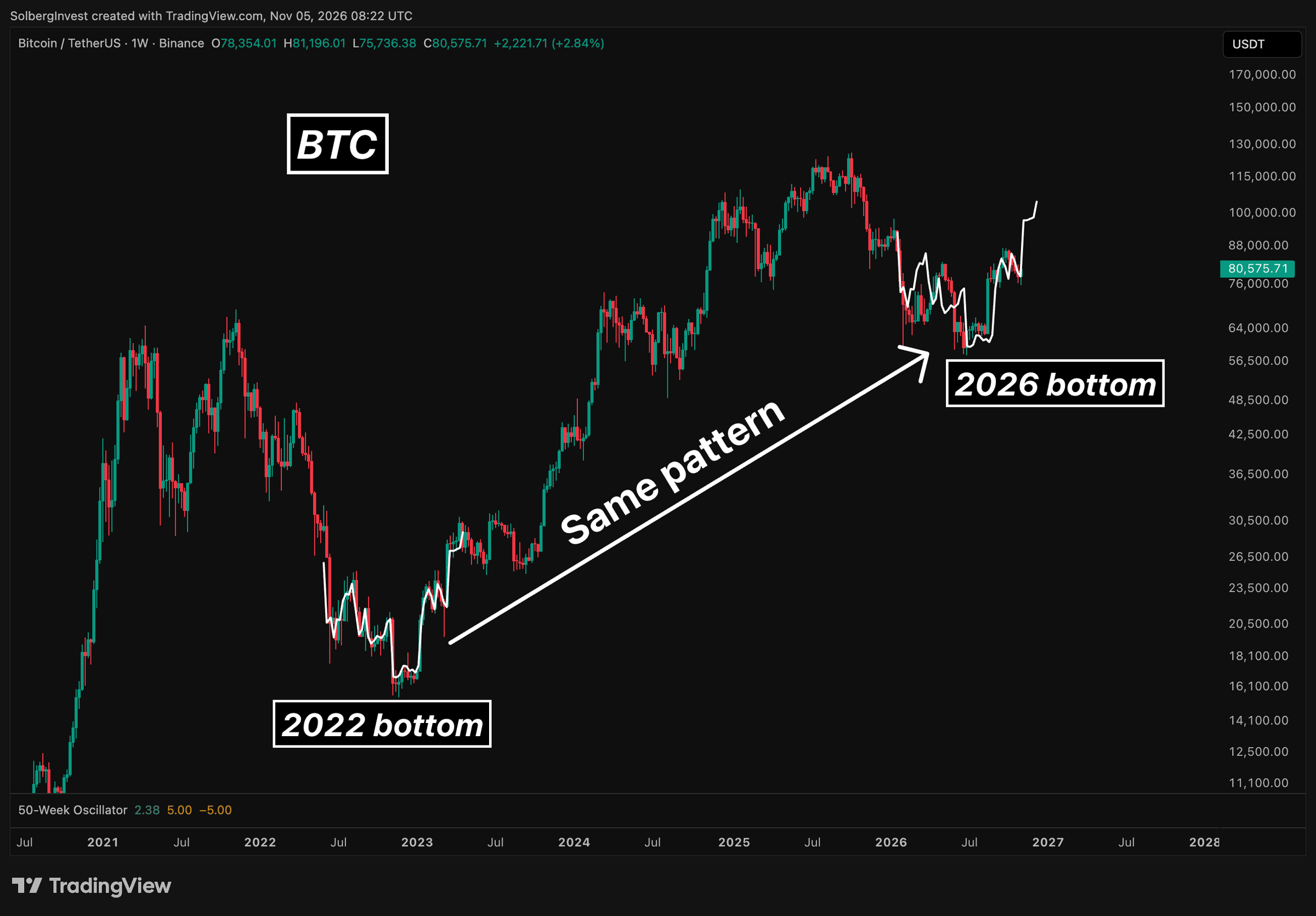
We seem to be repeating the pattern of the 2022 bear bottom:
The white line is the shape of the 2022 bottom, pasted onto the 2026 chart.
Bitcoin is at $80,575 as I write this, and the shape of the last few months looks a lot like the chop around the 2022 lows before the 2023 rally.
I'm not trading on it. Patterns like this look obvious in hindsight and rarely play out the same way twice.
But if the market is bottoming, that's the "general sentiment improves" part of the $FLIP thesis.
And micro caps with real traction tend to be the ones that move the most when it does.