

(Updated 11. September 2022)
Over the last few years, there has been a lot of debate in the crypto space regarding proof of stake vs traditional mining. Many new blockchains use this consensus mechanism and some major chains like Ethereum are transitioning from proof of work to proof of stake. But as miners usually rely on proof of work mining rewards, will proof of stake kill mining?
At the time, I expected proof of stake to displace mining for many projects, with block rewards moving from hardware operators to validators with staked capital. I did not expect Bitcoin to transition soon.
In this article, I’ll expand upon proof of stake and its benefits compared to proof of work. I’ll also examine the impact of proof of stake on mining.
Proof of Stake VS Proof of Work:
Before diving into the nuance of proof of stake’s advantages over traditional mining, let’s first understand some key definitions:
What Is Proof of Stake
Proof of Stake is a consensus mechanism where network participants (stakers or validators) validate block data by risking their capital.
Validators earn block rewards relative to their proportion of total staked capital. For example, by staking 1% of total capital a validator would earn 1% of the rewards.
Proof of Stake is theoretically less capital intensive as there are fewer hardware and energy costs. However, some chains have a minimum stake. For example, Ethereum will require validators to stake a minimum of 32 ETH.
Proof of stake relies on financial incentives rather than energy expenditure to secure the network. Validators acting maliciously have their capital ‘slashed’ (ie, deducted).
It is typically faster and more efficient than proof of work. Later in the article, we will examine the environmental benefits of proof of stake.
Examples include Ethereum 2.0, Cardano, EOS.
What Is Proof of Work
Consensus mechanism where network participants (miners) validate block data by competing for mining rewards via energy expenditure.
Native token rewards are paid to miners. For example, Ethereum miners receive ETH, and Bitcoin miners receive BTC.
Miners earn rewards by spending energy on complex mathematical problems. It is this energy expenditure that acts as the ‘proof of work’.
Mining is very capital intensive. Miners must pay for expensive GPUs and other hardware upfront, as well as electricity.
This mechanism, therefore, ensures network security by making it very expensive to control or attack the network
Examples include Bitcoin, Dogecoin, and Litecoin.
Some Differences Between PoS and PoW:
Block rewards (what miners/stakers get paid) are paid out very differently in proof of work compared to proof of stake:
‘Mining’ in the traditional sense, PoW, refers to systems where participants are rewarded for spending energy to secure the network. They are "paid" block rewards to compensate them for their time and expense.
Proof of stake does not have this traditional form of mining. Instead, validators earn block rewards by staking capital as they validate network data. Its hardware and energy requirements are lower, while staked capital can be penalized when validators make errors or act maliciously.
In summary, the main difference between PoW and PoS is that in PoW miners earn rewards through work and energy output, while in PoS "miners" earn rewards by risking capital.
I considered proof of stake more energy-efficient and potentially more accessible to validators, although the decentralization tradeoffs were less clear.
At the time, I therefore expected proof of stake to displace traditional mining in many networks. Ethereum's transition would remove its proof-of-work block rewards, ending that revenue stream for Ethereum miners.
These miners had strong financial incentives to resist the change to proof of stake. Some observers suggested that miners might support a hard fork that retained a proof-of-work version of Ethereum.
Even though I expected PoS to displace mining in many cases, I did not expect Bitcoin to transition. The article Will Bitcoin Be Proof of Stake In The Future? explains that view.
Is Proof of Stake Better For The Environment Than Proof of Work?
Proof of stake has been in the news recently as being "a green alternative" to proof of work. This intuitively makes sense, given that proof of work intentionally burns energy as a feature.
While proof-of-stake chains still use energy, this is not central to their security model. The proof-of-stake networks discussed here generally used less energy than comparable proof-of-work networks.
PoS vs. PoW - Energy Expenditure:
Danny Ryan, a lead Ethereum Foundation researcher, estimated that Ethereum's energy expenditure would drop by 99.9% after shifting from proof of work to proof of stake. The estimate is illustrated below.
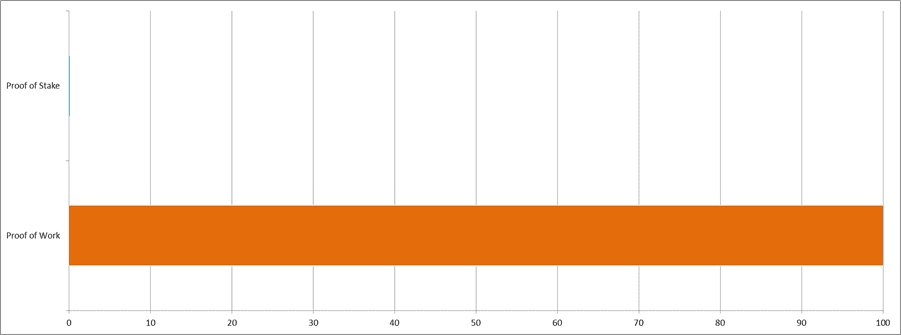
Ethereum energy expenditure under proof of stake and proof of work
Many proof-of-stake chains had lower energy use than their proof-of-work counterparts.
If we use energy consumption as a proxy for the environmental impact, we can therefore conclude that proof of stake is far greener than proof of work. However, is this assumption fair?
I believe greater nuance is required to assess proof of work's environmental impact.
Proof of Work's Environmental Impact:
It is true that proof of work consumes extreme amounts of energy. Bitcoin mining, for example, uses more electricity than some countries at this point.
Below you see a comparison between Bitcoin miners and the country Norway when it comes to energy usage:
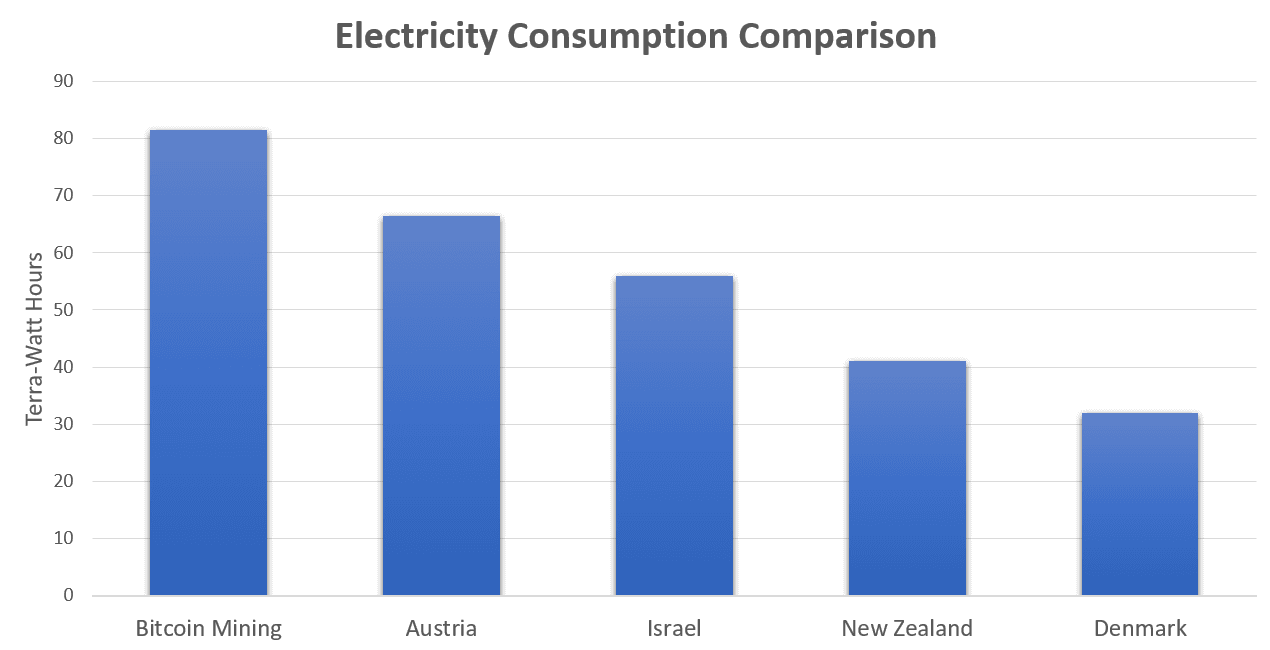
(Data from Oct. 2021)
Most people see charts like the one above and immediately draw the conclusion that proof of work is terrible for the environment, but that's a logical fallacy. Just because something uses a lot of energy does not mean it is bad for the environment.
It is not electricity itself that is damaging. Carbon dioxide and other pollutants emitted during generation determine much of the impact. Some miners used renewable electricity that was inexpensive because of seasonal or regular overabundance.
For example, some Bitcoin mining operations were located near geothermal, solar or hydroelectric generation: A significant share of Bitcoin's hash rate was historically associated with inexpensive Chinese hydroelectricity. In this sense, the environmental impact depended partly on the energy source.
Similarly, some suggest that energy-intensive mining combined with Bitcoin’s rising utility and profile may spur innovation: Because lower energy costs can improve mining margins, some argue that mining creates incentives to develop cheaper energy sources, including renewable generation.
Much of the energy used by proof of work is also isolated and cannot be used for other purposes: It is typically very expensive and inefficient to transport energy over long distances. As such, it isn’t economical to use the energy created a long way from urban centers (eg, at solar plants in the desert). Proof of work can help solve this problem. By using isolated energy by placing miners right at the energy source, proof of work can utilize energy that would otherwise be wasted. Some argue this actually reduces the burden on national grids significantly and allows isolated energy to be used extremely efficiently.
In a philosophical sense, one can compare Bitcoin to batteries, given the argument above. It effectively stores electricity, from remote parts of the world that is inefficient to transport through power lines, in the form of monetary value, which can be "discharged" by using it.
Despite these counterarguments, it is clear that at present, proof of stake has a lower environmental footprint than proof of work. Similarly, the public perception (which often drives commercial decisions) is that proof of stake is green.
Is Proof Of Stake Better Than Proof of Work?
The question of whether proof of stake is better than proof of work is complex. It is more a case of each consensus mechanism having advantages and disadvantages. We need to weigh these in aggregate to subjectively conclude one way or another, and your view may differ from mine.
Let’s, therefore, review the relative advantages and disadvantages of proof of stake:
Advantages of Proof of Stake:
Far lower energy footprint. This was favorable for both environmental impact and public perception, which could influence adoption.
Theoretically more inclusive, as barriers to entry are lower. Ongoing costs are lower and there is no need to invest in powerful hardware upfront. However, as token prices rise, minimum staking amounts increase in USD terms. For example, at $3,000 per ETH the 32-ETH validator requirement equated to $96,000. Staking pools could aggregate smaller positions, introducing a different set of intermediary and concentration tradeoffs.
Some designs can support higher throughput and lower transaction costs. I treated that as one possible adoption advantage rather than a result of energy use alone.
Changes the economics of a majority attack. An attacker would need to control a large share of staked capital and could put that capital at risk. This creates a deterrent, although it does not make attacks impossible.
Disadvantages of Proof of Stake
Can create a "rich get richer" dynamic. The greatest share of rewards goes to the largest capital holders. This is arguable antithetical to crypto’s founding philosophies. Similarly, over time it results in centralization as richer stakers gain a greater network share and consequently greater network influence.
Some critics argue that proof of stake lacks the energy-cost basis they associate with proof of work. Under that view, staking rewards are more dilutive than mining rewards; this remains a debated valuation argument.
Theoretically, proof of stake is less open to small-scale network participants. In practice, this isn’t the case due to the high hardware costs required to be competitive in the mining pool.
Potentially leads to more centralization due to lower competition. In theory, the competitive element of proof of work leads to more decentralized validators. However, again in practice, this does not always hold true as small-scale miners often aggregate their hash power in "mining pools".
Clearly, there is no absolute answer to whether proof of stake or proof of work is better. In my opinion, the environmental and performance-related benefits of proof of stake are very important. Probably more so than the theoretical and philosophical advantages proof of work maintains. This is not an argument that has been settled and both sides have their high-profile proponents.
Conclusion: I Expected Proof of Stake to Displace Mining in Many Cases
To conclude, I expected proof of stake to displace mining across many projects, but not across the board. Bitcoin looked unlikely to move to PoS, while other networks were shifting block rewards from hardware operators to validators with staked capital.
Proof of stake also has other benefits such as cleanliness, media narratives, and network performance. However, proof of work is not obsolete. Many believe deeply that proof of work provides greater value, security, and fairness as a consensus mechanism.