


(Updated 10. September 2022)
In this article, I will describe the similarities and differences between VeChain and Chainlink with the hopes of helping you get a better grip on the two projects, and figure out which you think is better. First of all, here's my opinion:
My conclusion in this 2022 comparison was that Chainlink had the stronger long-term case and lower relative risk. I still considered VeChain a credible project in the supply-chain sector.
I'll explain my position in detail. Here's the agenda for today:
What are VeChain and Chainlink?
VeChain improves supply chain management and provides proof of authenticity for brands.
With VeChain's blockchain solutions, businesses can slap a QR code on products that can be scanned by potential customers, showing the entire process from manufacturing to selling, proving the authenticity of the product.
For example, you can scan the QR code on a bag of coffee beans to see exactly where this particular bag of coffee was made, how it was made, how it was shipped, how it was packed, etc. Also, it helps keep track of businesses' inventory, and other logistical stuff.
The archived VeChain analysis documents the investment case I considered.
Chainlink had the largest integration count in the oracle-network data I reviewed. The Chainlink competitor analysis documents that historical comparison.
Chainlink connects the blockchain to the real world by feeding data through its decentralized oracles. Basically, Chainlink can feed data from the real world into smart contracts on blockchains, making them much more useful.
Chainlink expands the data available to blockchain applications. At the time, it listed roughly 1,500 integrations and was adding up to 10 each week. I saw broad potential for decentralized data feeds across the industry.
The archived Chainlink analysis documents my longer-term thesis.
How are VeChain and Chainlink similar?
Marketplaces. Both of these coins can be bought, sold, staked, or traded on various cryptocurrency exchanges around the world.
Native coins. Both of these projects have native coins, as VeChain supports the VET coin, and Chainlink supports the LINK coin.
Smart Contracts. Both of these chains support smart contracts.
Supply Limit. They both have a maximum supply; VeChain has a limit of 86.712 billion coins whereas Chainlink has a limit of 1 billion coins.
Low transaction fee. Both VeChain and Chainlink have low fees.
How are VeChain and Chainlink different?
Decentralization. VeChain is semi-centralized due to its consensus mechanism. Chainlink is highly decentralized.
Market Capitalization. Chainlink is almost twice as big as Vechain in terms of market capitalization. (source)
Blockchains. VeChain was previously built on the Ethereum blockchain but it shifted to its own blockchain in 2018. Chainlink is built on the LINK blockchain.
Usability. VeChain is specifically designed to enhance supply chain management and business processes whereas Chainlink aims to provide a network of decentralized oracles linking the real world with the blockchain world.
Consensus Mechanism. VeChain uses a Proof of Authority consensus mechanism whereas Chainlink uses a Proof of Stake consensus mechanism.
Historical Performance of VET and LINK:
Let's take a look at how these two have performed historically, going back to January of 2020.
Historical Performance of Chainlink (LINK):
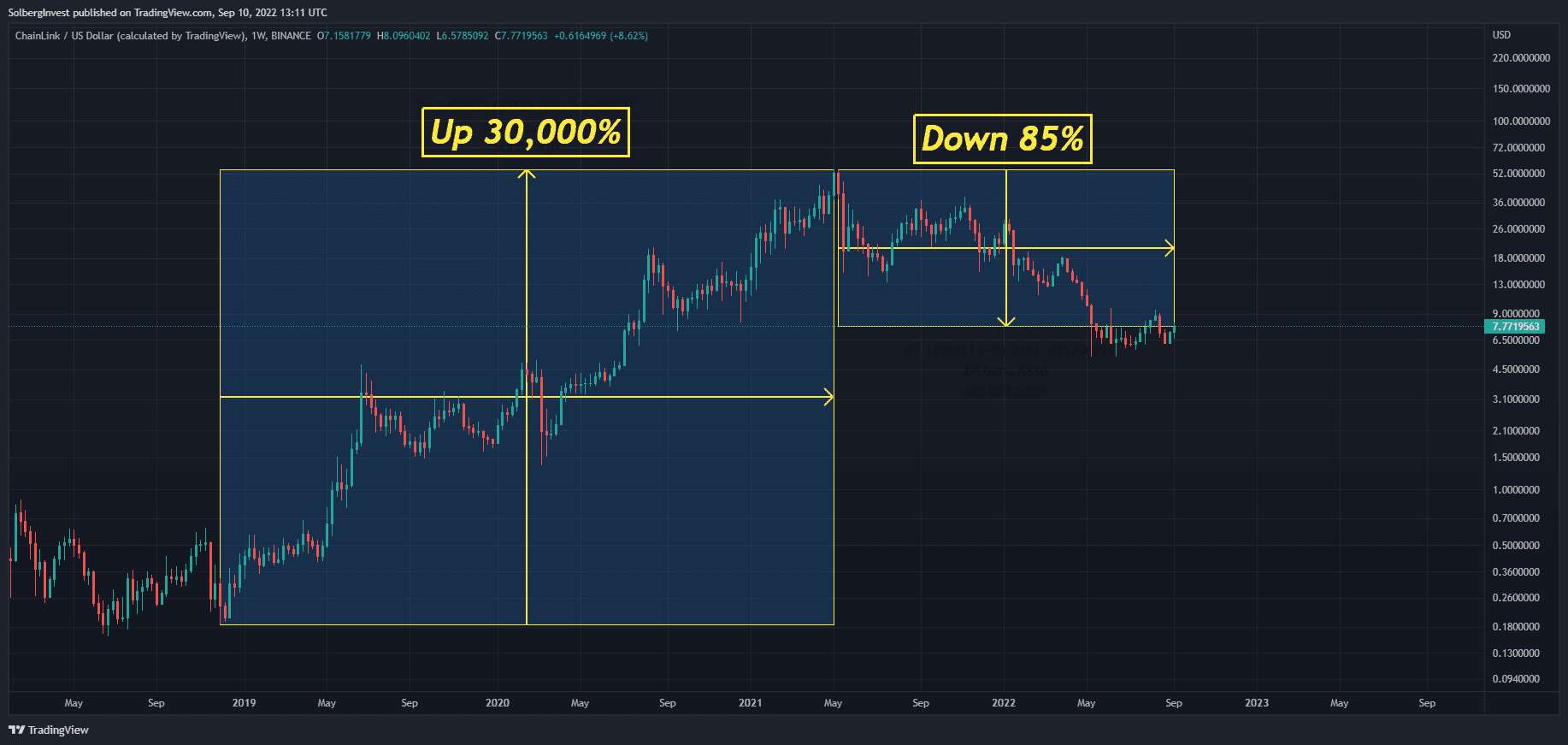
Chainlink surged roughly 30,000% in the bull market from the end of 2019 to May 2021.
In the current bear market, it is down roughly 85%.
Historical Performance of VeChain (VET):
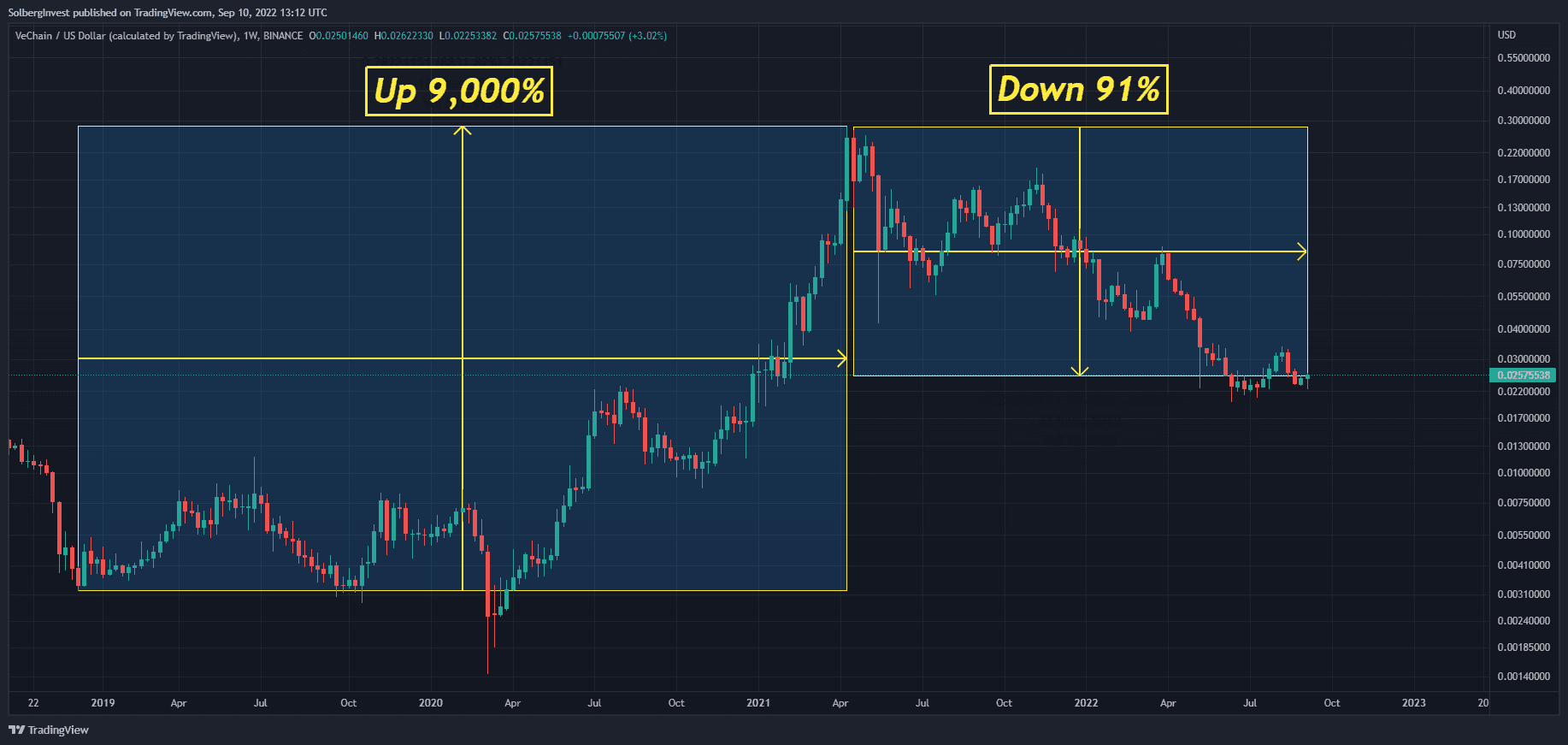
VET surged roughly 9,000% in the bull market from the end of 2019 to May 2021.
It has since crashed by over 90%.
It seems way more volatile than Chainlink, as both the surge and crash were more choppy than in Chainlink's case.
Conclusion: Why I Preferred Chainlink for Long-Term Exposure
Fundamentally, I found Chainlink more compelling. I expected the oracle sector to grow substantially and viewed Chainlink's adoption lead as an important advantage.
Historically speaking, Chainlink is also a bit less volatile than VeChain, especially in the bearish movements.
For those reasons, I preferred Chainlink as the long-term position and treated VeChain as the more volatile trading asset.
Personally, I held Chainlink for the long term and swing-traded VeChain with a 3-6 month perspective.
(all charts are made with tradingview, and in case you missed the disclaimer: This is not financial advice. It is just my personal opinion. Do your own research!)