


Bitcoin and Ethereum are highly correlated but still move significantly relative to each other. This article documents the three inputs I used when rotating between them.
My framework favored Ethereum when the ETH/BTC chart was bullish, Bitcoin dominance was high or market attention on Ethereum was unusually low.
Let's get into the details of how I applied those inputs.
When To Convert BTC to ETH (or the other way):
There are three things I use to figure out if I should have my capital in Bitcoin or Ethereum:
The ETH/BTC chart (technical analysis)
The Bitcoin dominance
General market sentiment
Let's go through them one by one.
Technical Analysis Of ETH/BTC:
The ETH/BTC chart tells us how much Bitcoin we can get per ETH we have. It shows the Bitcoin price of Ethereum.
If this chart goes up, it means that Ethereum is performing better than Bitcoin. If it goes down, it means that Ethereum is underperforming Bitcoin.
It tells us nothing about the USD price of the two coins. This chart can go up even if the USD price of both are falling if Bitcoin falls faster than Ethereum, or go down if Ethereum falls faster than Bitcoin.
I used technical analysis to form a view on whether Ethereum might outperform Bitcoin and whether to rotate between the two.
Below you see an example of a technical analysis I did a few years ago, showing a general trend-channel and how I used it to trade back and forth between Bitcoin and Ethereum:
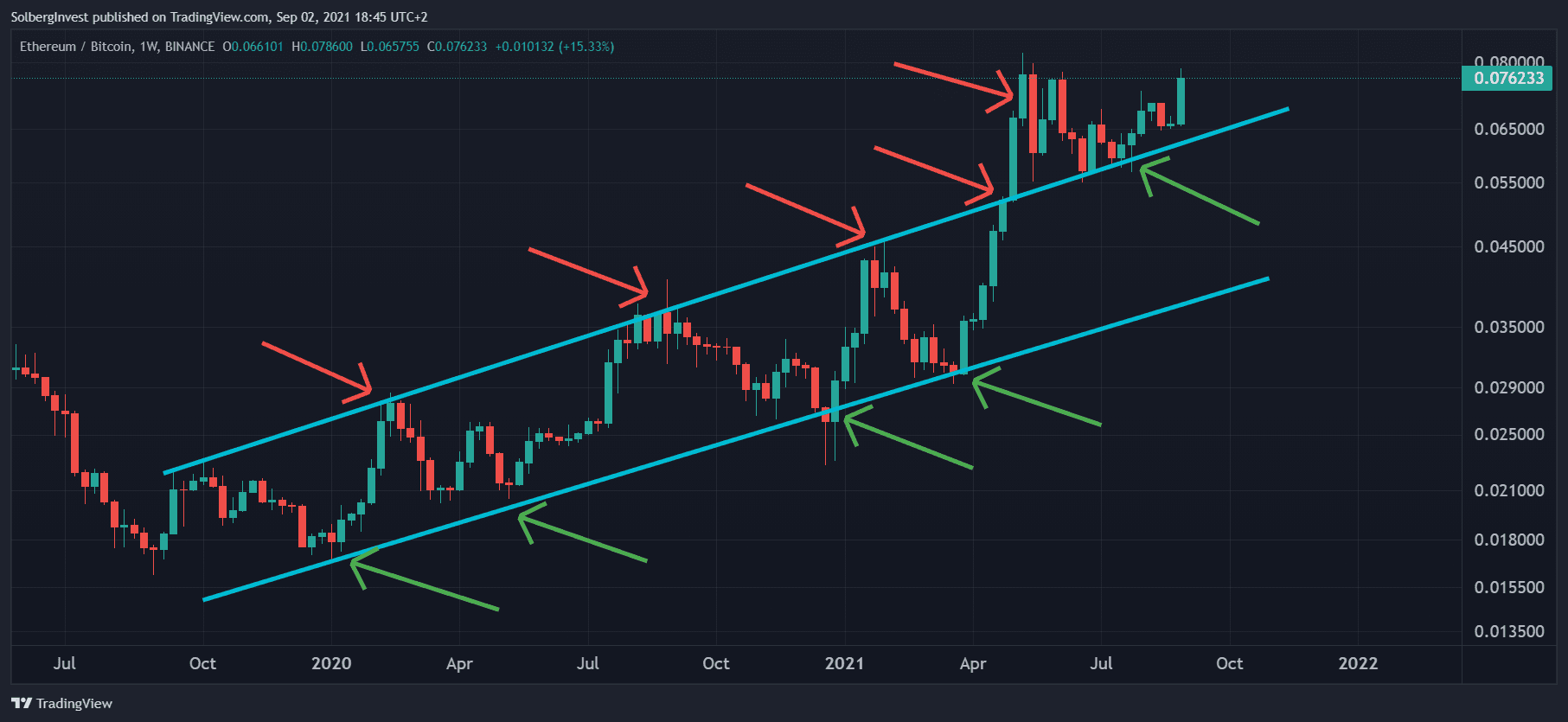
In general, I traded Bitcoin for Ethereum at the bottom of the channel (green arrows), and on the red arrows, I traded Ethereum back to Bitcoin.
The objective was to capture relative price changes between Bitcoin and Ethereum. In a successful hypothetical trade, that relative return would compound with the asset's USD return:
Let's say you manage to squeeze out a 2x gain in terms of BTC by trading the ETH/BTC chart. Assume also that Bitcoin itself increased 300% in terms of USD.
In that simplified example, the combined return would be 2 * 300% = 600%, before trading costs and taxes.
Using The Bitcoin Dominance To Trade Bitcoin and Ethereum:
The Bitcoin dominance (BTC.D) is a metric showing what percentage of the total crypto market lies in Bitcoin. If the BTC.D is at 50%, Bitcoin is 50% of the whole crypto market.
For example, if the crypto market is evaluated at two trillion USD and the BTC.D is 50%, Bitcoin's market cap is one trillion USD, because one trillion is 50% of two trillion.
Bitcoin dominance quantifies Bitcoin's share of the total crypto market. In my framework, a high reading made altcoins look relatively cheaper, while a low reading made them look relatively more expensive.
My framework therefore favored rotating Ethereum toward Bitcoin when BTC.D was low, and Bitcoin toward Ethereum when BTC.D was high.
BTC.D can also be viewed as a chart. I used technical analysis on it to form a view on the relative strength of Bitcoin and altcoins. Below is one historical example:
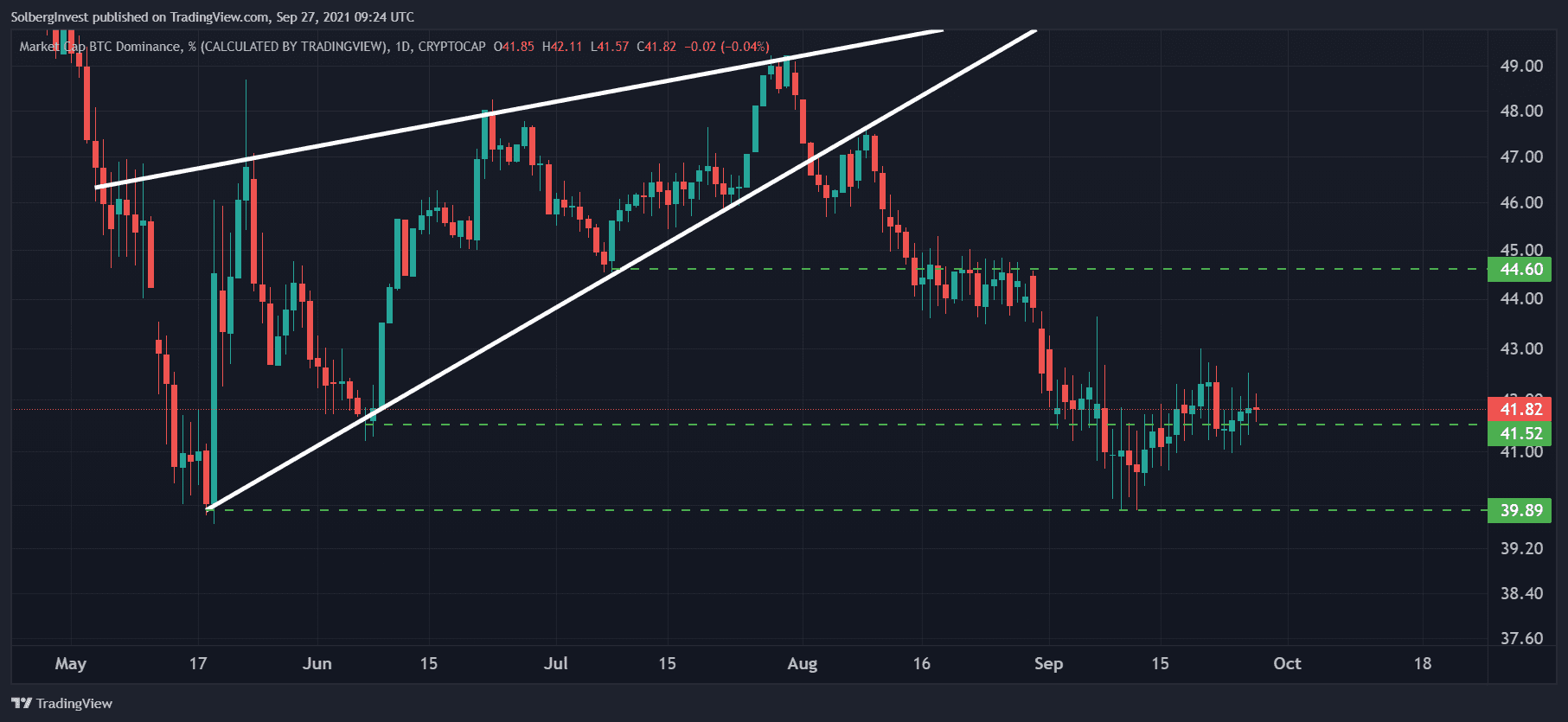
The white lines form a "rising wedge", which is a bearish pattern. The green lines marked the support levels I projected. In this historical example, those levels fitted the subsequent move reasonably well.
I used projections like these as one input when rotating between Bitcoin and Ethereum or altcoins more broadly.
TradingView's Bitcoin-dominance chart
General Market Sentiment To Trade Ethereum And Bitcoin:
If you're involved in Facebook groups, subreddits, or Telegram channels, you can gauge the general sentiment and hype of Ethereum and Bitcoin, respectively. You can use this to inform your trading decisions.
In general, this is what you want to do:
When attention on Ethereum became unusually intense, I considered rotating some Ethereum toward Bitcoin. When attention shifted heavily toward Bitcoin, I considered the opposite trade. Timing remained the difficult part.
This was more subjective than the chart-based inputs, so I treated sentiment as supporting context rather than a precise signal.
Things to watch out for, signaling the Ethereum is over-hyped:
Ethereum is constantly in the news
"Everyone" is buying Ethereum
"Everyone" is convinced that "The Flippening" (Ethereum growing bigger than Bitcoin in terms of market cap) is imminent.
People say that Bitcoin is out-dated, and that Ethereum is the real cryptocurrency
The price of Ethereum surges way more than Bitcoin
It was difficult to time the trade into Bitcoin because speculative surges could reverse sharply.
Should You Invest Or Trade Bitcoin And Ethereum?
Let's get one thing clear, investing and trading are not the same thing. Trading is more about speculating about what coins are going to be better in the short - midterm. Investing is buying and holding for the long term.
What I do myself is this:
Bitcoin Investing > Bitcoin Trading
My historical Bitcoin strategy explains the longer-term side of that approach.
Ethereum Investing < Ethereum Trading
Due to its higher volatility, I treated Ethereum as the more active trading position at the time.
For example, in May of 2021, I traded about 80% of my ETH over to BTC. A few months later, I started to buy up ETH with the goal of trading again in a few months, like 3-12 months, depending on what the market does.
This longer-term approach, buying and holding for a few months before rotating, is commonly called swing trading. It was the approach I used for trading Bitcoin against Ethereum.
Generally, I traded up to 80% of my Ethereum while retaining a smaller position during bull markets.
Conclusion:
I used three inputs when deciding whether to convert BTC to ETH or the other way around:
Technical analysis on the ETH/BTC chart
The Bitcoin dominance
General market sentiment
I used these inputs to form a relative view on which asset might outperform over different timeframes and to make the rotation process more systematic.