


(Updated 18. September 2022)
Very small cryptocurrencies can move rapidly in either direction. They were among the riskiest parts of the market and could produce large gains or losses within hours.
My starting rule was to define a process before considering these positions. Extreme volatility and frequent scams made consistent research, sizing and exit rules especially important.
I generally thought people should avoid this part of the market altogether. This article documents the process I used when I nevertheless considered a very small speculative position.
My starting point was to build larger positions in more established assets before considering this speculative part of the market.
Creating A Strategy For Investing In Shitcoins
First of all, what I mean with shitcoins is this: coins with extremely low market cap and/or coins that do not necessarily have any clear use-case other than being funny.
The most obvious examples of shitcoins are meme-coins with absurd names like "Twerk Finance" and "PooCoin".
To create a shitcoin investment strategy, you need to figure out the following:
Where I found new projects
How I evaluated them
How I bought them
How I sized positions
When I took profits
Let's go through them one by one and create a good shitcoin investing strategy!
1) Where To Find New Shitcoins
This might seem tricky for new investors, but it's actually fairly easy. This is what you need to do:
My historical discovery process began with public subreddits and Facebook groups dedicated to very small cryptocurrencies, followed by independent checks on the projects being promoted there.
For example, AllCryptoBets was one source I used. I also searched public Facebook groups focused on micro-cap altcoins.
I treated the projects promoted in these groups as research leads, not endorsements:
Some of these coins might be scams. You need to do some research before putting any money into them and make sure you're comfortable with losing everything you invest.
A separate article documents the discovery sources I used and the risks I checked.
2) How To Evaluate Shitcoins
If you find a bunch of shitcoins, how do you pick the right ones? That's what we will figure out now.
When evaluating shitcoins, you need to know this:
Community activity and developer marketing were among the main short-term price signals I monitored.
That made community activity relevant to the research, but not proof of quality.
A visible and active community was one signal I considered, but it did not establish that a project was legitimate or valuable.
"That's great, but how do I figure out if the community is good?"
My approach was to observe the community firsthand.
I joined the project's public communication channels, which were usually Telegram groups, to assess activity and behavior.
Once you're in the telegram group, this is what you need to look for:
1) How many people are in the telegram group? You're usually able to check it on the top of the screen if you're on mobile. On PC it should be in the top right corner.
2) Are the members active? If only a handful of people are sending all the messages in the chat, it's a bad sign. You want to see a lot of traffic, as this means the community is engaged.
3) Is the community helpful? Ask some questions like "How do I buy this coin?" or "Is this coin a good buy?" and see how much effort they put into answering them.
4) Ask if there's a plan for marketing or shilling (pumping) the coin.
The next step in my process was to inspect the coin's price chart and transactions, usually with DEXTools.
There you'll also see how many "holders" the coins have. This basically means how many people are actually holding the specific coin. Be sure to compare this number to the number of people in the telegram channel.
If there are many more holders than telegram members, it's a sign that people investing in this coin aren't contributing to the community, which is a bad sign.
To summarize, I'll give you an example:
Researching BurnX Token: Practical Example Of Shitcoin Evaluating
1) I went on subreddits and scanned for new potential shitcoins.
2) To research them, I joined their Telegram channel to ask questions and check out the community.
3) Once I'm in the telegram group, I usually ask a few "dumb" questions just to get the vibe of the community. If they get annoyed by stupid questions, it's not a coin I'm investing in.
I look for pinned posts about marketing plans.
All things considered, the community seems good. After engaging with it, there seem to be many people actively spreading the word and buying the dips.
Now I'm going to check DEXtools to make sure things are looking legit: (illustrated by images below)
First, I searched DEXTools for "BurnX Token". If a name search failed, I used the contract address from a source I could verify independently rather than relying on a chat message.
Then check out the number of holders etc. I now see that there are approximately the same number of holders as members in the telegram group, which is good.
Then I check if there are any sell orders. This is important because it might be a "honeypot scam":
A honeypot scam is basically a project/coin you can't sell. It's only possible to buy. Whatever money you invest, you'll never get back...
Scroll through the images below for further explanation:
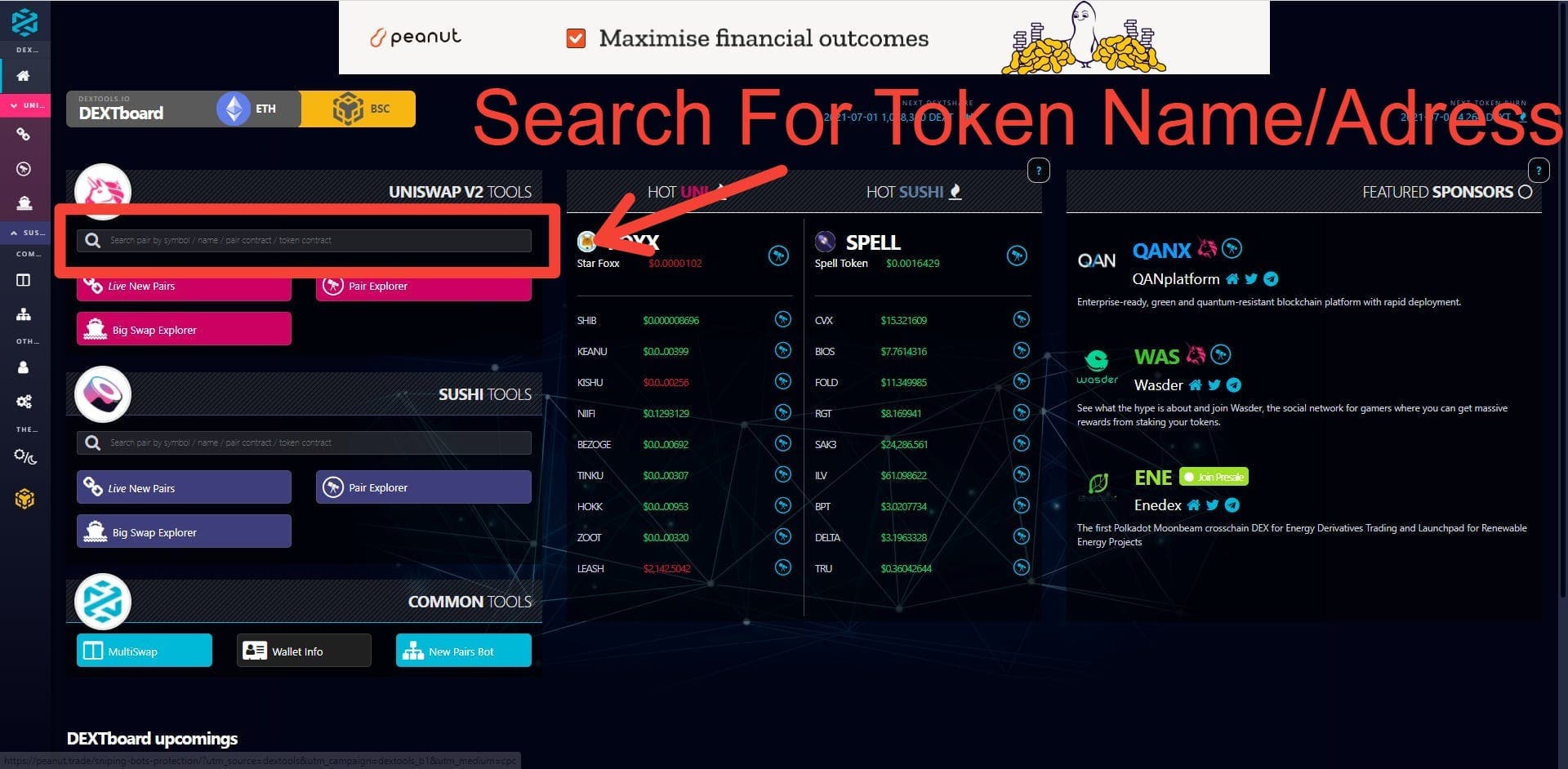
Step 1
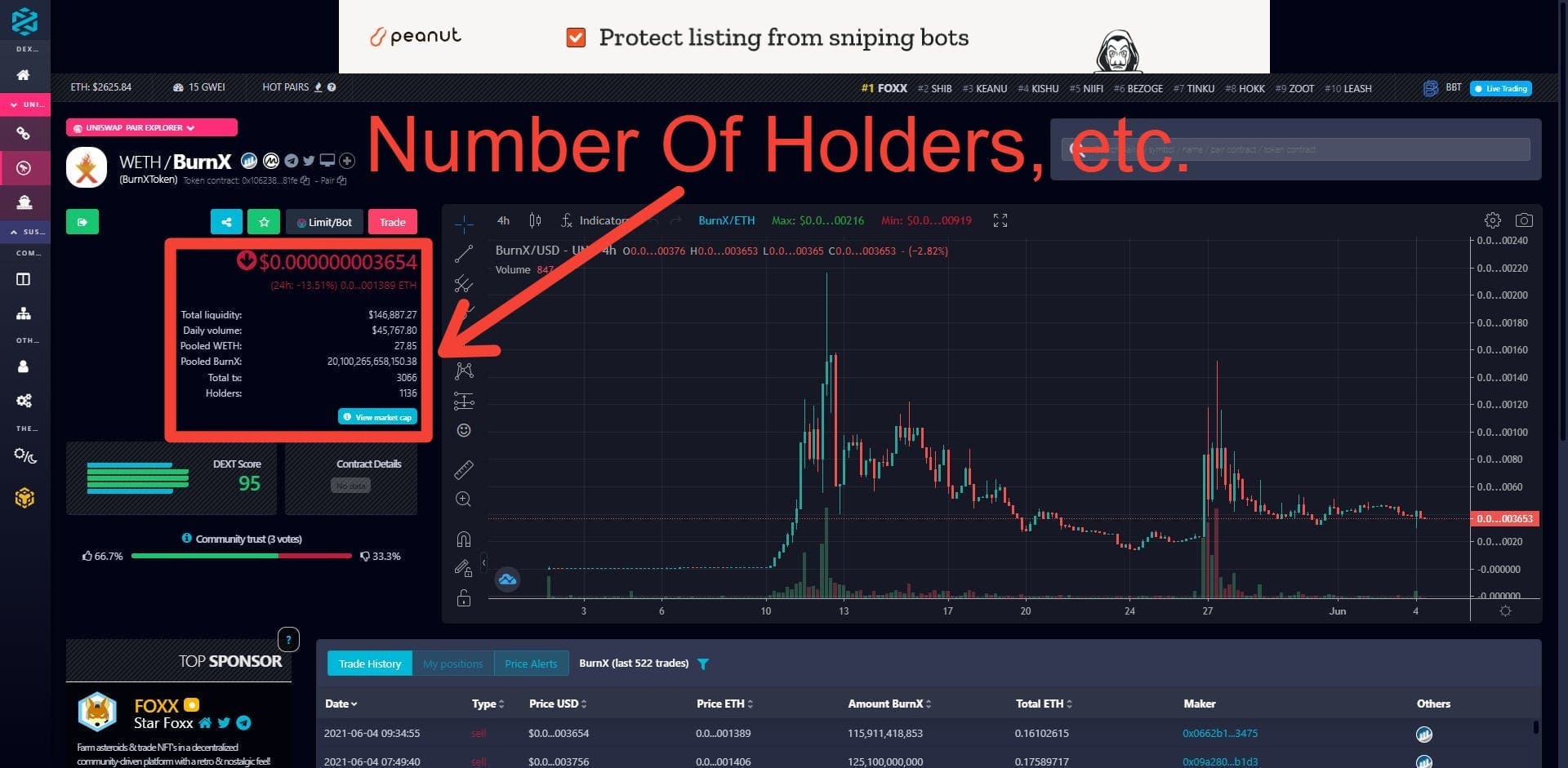
Step 2
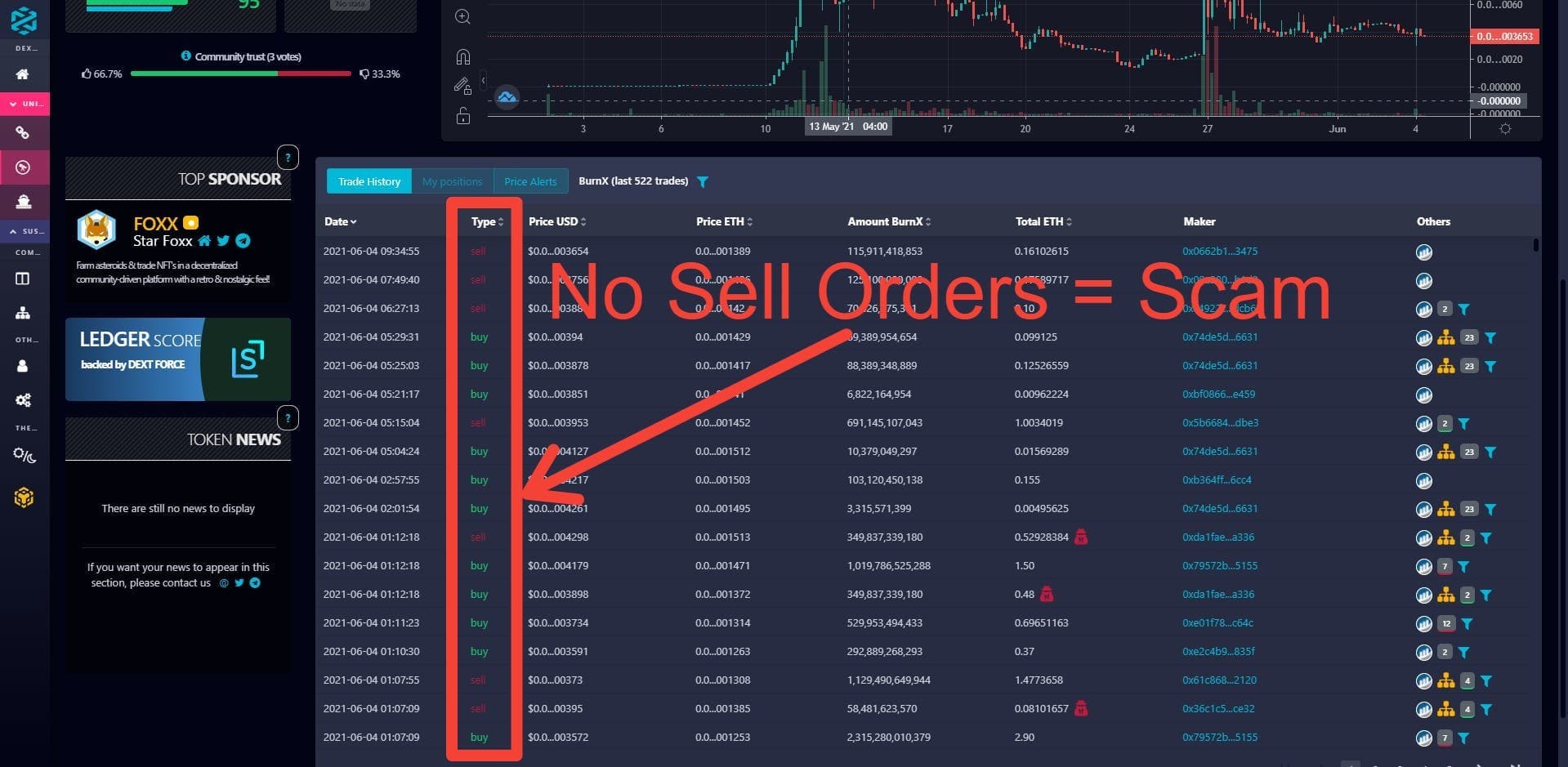
Step 3
At that stage, the coin remained a research candidate. I would observe the community for a few more days rather than treating fast membership growth as an automatic investment signal.
3) How to Buy Shitcoins
How to buy a specific shitcoin depends mainly on one thing: Is it built on Ethereum or Binance Smart Chain?
If it's built on Ethereum, you can buy it using Uniswap, the decentralized exchange for ERC-20 tokens (Ethereum-based tokens).
The operational path I described at the time was to acquire the chain's base asset on an exchange, transfer it to a compatible self-custody wallet, connect the wallet to the relevant decentralized exchange, and locate the token using its verified contract address.
For Ethereum-based tokens, that exchange was often Uniswap. Binance Smart Chain tokens commonly used PancakeSwap.
Binance Academy's How to Get Started with Binance Smart Chain (BSC) provided operational background.
4) How Much Should You Buy?
This was highly dependent on my goals and risk tolerance. The position-sizing article documents the broader framework I used.
Here are some general guidelines for the average investor:
| Low Risk | Medium Risk | High Risk |
|---|---|---|
| 2% Of Portfolio | 4% Of Portfolio | 6% Of portfolio |
Some people might find those percentages way too low, and that's fine. There's no right or wrong answer to this question.
Basically, it's a matter of managing your risk. Shitcoins are EXTREMELY risky. They can 10x in five hours, only to crash with 90% in the next five.
For this reason, I kept this category to a small speculative allocation rather than a significant portion of the portfolio.
Let me say that one more time:
I did not treat these positions as the primary source of portfolio returns.
This is what I personally do:
Under normal market conditions, I did not invest in shitcoins. When speculative activity increased, I sometimes used a small allocation in this part of the market.
I have about 95%-98% of my portfolio in fundamentally strong projects like Bitcoin, Ethereum, and Chainlink, and I speculate with 2%-5% in different shitcoins.
I never invest more than 1% of my portfolio in any one coin. And I always take profits after 3x.
5) When to take profits
This also largely depends on your risk tolerance and goals. However, I'll provide some general guidelines and what I personally do.
I pulled out an amount equal to my initial investment after 3x, no matter how bullish I was on the specific coin. That recovered the original cost basis, while the remaining position still carried market risk.
If the remaining position subsequently fell to zero, the recovered cost basis limited the loss on that trade.
After taking out the initial investment at 3x, I pull out 20%-30% after each 3x.
If you're more conservative and want to decrease the risk, you can pull out 50% after each 3x, or maybe 30% after every 2x.
The approach I preferred was to realize profits gradually rather than rely on a single extreme price target.
No matter what you're inclined to do, make sure to formulate a plan. Here is an example:
| ROI Generated | Profit Taking |
|---|---|
| 3x | Initial Investment |
| 6x | 30% of the current value |
| 10x | 30% of the current value |
| 20x | 100% - Sell everything |
A written plan made the exit process less dependent on emotion.
Summary: Our Completed Strategy For Investing In Shitcoins
1) I used public forums such as AllCryptoBets to build a research list, treating promoted projects as leads rather than endorsements.
2) I observed the public Telegram groups, asked basic questions and checked pinned messages for marketing plans and participation levels. After a few days, I removed projects whose communities did not look active or credible.
3) I checked the remaining coins on DEXTools and compared holder counts with participation in the Telegram group. I also looked for actual sell transactions to identify potential honeypot scams.
4) I sized the remaining candidates conservatively. My general cap was 1% of the crypto portfolio in any one coin and 6% across the category, adjusted for my goals and risk tolerance.
5) I wrote down the profit-taking plan in advance. My historical rule recovered an amount equal to the initial investment after 3x, then reduced the remaining position by 20%-30% after each further 3x move.