

(Updated 21. September 2022)
After learning about Bitcoin, I began examining Ethereum's different risk and return profile. This archived analysis asks whether I considered it safe to invest in at the time.
Here's the short answer:
In this analysis, I considered Ethereum one of the relatively safer cryptocurrencies because of its position in DeFi and NFTs, its market size and the planned Ethereum 2.0 upgrade.
I got this question often from investors weighing Ethereum's potential against its risks.
A separate article documents the Ethereum trading and investing strategy I used at the time.
How I Evaluated Ethereum's Relative Risk
My approach to mitigating risk had two parts:
1) Formulate a strategy with a goal and clear steps. For me, this meant deciding in advance at what prices I would sell, how much exposure I would take, and how I would build the position.
2) Follow the plan once it is set. A written strategy only helps if it guides the decisions that follow.
Below you see an example of what a decent Ethereum investment strategy looks like, making it much safer:
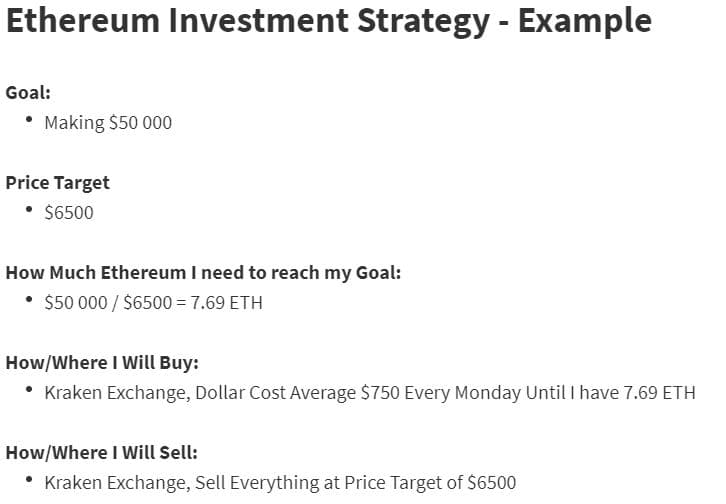
(random numbers)
Investing in Ethereum without a plan of action often becomes an emotional choice, which stops many people from reaching success.
Creating a strategy, like the example above, removes the emotions from the equation. It lets you make investment decisions based on logic and analysis, which is much better, and safer, in the long run.
In other words:
My framework was to develop a well-formulated strategy, including a sell plan, position sizing and an execution method.
This made the process more deliberate, but there were still risks associated with the investment.
The Risk of Investing in Ethereum
Even though I considered Ethereum relatively safer than many cryptocurrencies, it still carried substantial risk. I focused on two categories:
**When investing in cryptocurrencies other than Bitcoin, there are two major risks:
Bitcoin might crash, dragging down the market with it (because Bitcoin is the market mover)
The risk that the specific coin, in this case Ethereum, might fail.**
The risk of Bitcoin crashing is not the topic of this article. The second risk is what we'll focus on, as that's the relevant one in this case.
So, what exactly are the risks of investing in Ethereum? There are mainly two risks; the blockchain being hacked, and competitors catching up.
Risk 1 - The Ethereum Blockchain Being Hacked/Attacked
At the time, I considered this highly unlikely because Ethereum had a large validator set and a high degree of decentralization.
To attack the Ethereum blockchain through its consensus mechanism, an attacker would need to control 51% of all staked ETH, which I considered extraordinarily difficult in practice.
Think about it:
To attack the blockchain one needs to scoop up 51% of all the Ethereum that's being staked. That's going to push Ethereum's price to the sky. The more you buy the higher the price gets.
The economic incentive also worked against such an attack: accumulating that much ETH would be extremely costly, while a successful attack could destroy much of the position's value.
Risk 2 - Competitors Catching Up
This is always going to be a risk, as competitors like Cardano, Binance Smart Chain and Polkadot generally have more scalable, faster and cheaper to use blockchain.
Lots of new cryptocurrency investors stay away from Ethereum, in favor of its competitors, for those reasons. It is often justified with "bro, the tech is 100x better, and Ethereum is slower than my granny". Which are valid points, for the time being. However, there's more the Ethereum than meets the eye:
At the time, Ethereum was substantially ahead of its competitors in adoption, which I considered one of the most important factors in the crypto market.
Adoption means to be accepted and used by people and businesses. When people ask me about the adoption of Ethereum, I usually tell them about three things: Ethereum's dominance in DeFi, in NFT and the "EEA":
EEA stands for "Enterprise Ethereum Alliance". There are some huge names in EEA, like Microsoft, J.P.Morgan and Santander who work together to improve Ethereum and make it better for business.
Almost 60% of the entire DeFi market is built on Ethereum:
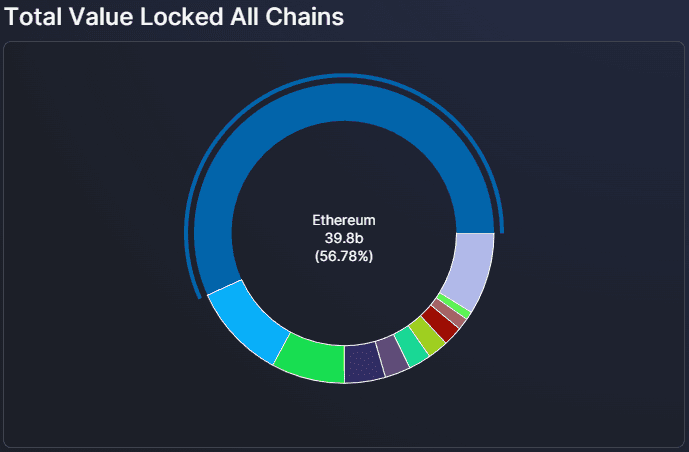
Over 75% of all NFT sales have been on Ethereum. (source)
The competitors shown here had much lower adoption at the time, which supported my view that Ethereum carried lower relative risk than those alternatives.
Below you see the difference in market capitalization (total value of all coins combined) between Ethereum and its closest competitors:
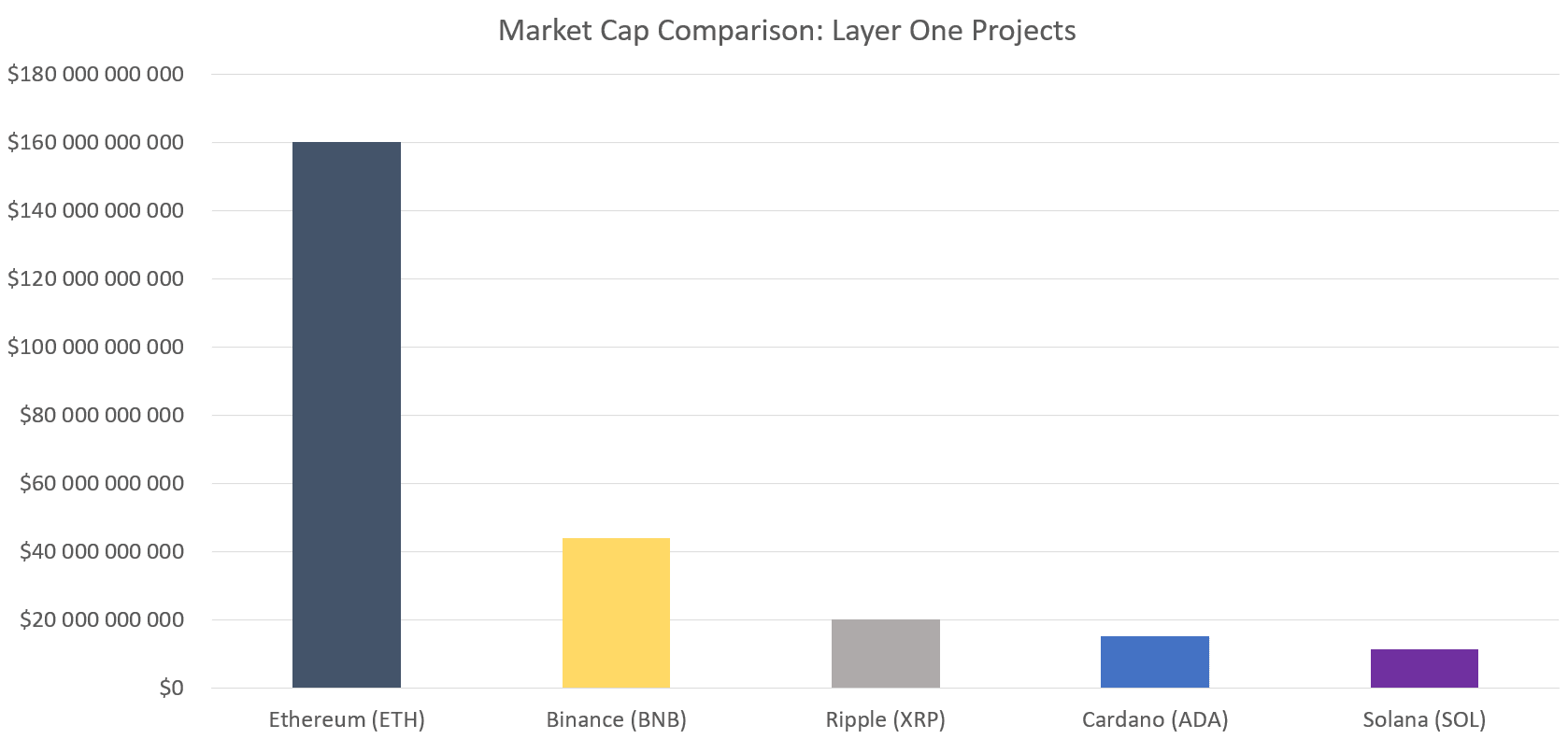
Ethereum's relative market size and adoption strengthened my view that it carried lower risk than many competing crypto assets.
Ethereum Is Historically A "Safe" Crypto Investment
Ethereum produced very large historical returns, particularly in 2016-2017.
Let me show just how much Ethereum surged in the bull market of 2016 - 2017:
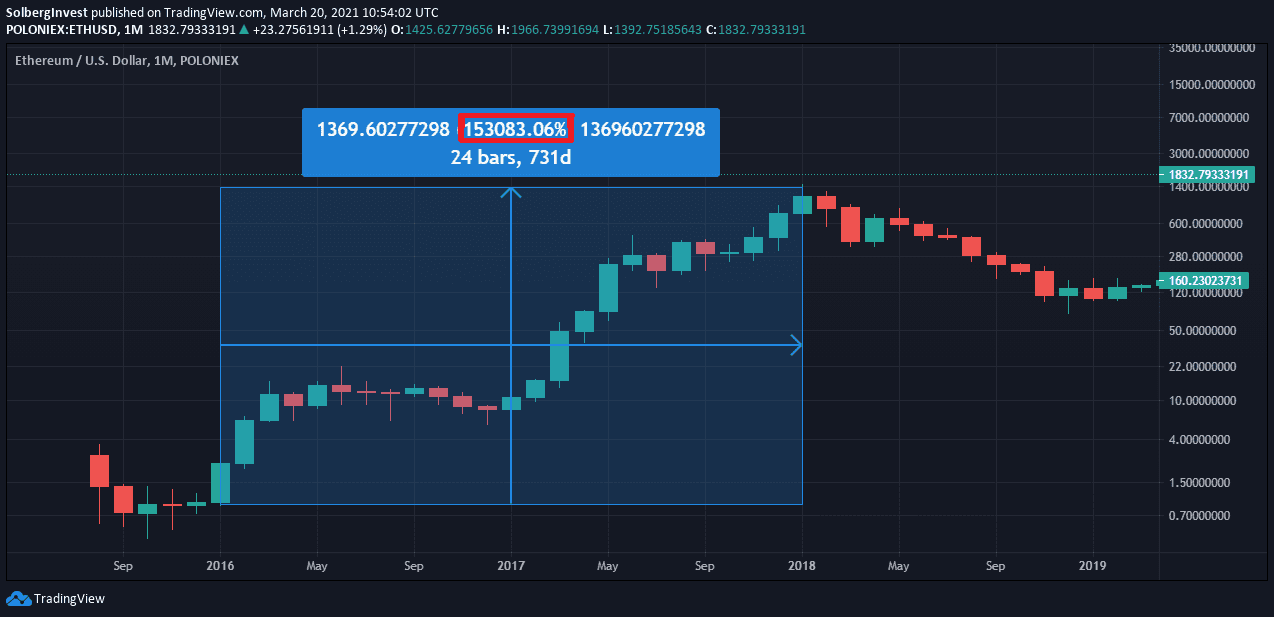
That right, in 2016-2017 Ethereum surged over 153,000 percent.
If you invested $2500 at the beginning of 2016 and sold at the end of 2017, it would turn into: $2,500 * 1,530 = $3,825,000
In the most recent bull market and the following bear market, Ethereum also declined less than many smaller cryptocurrencies:
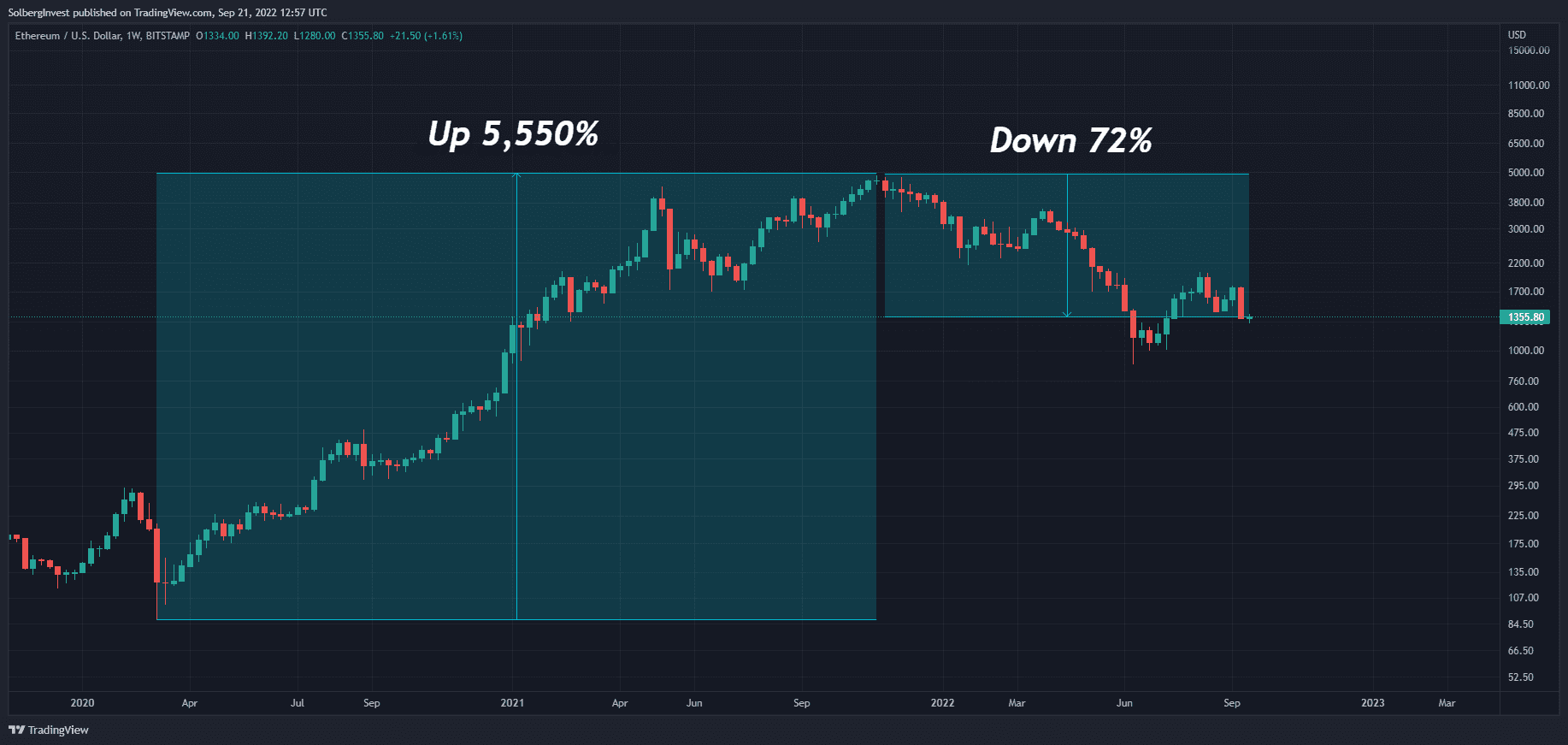
Most other cryptocurrencies are down 85 - 95 percent in the current bear market. Ethereum "only" being down 72% is a sign of maturity.
Conclusion: Ethereum Is One Of The Safest Cryptocurrencies
The main risks I identified were an attack on the blockchain and competitors catching up. Under the conditions examined here, an attack looked very difficult and the closest competitor was only one-quarter of Ethereum's size. Those factors supported my conclusion that Ethereum was among the relatively safer crypto assets at the time.
I paired any position with predefined sizing and exit rules to reduce emotion-driven decisions.