


There was substantial interest in Holo (HOT) in 2021 because of its different approach to distributed applications. My question was whether that made it a good investment at the time.
In this 2021 analysis, I concluded that Holo looked attractive based on both technical and fundamental analysis. The chart-based scenario produced a wide potential range, while the two co-founders each brought decades of experience with coding and distributed systems.
In this article we'll get into the technical price movements, as well as the fundamental aspects of Holo. We're going to look at the team behind the project, and some of the applications built on its holochain.
We're Going To Look At:
Technical Analysis Of Holo (USD, BTC And ETH)
The Risk / Reward Ratio Of Investing In Holo
Fundamental Analysis Of Holo
If Holo Is A Good Investment in 2021 Or Not
Technical Analysis Of Holo For 2021
Technical analysis means to analyse the price charts. What we want to find are patterns that predict with reasonably high probability tht the price of Holo will increase.
However, we're taking it a step further:
Instead of only looking at the USD price of Holo, we're also going to look at the BTC and ETH price. After all, if the price of Holo isn't going to increase in terms of BTC/ETH, why would you choose to invest in it?
You always have to justify the added risk of investing in smaller coins, and therefore, we will analyze Holo in terms of BTC and ETH as well.
Holo / USD Analysis
The Holo / USD charts were looking good to me. We had recently seen a stark correction of more than 70%, which can reset an overheated altcoin market:
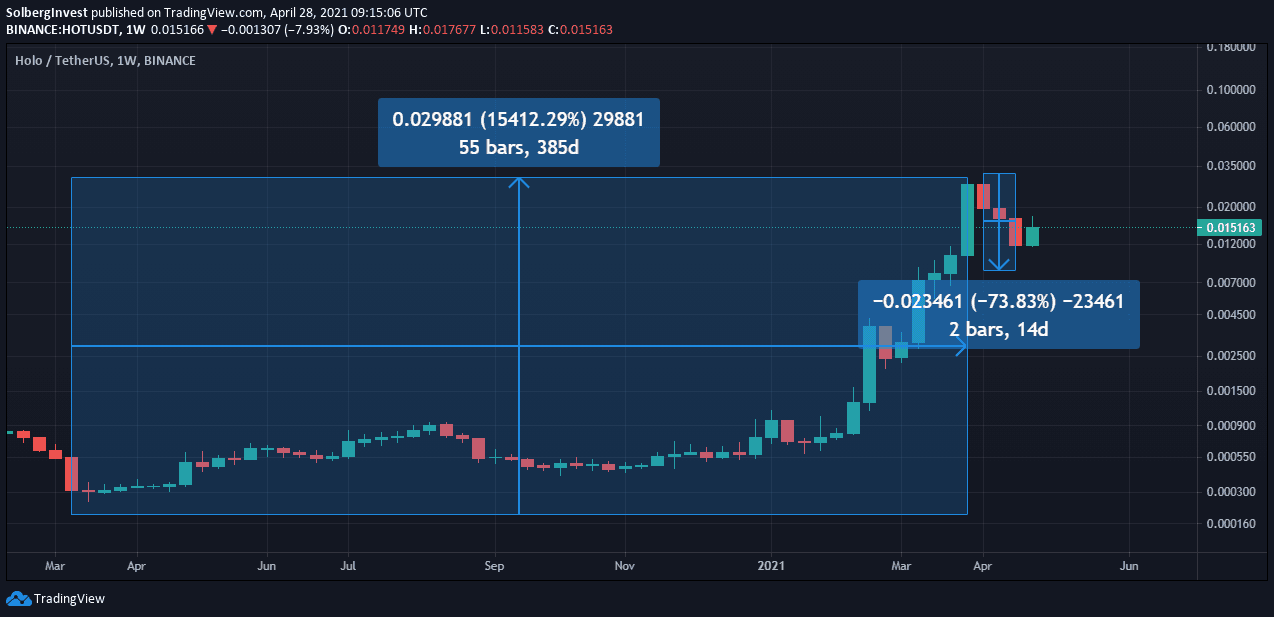
However, Holo has been on fire these last 12-15 months, surging over 15 000%. Often, when a coin has gone that parabolic, it's a good idea to stay away.
Nevertheless, we've seen going like AAVE surge with over 200 000%, so there are no "laws" preventing Holo from going further, especially now that it has had a 73% correction.
Another way to view this chart is to draw resistance and support lines, showing where most traders buy and sell Holo:
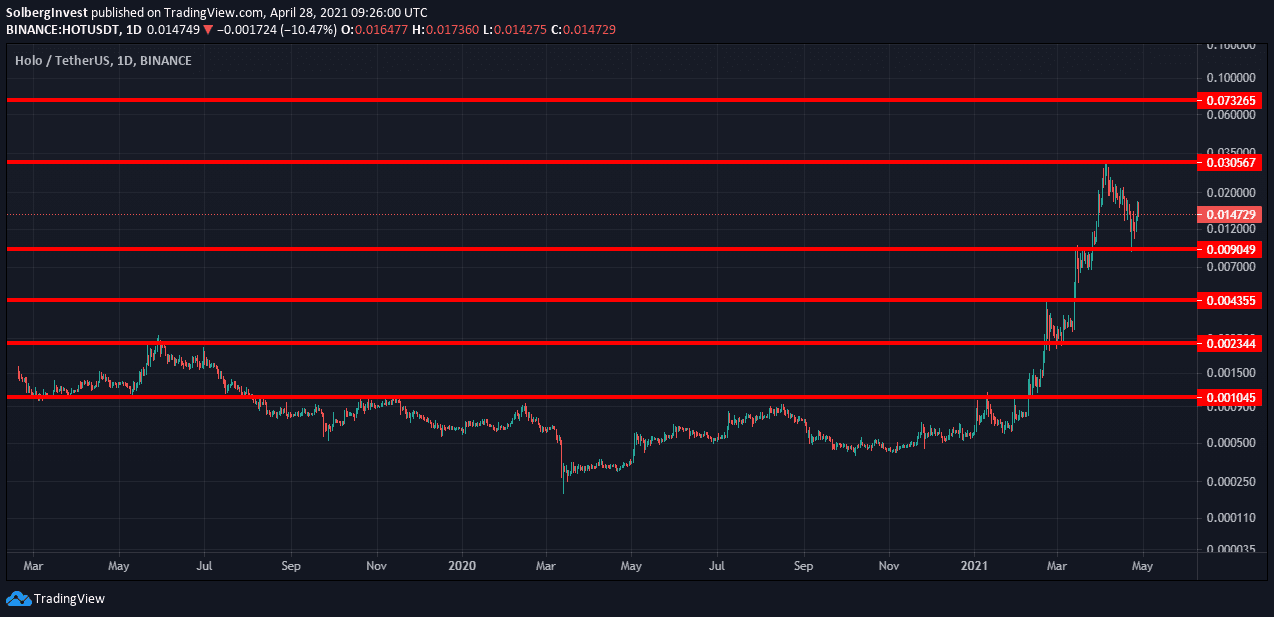
The red lines are critical price levels where the Holo price has first been rejected, adn pushed down, only to flip it into support later on, and surge higher.
We did actually hold the previous resistance aas support recently, which is a major bullish sign.
The upper red line, which we have not reached yet, is potentially the next citical price level. I took the average percentage range between the other critical levels.
This level was at $0.073265.
In my 2021 reading, the Holo / USD chart supported a bullish case, especially after its recent correction of 73%. Let's move on to the Holo / BTC charts.
Holo / BTC Analysis
The chart we'll analyse now tells us how much BTC we can get per Holo we have. If the chart moves up, it means that Holo is doing better than BTC, if it moves down, it means that BTC does better than Holo.
Holo has already done phenomenally well in terms of BTC in 2021, surging almost 2500%. However, we've seen a correction on this chart as well, at 63.5%:
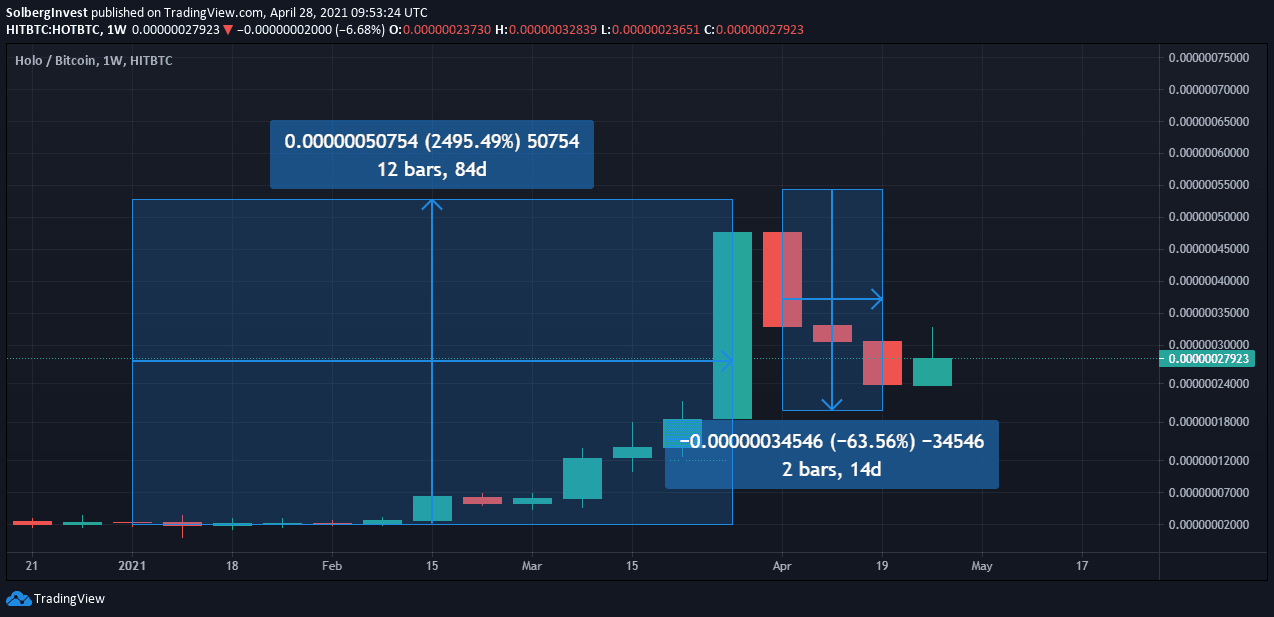
This correction was important to my 2021 thesis. I would not buy a coin immediately after a 2500% surge; I would wait for a correction before considering it.
Another bullish sign this chart reveals, is that the correction bounced back up after hitting a critical level:
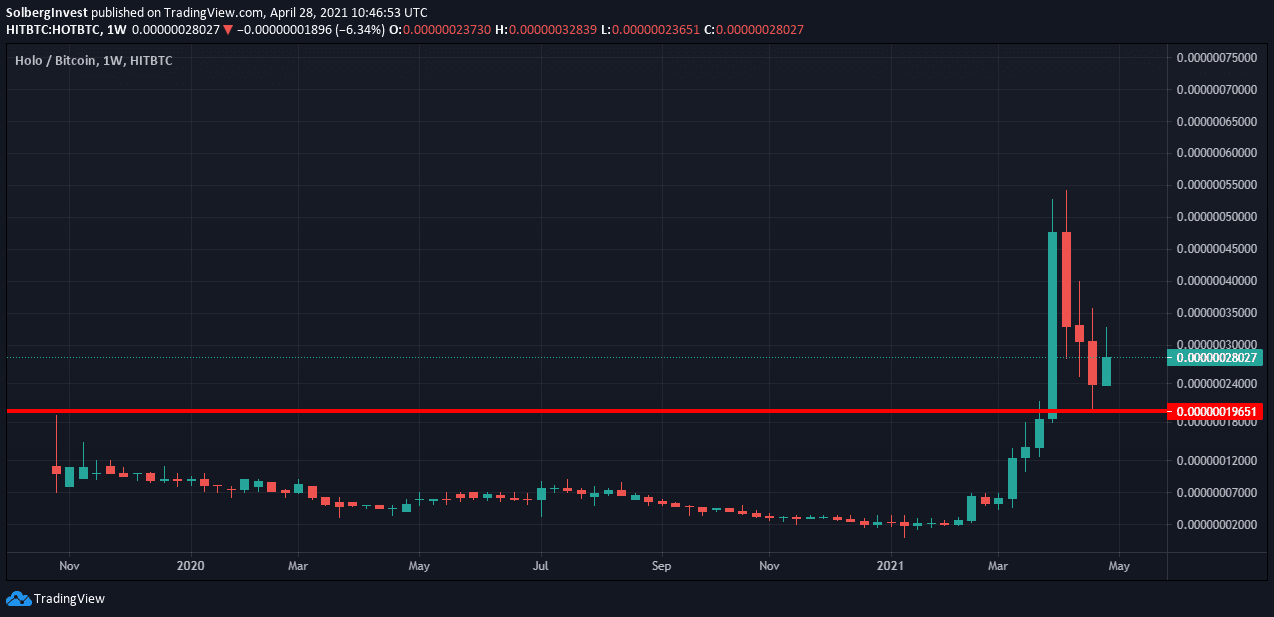
I read this as bullish and as a possible sign that the BTC price of Holo had found a bottom.
In my 2021 reading, the Holo / BTC chart also supported a bullish case.
Let's dig even deeper:
Holo / ETH Analysis
We see the same pattern on the Holo / ETH chart as we did on the other two; A major surge, followed by a hard correction:
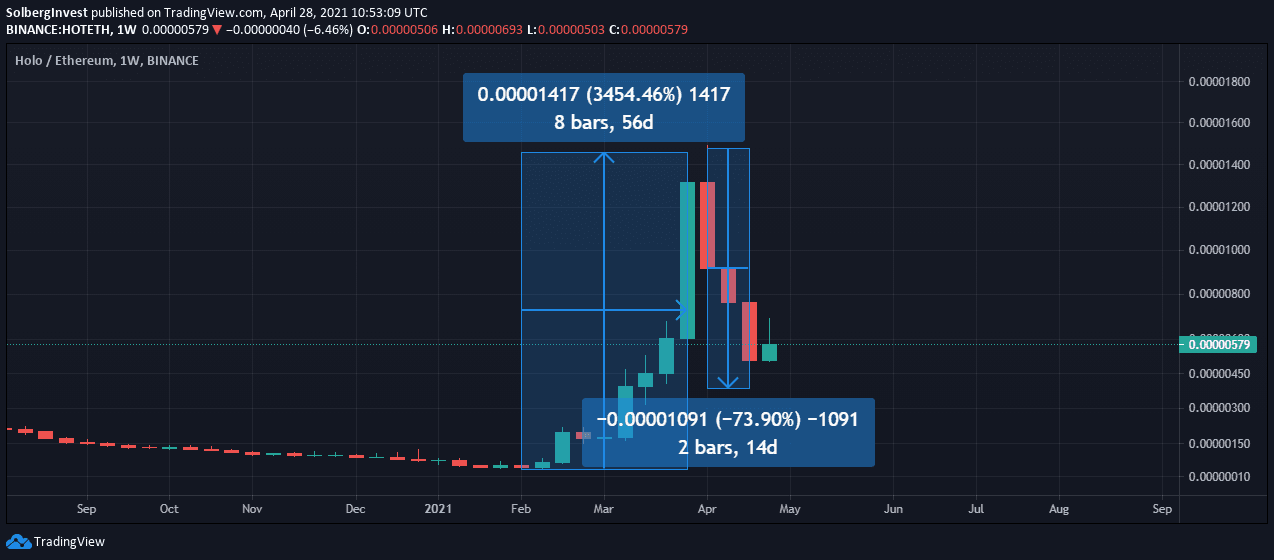
Once again, this correction was much needed for investors to be able to justify entering into a position in Holo.
However, on this chart, we're able to gather more specific information about what prices to expect in the future, and what the potential risk/reward ratio of investing in Holo in 2021 might be:
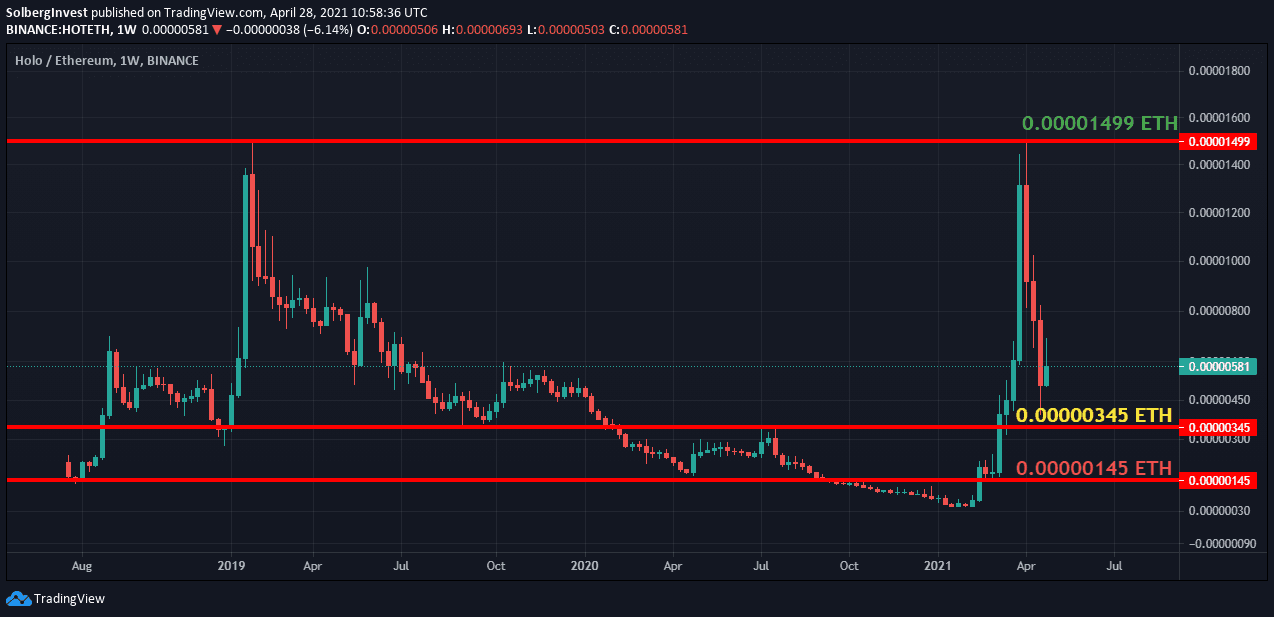
Here we see an ETH price that Holo had reached twice in the past: 0.00001499 ETH. I used this as the upper chart scenario for Holo in terms of ETH.
I used 0.00000145 ETH as the lower chart scenario.
There seems to be a critical level in the middle of those two outcomes as well, this is at 0.00000345 ETH.
Of course Holo could move far outside this range in either direction, but that was not what this chart suggested was reasonable to expect.
In order to get the USD price of Holo at these ETH prices, we need have a prediction of what price ETH will reach in 2021.
I used an $8,000 ETH scenario from my 2021 Ethereum price analysis, which gave the following Holo prices:
Best Possible Outcome: 0.00001499ETH * $8000/ETH = $0.11992
Worst Possible Outcome: 0.00000145ETH *$8000/ETH = $0.0116
Neutral Outcome: 0.00000345ETH * $8000 = $0.0276
The Risk / Reward Of Investing In Holo In 2021:
With the calculations above, showing the best and worst possible outcome of 2021, we can figure out the risk / reward ratio of investing in Holo in 2021:
This ratio depended on Holo's market price. I used CoinMarketCap's Holo price history as the source for the calculation below:
Let's find the potential risk and reward:
Potential Risk: 0.0116 (worst possible outcome) / 0.01577 (current price) = 0.7356
Potential Reward: 0.11992 (best possible outcome) / 0.01577 (current price) = 7.6
The risk/ reward ratio at the time of writing therefore is: 7.6 / 0.7356 which is equal to 10.33 / 1
In other words:
On this chart-based framework, the potential reward-to-risk ratio was over ten to one, which looked attractive to me in 2021.
However, this analysis takes nothing about the fundamental aspects of Holo into consideration. It looks only at the technical aspects.
Also, it does not say anything about the probability of Holo actually reaching the upper parts of the potential reward.
We must therefore conduct a fundamental analysis as well, to complement out technical research.
Together, they give us a picture of the potential reward and risk of investing in Holo in 2021, as well as the probability of Holo actually fulfilling its potential.
Fundamental Analysis Of Holo
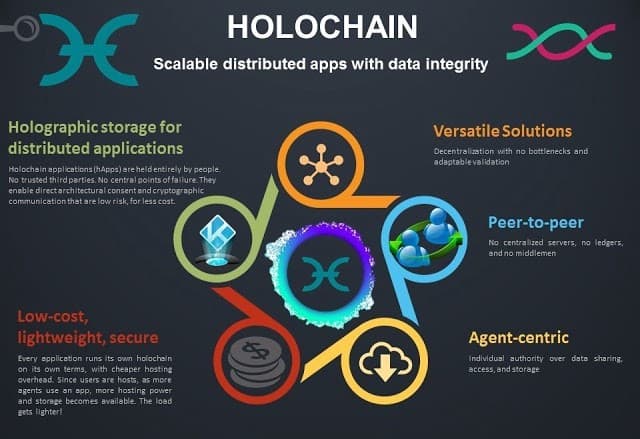
In this analysis, we'll use "Holo" and "Holochain" as similar terms. However, they actually refer to different things:
Holochain is the platform where applications can be built, like the Ethereum blockchain.
Holo is the distributed hosting platform hosting the applications built on the Holochain, making them available to the public.
All in all, Holo seeks to build a platform for applications that is scalable, decentralized and agent-centric.
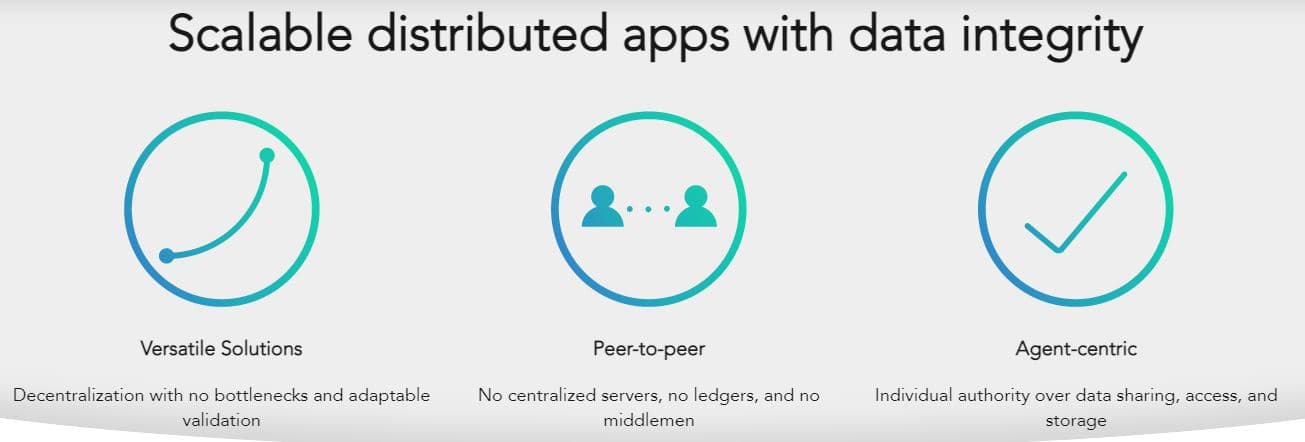
Holochain Is Not Like Other Blockchains
Blockchains traditionally takes a lot of work to run. Also, the work increases for each participant over time, as the blockchain gets larger every day (because more blocks are added every day).
All nodes have to keep a copy of the entire blockchain at all times, and they all have to be synchronized and agree with each other.
This is both a strength and a weakness of blockchain technology, as it creates a fully transparent and highly secure way of transaction information or value, but at the same time makes it hard to scale it up for mass-use.
For instance, the ethereum blockchain is experiencing high traffic at the moment, this has lead to slower transactions, and skyrocketing transaction fees.
Holochain tries to solve this problem in a radical, but promising way: All nodes does NOT have to keep an up-to-date copy of the public blockchain, and ll its transactions.
Holochain Is Improving Traditional Blockchains
Instead of requiring all nodes to store a complete and updated copy of the entire blockchain, and all transactions ever made, nodes takes care of parts of the complete blockchain, and feeds it into the bigger picture.
Coin Bureau framed the relationship this way:
Imagine the entire public blockchain as a river, and each node is similar to a smaller stream that feeds into the river.
If a node goes offline it creates a fork of the public chain, but the public chain continues forward, without being impacted by the loss of one of its nodes.
Steve Walters (coinbureau)
Holochain is Highly Scalable
In theory, the scalability of the Holochain is unlimited, however, the scalability question is not directly relevant to Holochain.
Let me explain:
Usually, when one measures the scalability of a blockchain, one looks at the number of transactions that can be done per second. For instance, Bitcoin can complete about 5 transactions per second, Ethereum 7-10, etc.
This question is kind of absurd when it comes to Holo, as the transactions are not verified in the same way as with traditional blockchains:
Traditionally, all nodes must agree on the validity of transactions, and all nodes must have keep all transactions on their copy of the blockchain. On the Holochain, nodes run their own little part of the blockchain, and feed it into "the river".
In Bitcoins case, more nodes does not equal more scalability. More nodes only turns into higher mining difficulty, and more resources required to hash blocks.
On the Holochain however, more nodes equal more scalability, as more nodes help out with running parts of the blockchain.
Think of it as a collaboration on the Holochain vs a competition on the Bitcoin blockchain.
The developers of the Holochain has this quote I really like, explaining why the scalability question is kind of absurd:
It is like asking, ‘How many words can humanity speak per second?’ It’s an irrelevant question. With every human being born, that number increases. Same for Holochain.
Developers of Holochain
The Team Behind Holo
Holochain has a great team, with more experience than most others. Let's take a look at the two founders:
Arthur Brock, the guy on the left on the image below, is the chief architect. He has over 30 years of programming experience. He has worked as an " online alternative currency system designer" for two decades.
Eric Harris-Braun, the guy on the right, also has over 30 years of coding experience, and has worked with design of peer-to-peer communication applications, system design, framework design, and more.

The rest of the team consist of UX experts, software engineers and developers. These are spread around the golde, and all have relevant experience as far as I could tell.
The project's team page provided more background on the contributors.
All things considered, I thought the team had unusually deep competence and relevant experience.
The only thing missing is a marketing/business oriented person. This is not necessary, but I think it could help drive adoption of Holo, and increase the value of HOT, the token you buy to invest in Holo.
Holochain Is Already Working
Some cryptocurrency projects are selling you "plans". They want you to invest your hard-earned money into a blueprint, with the promises of one day being the best product out there.
This is not the case with Holo, as they already have a finished product, with traction building as we speak.
Here are some of the applications built on the Holochain:
Sacred Capital - which seeks to establish a "reputation economy"
Core.Network - a platform where you can connect all your social profiles, and regain control of your data and privacy.
JustOne Organics - which is supporting farmers by buying their organic food, and "seconds" (visually imperfect food), and dehydrating it to sell it to consumers.
Conclusion: Holo Is A Good Investment In 2021
The technical side of this 2021 analysis produced a reward-to-risk scenario above 10:1. That chart-based outlook was complemented by a project I found fundamentally promising.
All things considered, I concluded that Holo was a good investment in 2021 based on both technical and fundamental analysis.