

On has become a bigger and more profitable company while the share price has fallen back to roughly 20x earnings. As long as customers keep paying full price for the shoes, I think that is a fair price for 20% growth.
The answer in brief
On has gotten better as a company while the stock has gotten cheaper. That combination is why I'm interested.
Revenue is growing around 20% in constant currency, profits are growing faster than revenue, and I'm paying roughly 20x earnings for it.
The brand is On's biggest asset, and it's also the biggest risk.
What would change my mind is American customers deciding they don't want the shoes at full price, rather than On choosing to sell fewer of them. So far I don't see that.
And the football rumor? Since I wrote the first draft, On confirmed the deal.
Better company, cheaper stock
The company in today's analysis is growing revenue by around 20% in constant currency. Margins are improving. Profits are growing faster than revenue.
Meanwhile, the stock trades at roughly 20x earnings and touched a 52-week low in August, right after the Q2 report.
You know I like combinations like these: The company has gotten better while the stock has gotten cheaper.
On Holding (or just On from now) finds itself in just that situation.
As I write this, the stock is at around $32. That is roughly 20% above the low, so it has bounced a little. But it's still almost 40% below the high of the past year and around 16% below its 200-day moving average.
In other words, investors have gotten more cautious on On. They are selling very expensive shoes, and somehow convincing more and more people to buy them.
When I wrote the first draft of this, I also mentioned a rumor about one of the biggest football players in the world joining the brand. That rumor has since been confirmed, and I'll get to it further down.
Luckily, we never needed it to make the investment case interesting. So let's start with the shoes.
From running shoes to sportswear
On started in Switzerland in 2010 with one main idea: make a better running shoe.
Running is still the heart of the company, but today On sells products across running, tennis, training, outdoor and lifestyle. More importantly, the company is increasingly moving beyond footwear and into apparel and accessories.
At the same time, On wants to become a global premium sportswear brand.
Think about how that works from the customer's perspective. You buy a pair of Cloudmonsters and if you enjoy them, you might eventually buy another pair.
Then perhaps you add some running shorts, a jacket and a T-shirt...
Suddenly you've spent CHF 600 just to go for a jog.
Welcome to premium sportswear.
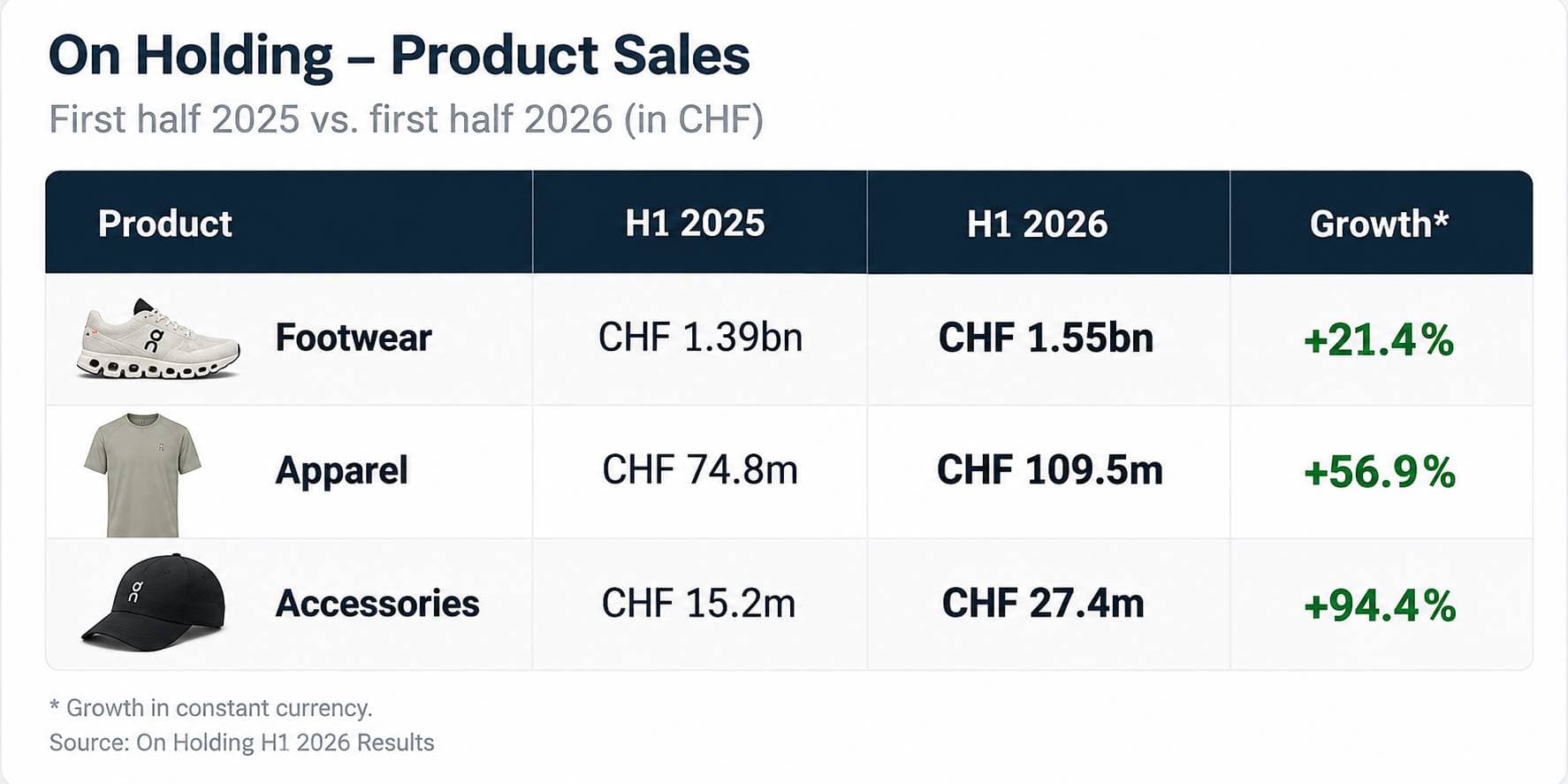
And the numbers suggest this is already happening. In the first half of 2026, footwear grew 21.4% in constant currency. Apparel grew 56.9% and accessories grew 94.4%.
On doesn't report whether the person buying the jacket is the same person who bought the shoes. So I can't see the bigger shopping basket directly in the accounts. What I can see is that the categories On added after footwear are growing two to four times faster than footwear itself. That is what I would expect if existing customers were coming back for more, and it would be hard to explain if the brand only worked on feet.
Here's the size of it, though. Footwear still represents around 92% of sales, so shoes will remain the engine for a long time. Apparel and accessories together did about CHF 137 million in the first half. Footwear did CHF 1.55 billion. Even if apparel doubles again next year, it adds roughly CHF 100 million to a company selling over CHF 3 billion a year.
So apparel is too small to move the revenue line yet. Its job today is to give On another way to grow without necessarily finding new customers.
Same customer. More products. Bigger shopping basket.
And there are still plenty of customers left to find.
According to On, global brand awareness is only around 30%. That is the company's own survey, so treat it as their number rather than a fact about the world. But for a company already selling billions' worth of products every year, it's surprisingly low. It also tells you where the next few years of growth are supposed to come from: people who have never heard of On, rather than people who already own three pairs.
The brand is going global
On is already a major brand in the US, but increasingly the growth is coming from elsewhere.
In H1 2026, sales in EMEA grew 22.8% in constant currency, while Asia-Pacific grew an impressive 58.1%. Asia-Pacific sales have increased from CHF 240 million to CHF 345 million in only one year.
Positive development in sales globally is nice to see as a stockholder.
It lowers the risk because you have more than one market that wants your product, and therefore can handle some headwind in another market at the same time. We're seeing exactly that right now. The Americas slowed down in Q2, and the group still grew sales by double digits because Europe and Asia picked up the slack.
On isn't dependent on squeezing another pair of shoes out of the same American customer. It can grow by entering new countries, opening stores, attracting new customers and then selling those customers more products.
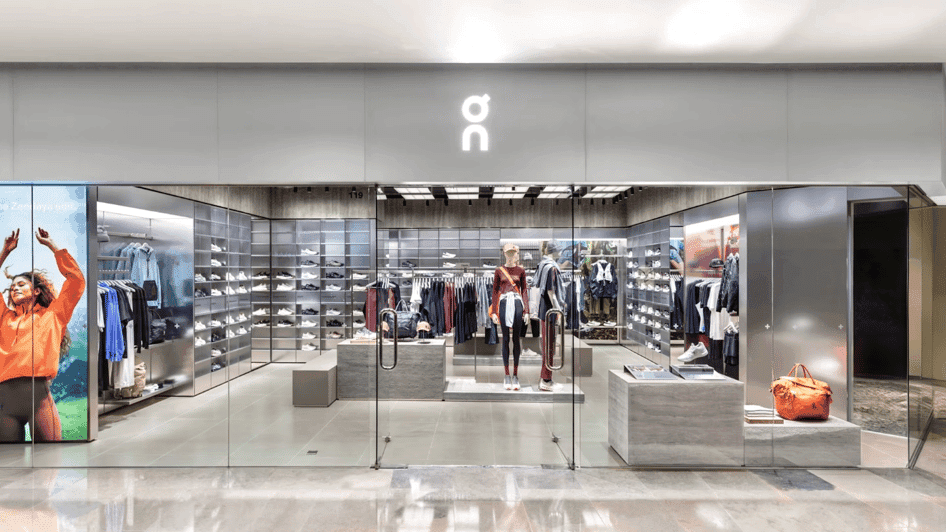
And the company's own stores are also becoming increasingly important.
Direct-to-Consumer sales grew 31.6% in H1 in constant currency, compared with 19% for wholesale, and DTC now accounts for almost half of quarterly sales.
I like that for a simple reason: On gets closer to the customer and keeps more of the money.
Instead of selling a CHF 200 shoe through someone else's store, On can sell it itself while controlling the presentation, customer experience and price.
One thing to keep in mind: DTC includes On's own website, so it's more than the physical stores. A good part of that 31.6% is online. Stores like the one in Hong Kong matter for the brand, but they also cost money to run. Management says DTC is their highest-margin channel, and the group margins (which we'll get to next) suggest they're right. Still, if On opens stores faster than customers walk into them, that channel starts costing money instead of saving it.
Of course, On still needs to make money. Otherwise On has simply built some very expensive shoe displays around the world.
More sales – even more profit
This is about as deep as I want to go into the accounting, because the important part is pretty simple.
In Q2 2025, On generated CHF 749 million in revenue and CHF 93 million in EBIT (operating profit). One year later, revenue had increased to CHF 850 million while EBIT reached CHF 119 million.
Revenue grew 13.5% – EBIT grew almost 29%.
That's scaling.
Gross margin also increased from 61.5% to 65.4%, meaning On isn't buying its growth by lowering prices. Customers are still willing to pay premium prices while the company becomes more profitable.
If you zoom out from one quarter to the last twelve months, the picture is the same. Revenue is around CHF 3.2 billion, the gross margin is around 65%, the operating margin is around 14% and the net margin is around 12%. Return on equity is about 24%.
And the balance sheet is not the problem. On has roughly CHF 1.2 billion in cash against about CHF 560 million in debt, and it generated close to CHF 290 million in free cash flow over the last year. That matters for a growth company, because the new stores, the new countries and the football boots get paid for with On's own money. Nobody needs to issue shares or borrow to fund the plan.
That's important because I don't think On's greatest asset is CloudTec, LightSpray or any other piece of shoe technology.
It's the brand.
Nike has engineers too. So do Adidas, Hoka and New Balance. What On needs to protect is the customer's willingness to walk into a store, look at a pair of shoes costing CHF 200 and think:
"Yeah, I'll take those."
As long as that continues, the economics can be very attractive. Every extra pair sold at full price through On's own store sends a bigger share of the money straight into operating profit, which is exactly what the Q2 numbers show.
Protect the brand at all costs
This is also why I'm not overly worried about the recent slowdown in the Americas.
Part of it actually appears intentional.
On could push more products into American retailers and generate higher sales today, but that creates a risk if those retailers can't sell everything at full price.
And premium brands don't want this:
CHF 200 → CHF 180 → CHF 160.
Eventually, the customer learns to wait. Why buy On at full price if it's always on sale three months later?
Management has therefore deliberately limited some wholesale volumes in the US and moderated its 2026 growth expectations to the low-20% range in constant currency. At the same time, gross-margin expectations have actually increased.
I like that decision!
I'd rather own a management team willing to sacrifice some short-term sales than one desperately pushing products into stores just to hit a quarterly growth target.
But "intentional" is only part of the story.
On the Q2 call, management also admitted that some of its everyday running shoes sold through more slowly than hoped in the US. The decision to hold back wholesale shipments was partly a response to that. So On chose to ship less because some shoes were sitting on shelves a bit longer. That is still the right response. But it means American demand was softer than the brand would like, and the stock fell hard on the day for a reason.
So there's something we need to watch: if American growth keeps slowing, we need to know whether On is choosing to sell fewer shoes, or customers are choosing not to buy them.
The way I'll tell the difference is simple. If On keeps holding back wholesale while gross margin keeps rising, it's a choice. If gross margin starts falling while sales slow, the customer is making the choice for them.
Simen has just handed you a simple way to read On's next reports: if wholesale stays restrained while gross margin keeps rising, the slowdown is a choice. If margin falls while sales slow, the customer is making the choice for On. That test is only useful if it gets applied quarter after quarter, and Simen will be doing exactly that as the Q3 and Q4 numbers land. Inside the Solberg Invest community you can follow how he updates this view over time, including when the evidence stops supporting it. Read about the Solberg Invest community
The valuation finally makes sense
On isn't a traditional value stock. It trades at roughly 20x earnings, which isn't exactly bargain territory – but neither is it terrifying.
To be precise: as I write this the stock trades at about 21x trailing earnings and around 15x next year's expected earnings. The forward number depends on analysts being right about 2027, so I don't lean too hard on it. But it tells you that if On just delivers what it has told us to expect, the multiple falls quickly.
I'm much more interested at this valuation than I would have been a few years ago. The company is larger, more profitable and still has plenty of room to grow internationally and across new product categories, yet the share price has fallen back toward levels seen in early 2024.
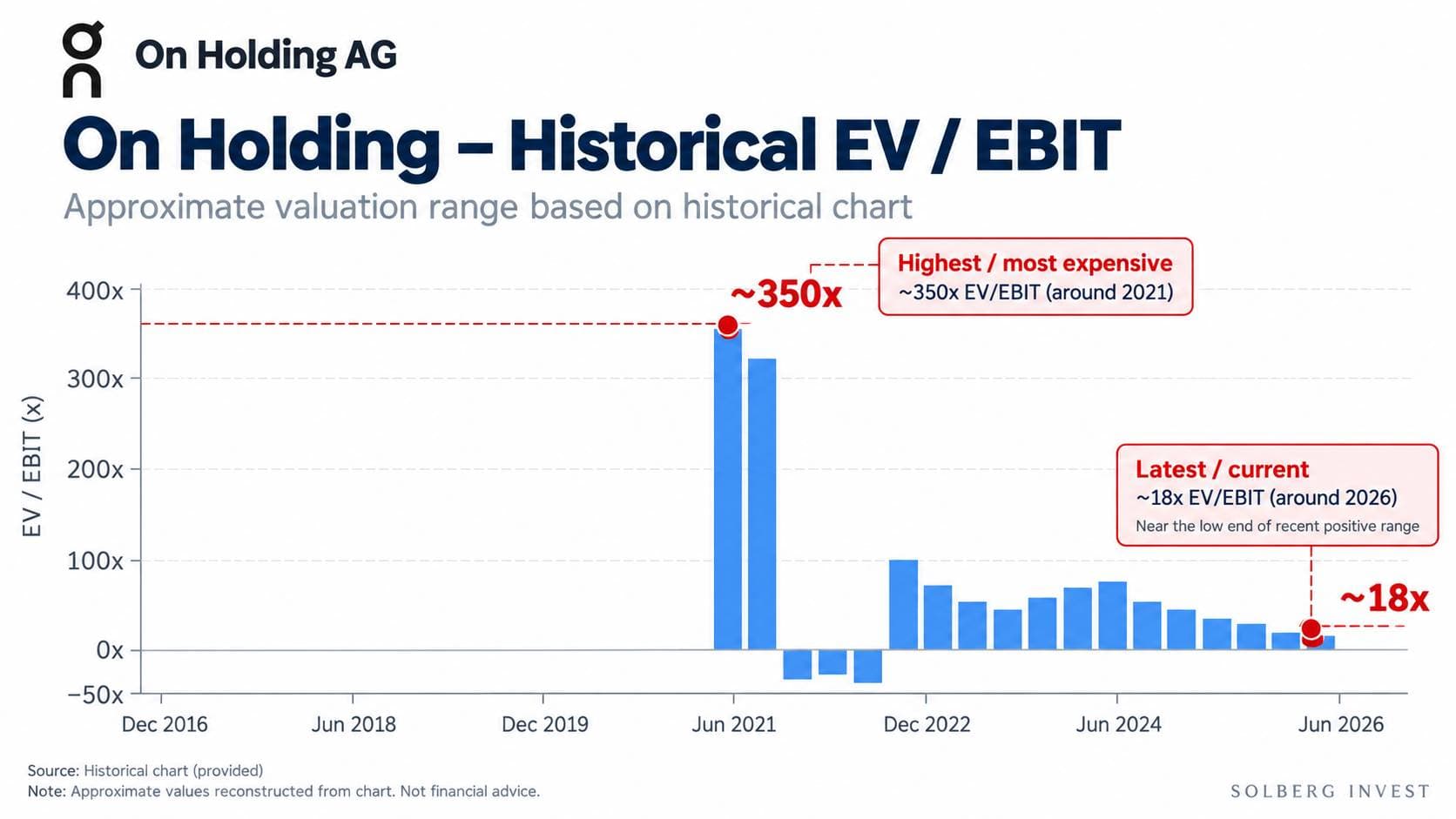
At one point, investors were willing to pay around 77x EV/EBIT for On.
Seventy-seven.
Apparently CHF 200 shoes weren't expensive enough. The stock had to join in too.
And 77x wasn't even the top. Right after the IPO in 2021, when profits were tiny, the multiple went above 300x before turning negative for a few quarters. That part of the chart is mostly a function of how small the profits were back then. The useful history starts in 2023, when On actually made real money. From there, the multiple has come down almost every quarter while the profits went up.
Today, expectations are much more reasonable. I'm still paying for growth, but I'm no longer paying for perfection. There is a difference between paying a high valuation and paying a fair price.
Two things happened after the Q2 report that make me more comfortable.
First, On held an investor day on September 22 where it laid out financial targets for 2029 and confirmed its outlook for this year. I don't own stocks because of targets. But management setting goals for 2029 while the stock sits near a 52-week low tells you they aren't seeing what the market is afraid of.
Second, On announced its first ever share buyback authorization. A company that has spent its whole public life putting every franc into growth is now saying it has cash to spare for its own shares. That's what the balance sheet told us above, and management agrees.
An authorization is just permission, though. We'll see whether they actually buy.
Though it's not dirt cheap, I'm comfortable paying 18x EV/EBIT with over 20% revenue growth, and the potential of revenue to continue growing. Just have a look at On's history of the EV/EBIT multiple:
Now... about that football player
Remember the rumor from the beginning?
The player is Kylian Mbappé.
When I wrote the first draft of this, his deal with Nike had ended and there was speculation that On could be involved in whatever came next.
Since then, On has confirmed the deal.
On September 18, On announced that it is entering football alongside Mbappé. Thierry Henry has been named Director of Football. The first football products are planned for 2027, and the first boot is in development. According to Reuters, the deal includes both cash and equity, although On hasn't disclosed the details.
So I need to correct what I wrote: the Mbappé deal is now confirmed.
And holy shit, I'm glad there was something to it.
On has never made a football boot (soccer cleat – there you go, America), so this marks On's entrance into an entirely new sport, with one of the most recognizable athletes on the planet leading the launch.
The equity part is what I find most interesting. On has already shown us this playbook with Roger Federer, who became a co-owner in 2019 before On built a serious tennis presence around the relationship.
An athlete with skin in the game is much more interesting than an athlete collecting another sponsorship cheque. He gets paid when the company does well, so he has a reason to care whether the boots are actually good.
How much equity, and whether he gets his own sub-brand as the rumors suggested, I can't tell you. On hasn't said.
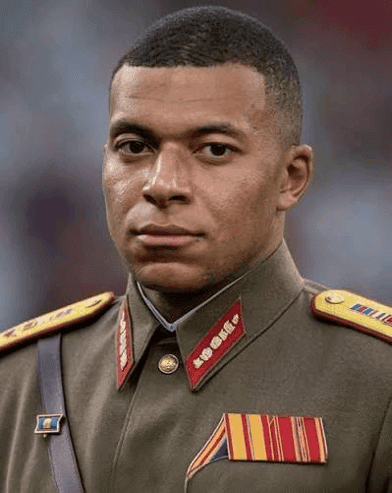
And if you've seen all the memes about Mbappé apparently wanting to run every football club he enters like a dictator, perhaps this is the perfect solution:
Give the man some shares, his own football boot and let him think he's running the company too.
Football is still a small part of the business
Jokes aside, football could be a fascinating next step for On. Running gave the company credibility, tennis expanded the brand, and football could expose it to an enormous global audience.
Football also happens to be the sport with the biggest audience in exactly the regions where On is growing fastest. If the plan is to reach the 70% of people who have never heard of On, Mbappé on a football pitch is a very direct way to do it.
But I want to stay realistic here.
Football boots are a different product from running shoes, and On has never made one. The first products won't be in stores until 2027, so there is no revenue from this for over a year. And Nike and Adidas have owned football boots for decades, so this will not be a cheap fight.
So for now:
Mbappé is the cherry on top – not the cake.
What can go wrong?
The biggest risk with On is simple:
Nobody needs On shoes.
This isn't ResMed from my previous newsletter. Nobody wakes up in the middle of the night screaming:
"Quick! Get me a Cloudmonster!"
On is a consumer brand, and consumers can change their minds quickly. You can wear On today, Hoka tomorrow and Nike next year. There are basically no switching costs, which means On has to keep earning the customer's attention.
If On stops being desirable, inventory starts building. Then come discounts, weaker margins and eventually weaker profits.
So what does the evidence say right now?
Margins are improving. Apparel, accessories, DTC and international markets are moving in the right direction. On those I'm not worried.
Inventory is the one I'd describe more carefully than I did in the newsletter. Inventory was up quite a bit year over year, and an analyst asked about it on the Q2 call. Management put it down to volume growth and currency movements, which is a reasonable answer for a company growing 20%. But it's also the answer you'd hear if demand had softened, so it doesn't settle the question. I'm watching it rather than drawing a conclusion either way. I'll keep comparing inventory growth with sales growth every quarter.
One more thing to keep in mind on margins. On's own filings say the gross margin improvement came from several places: cheaper freight, more DTC in the mix, premium pricing and a helpful currency. The company also expects tariff refunds to boost reported gross profit in a coming quarter. That means the next margin number will look better than the underlying business. When you see it, strip the refund out before celebrating.
And then there's football. A new sport, a new product and a launch led by one of the most-watched players on the planet. If the boots are bad, the whole world will know within a week. That is a brand risk On has taken on voluntarily, and it's bigger than whatever Mbappé costs.
But brand heat is the risk.
Everything else comes after that.
Simen has already told you which number to strip out next quarter
The risk section you just read is where this analysis earns its keep. Simen flagged that the next reported gross margin will be flattered by tariff refunds, that inventory growth deserves a careful comparison with sales growth for two quarters running, and that the football launch is a brand risk On chose voluntarily. None of those points resolve themselves today. If you want to see how Simen weighs each of them as the actual numbers arrive, rather than guessing at his view from one article, the Solberg Invest community is where that ongoing work lives. See how the community works
What I'm watching
I don't need On to grow 50% every year, and I definitely don't need the stock trading at 77x EV/EBIT again.
What I want is much simpler:
More people discover On → customers buy more On products → On sells more directly → margins improve → repeat.
That's really the whole investment case.
On has roughly 30% global brand awareness, apparel and accessories are still tiny compared with footwear, Asia is growing rapidly and DTC still has room to expand. If those pieces continue moving in the right direction while margins improve, there's plenty left to build.
So here is my checklist for the next few reports:
International growth. EMEA and Asia-Pacific need to keep growing well above the group. If Asia slows from 58% to 30%, fine. If it slows to 10%, something has changed.
Apparel and accessories. I want them to keep growing faster than footwear, because that is the only proof I have that the brand works beyond shoes.
The Americas. Slower sales are acceptable as long as gross margin keeps rising. If both fall together, the "intentional" explanation is gone.
Inventory versus sales. Inventory growing faster than sales for two quarters in a row is when I start worrying.
The buyback. Whether it actually happens, or stays a press release.
And perhaps I'll keep one eye on the feet of a certain French football player. From 2027, that stops being a joke and becomes a real product line to judge.
At around 20x earnings, I'm finally paying a price where I think the story becomes interesting.
The stock has gotten cheaper. The company has gotten better.
And now they really do need to start making football boots.
Sorry, America.
Soccer cleats.