

io.net is a real AI cloud business trading at roughly 5x its estimated annual revenue, but the token only captures a tiny share of that through burns while far more supply enters circulation. Buying $IO is a bet that revenue and margins grow enough for the burns to matter, and I want a trend reversal on the chart before I make that bet.
The answer in brief
The business checks out, but the $9.4 million number doesn't.
io.net's own dashboard shows about $845K in estimated earnings for the last 30 days. Annualise it and the token still trades at roughly 5x that, which is cheap for the space.
The problem is the token. Burns are small next to what goes out to GPU suppliers, and a big unlock lands next month.
So buying $IO is a bet on revenue and margins growing enough for the burns to matter.
I'm not buying yet. I want a higher high on the chart first.
What I'm looking for
As we're in the tail-end of the bear market, I'm starting to look for opportunities again.
I'm simply looking for:
real business
real revenue
good tokenomics
That last one is the hard part in crypto. Plenty of projects have the first two and a token that does nothing.
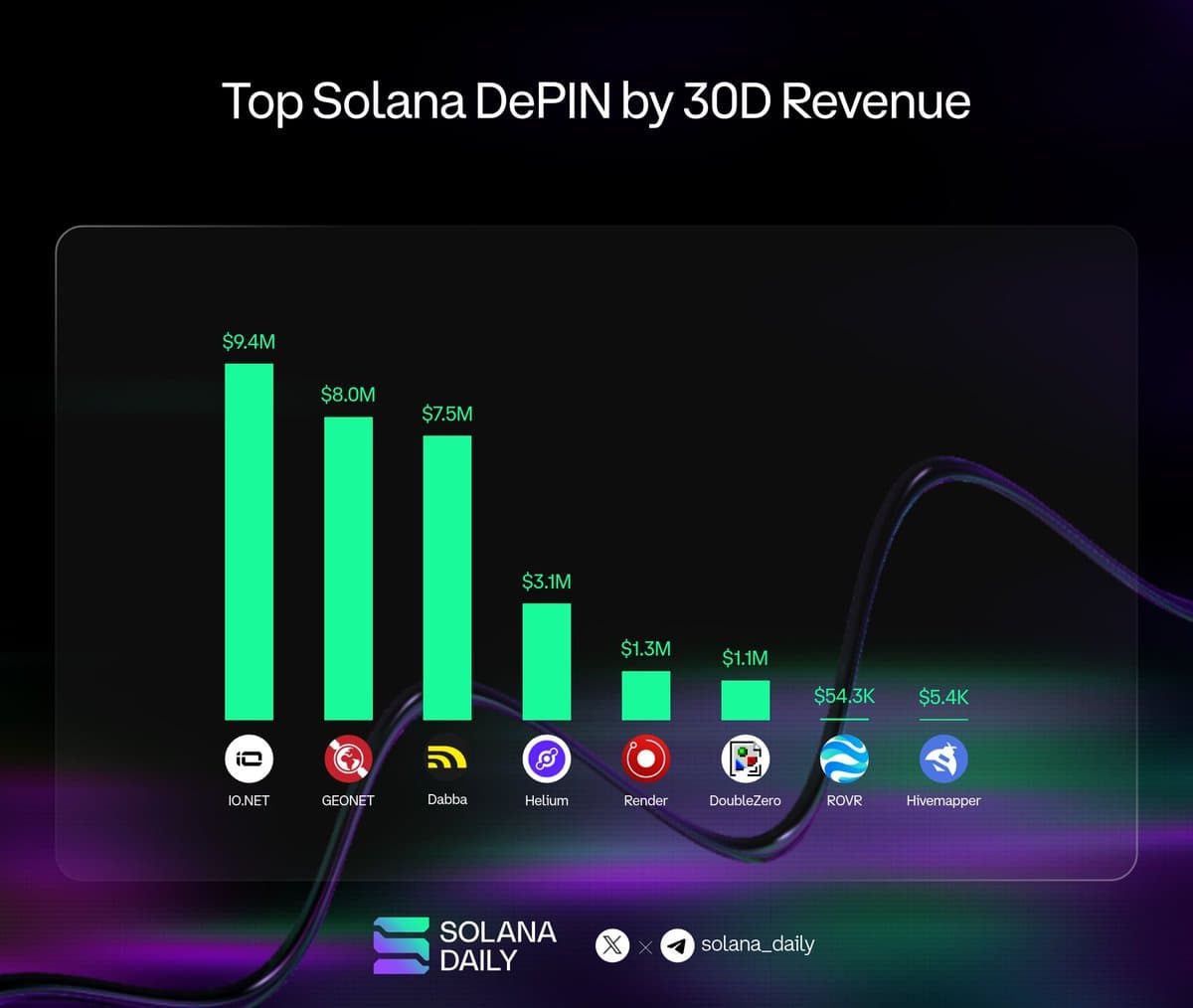
I noticed a chart going around on X saying io.net, a micro cap at around $50M market cap, made $9.4 million in revenue in 30 days.
Almost $10M in monthly revenue, and just $50M market cap?
If that were true, it would be the cheapest thing I've seen this cycle.
Skeptical, I dug in.
This letter is that investigation, in the order I did it. The business first, then the revenue number, then the token.
The business is real
io.net rents out GPUs.
GPUs are those chips every AI company is fighting over, and the reason Nvidia is the largest company in the world.
Many such chips are sitting unused, and io.net lets you rent them out by the hour.
The CEO calls it an Agoda for GPUs. Data centers have the hardware, io.net has the distribution.
They don't own the chips. They match supply and demand and take a cut.
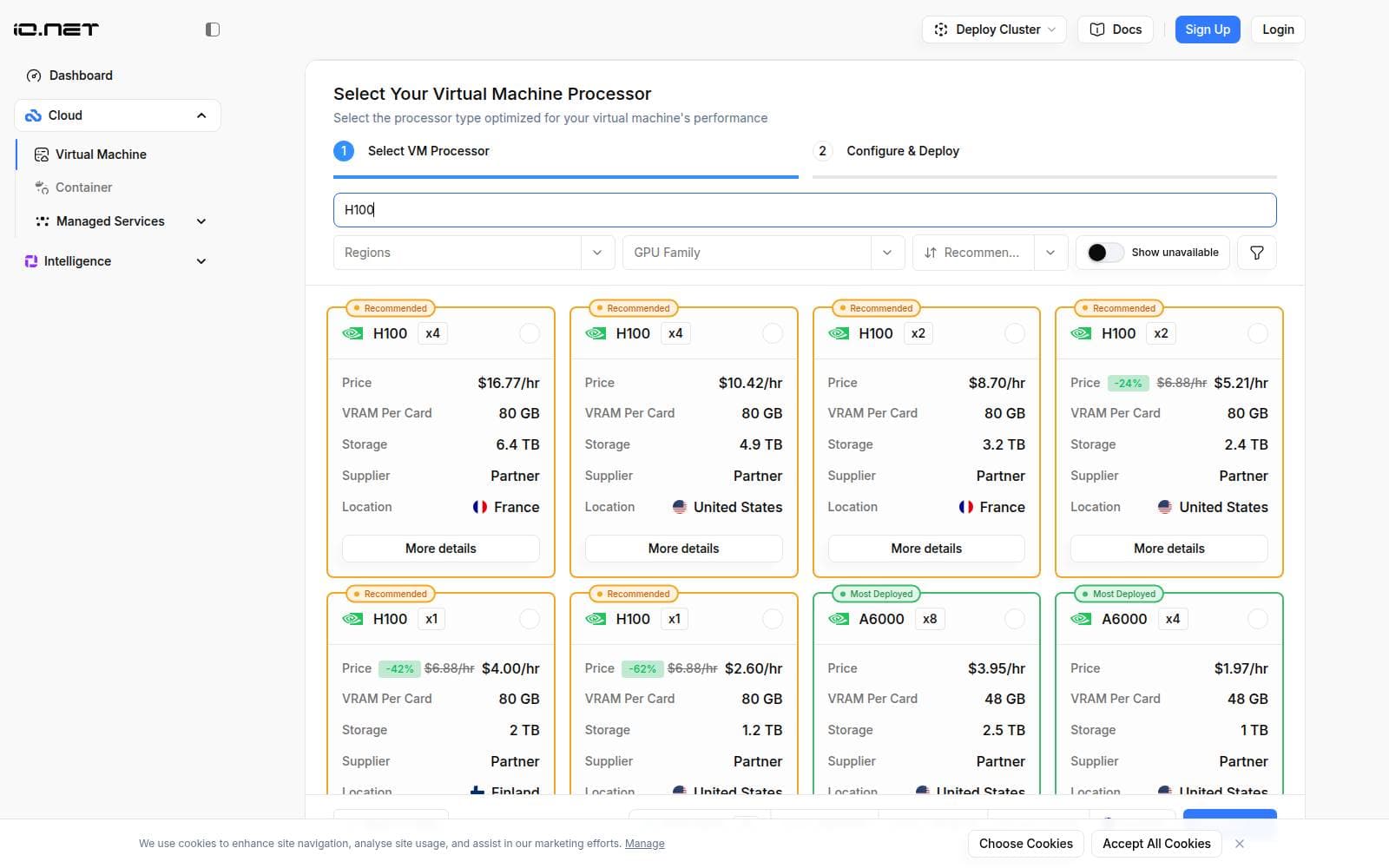
I checked their inventory, and it's legit.
A single H100 for $2.60 an hour. Four for $10.42. Machines in the US, France and Finland, all listed as available.
Runpod, a specialist competitor, lists H100s at $1.99 to $3.49, so it's competitive pricing.
But renting out unused GPUs isn't revolutionary...
Akash, Render, etc. have done this for years and years.
So the question is whether anyone actually rents these.
They actually have customers
What separates io.net from most others... is that they actually have customers.
About a thousand cluster-ready GPUs are on the network today, and 98% of them are rented out.
In this corner of web3 it's normal to see thousands of GPUs listed and almost none of them in use. Here the supply is nearly sold out.
Wondera, an AI music app, has posted that it has run 552,000 GPU hours on io.net and spent $1.24 million.
That's a real customer talking about real spending in public. Which is rare in this corner of web3.
And in addition to GPU renting and cloud services, they also offer intelligence.
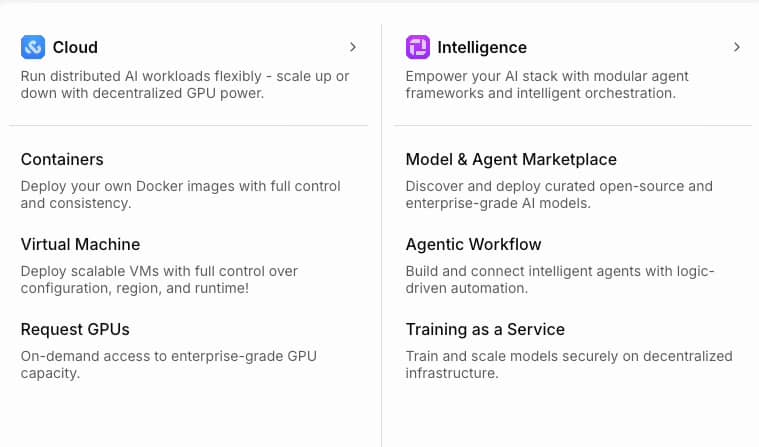
Cloud is the hardware side: containers, virtual machines, raw GPUs on demand.
Intelligence is the software side: a model marketplace, agent workflows, and training as a service.
They also sell the AI that runs on those GPUs.
That matters for the next check, because it means we can see part of their usage from the outside.
The OpenRouter check
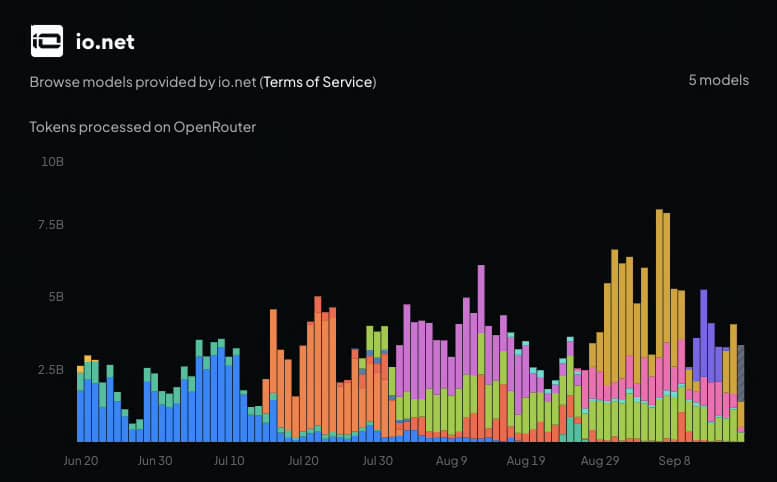
Lucky for us, they serve their models through something called OpenRouter, which lets us see how people use the models they provide.
They serve five models there, all open-source ones like GLM and Qwen.
They've served roughly 125 billion tokens in the past month.
Tokens here means AI usage, the words a model reads and writes. More tokens, more usage.
And the chart is going the right direction. Daily usage in late August and early September is roughly double what it was in June.
For reference, OpenAI, the company behind ChatGPT, served 63 trillion through OpenRouter in the same timeframe. So io.net is tiny in the big picture. But we're not comparing it to OpenAI.
More interestingly, I found two crypto-native companies on the list we can compare io.net to:
Chutes - 270 billion This is one of the leading subnets on Bittensor, focused on coding agents. I actually own some of their token through staking TAO.
Venice - 1.6 trillion Privacy-first access to AI, with a token you can stake for more usage. This was actually one of our picks in the AI Agent Lab back in 2025, and it has gone over 10x since.
In terms of market cap per billion tokens served, using market caps as I write this, here's the comparison:
io.net: $55M / 125B = about $440K per billion tokens
Chutes: $102M / 270B = about $380K per billion tokens
Venice: $1.24B / 1.6T = about $780K per billion tokens
Lower number means cheaper coin per token served.
So Chutes is the cheapest, io.net is close behind, and Venice is almost 2x more expensive than io.net.
Venice is the one that already 10x'd. io.net is priced at less than half of it on this metric.
Now, this is a rough metric. It only counts usage that goes through OpenRouter, and it says nothing about margins. But it's a useful sanity check.
Chutes is building fully decentralized agents, which by itself is a value proposition.
And io.net does more than simply offer inference (AI use).
Agent Cloud, for example, is an API for AI agents to rent GPUs on their own. Confidential compute, a separate product, protects sensitive workloads while they run.
Think of the models as the software, and GPUs as the hardware. io.net has both.
So far, everything checks out.
Now the revenue number.
The $9.4 million MRR claim
io.net runs a public dashboard, the Explorer, that records what the network earns.
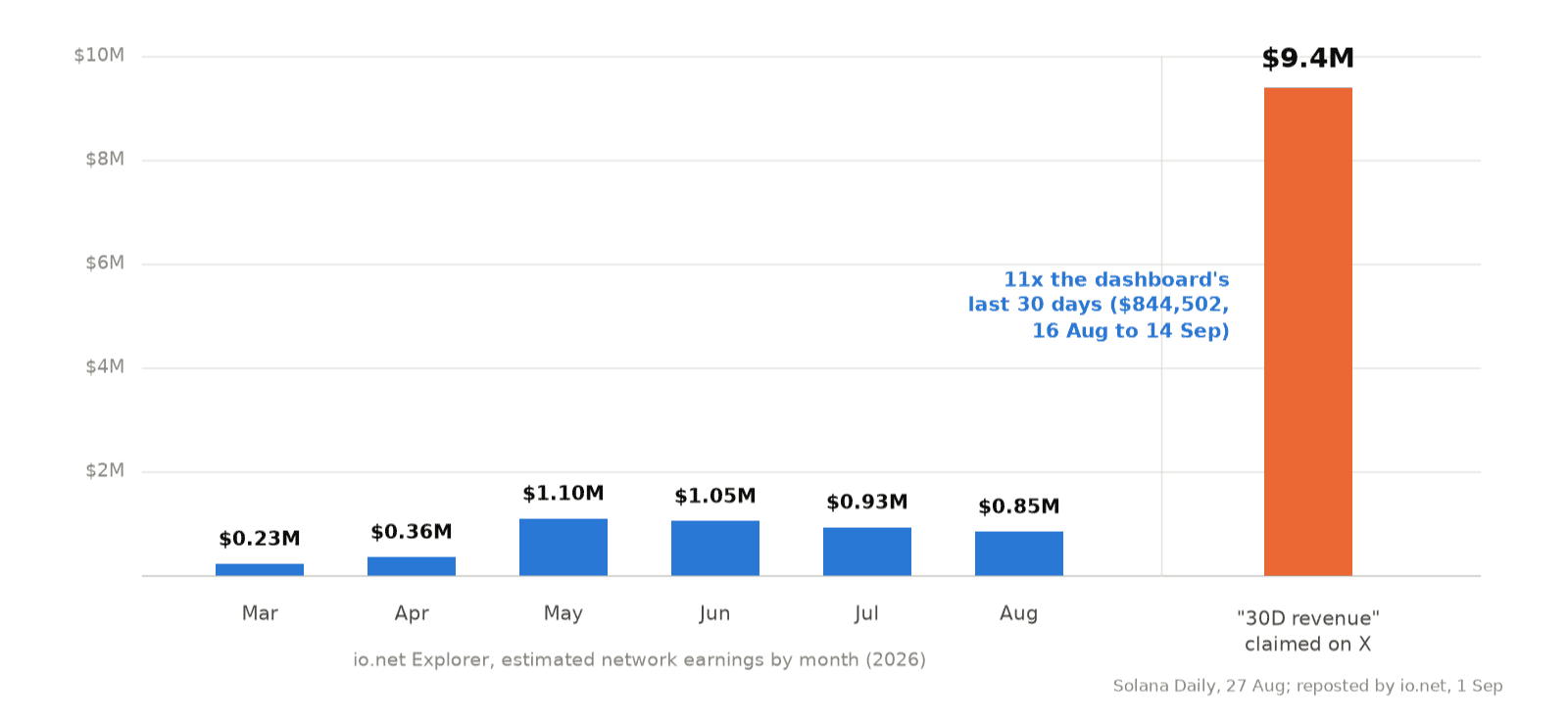
For the 30 days to 14 September, it shows $844,502.
Not $9.4 million. $845,000.
The Explorer calls this estimated network earnings. It's their own estimate of what the compute earned, not audited revenue. But it's the only number they publish, and it's the number the chart on X should have used.
The $9.4M chart came from an account called Solana Daily.
It ranks io.net first among Solana DePIN projects by 30-day revenue, ahead of GEODNET at $8.0M and Dabba at $7.5M. io.net itself reposted it on 1 September.
My guess is that they annualised the 30-day revenue. $9.4M is about 11x the dashboard's last 30 days, so it's not a clean multiply by 12 either. Whatever they did, the monthly number is $845K.
Month by month estimated earnings according to io.net's Explorer:
$227K in March
$358K in April
then a jump to $1.10M in May
$1.05M in June, $930K in July
and a slow drift down to $845K in August
So revenue is almost 4x what it was in March. Good. But it peaked in May and has drifted lower every month since. Less good.
The May jump lines up with an $8 million enterprise contract announced in June, which management says brings in about $650K a month.
If that's still running, one customer is 3/4 of the whole revenue.
I don't know the answer to that. Whether that contract is still live, and whether the drift since May is the rest of the business shrinking or the contract winding down.
Annualise the last 30 days and you get about $10M.
Against a market cap of about $55M as I write this, that's roughly 5x.
Cheap, compared to competition in the DePIN space.
(DePIN = decentralized physical infrastructure networks)
So the headline was wrong by about 10x, and the coin still looks cheap on revenue. Which brings us to the question that matters more.
Cheap or not, the more important question is if the token, $IO, captures value.
Does $IO capture value?
More often than not, the token isn't linked to the adoption of the company.
In cases like that, the company can do great (make lots of money) but the token stands still.
We need to figure out if this is true or not:
If io.net makes more money, does the token go up in price?
Here's how it's meant to work:
Customers pay, mostly in normal money. io.net buys $IO with part of it, and burns those tokens.
The docs say at least half of what's left after paying the GPU suppliers goes to burns.
And as far as I can tell, it kind of works like this today.
Roughly $268,000 of $IO has been burned so far.
I checked Solana, and there's a transaction from 15 September that permanently destroys 28 $IO from the settlement wallet. The maths matches the formula they describe in their docs.
So the mechanism exists and it runs.
The problem is scale... and the inflation.
In the last 30 days:
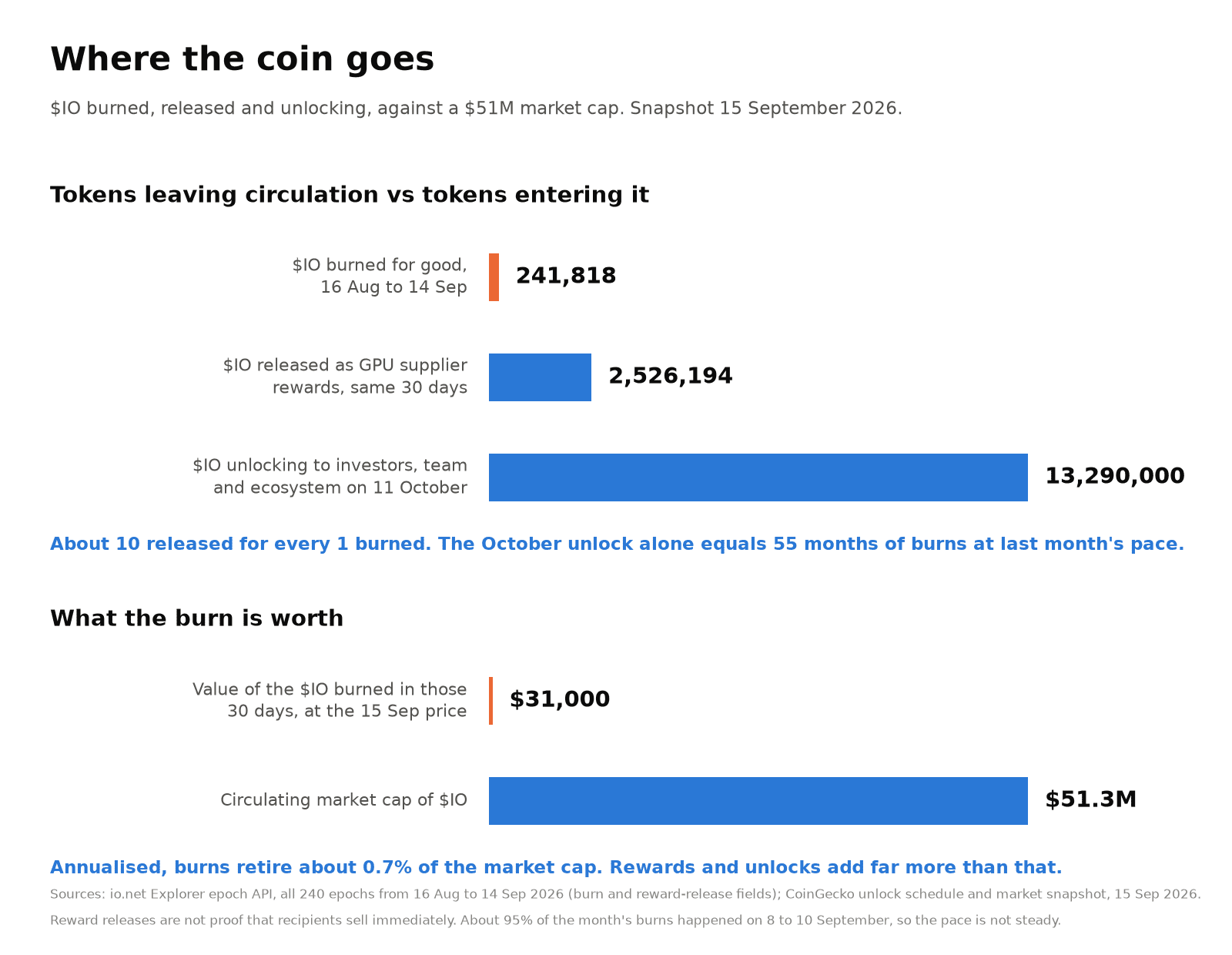
241,818 $IO were burned.
2,526,194 $IO were released as rewards to GPU suppliers.
About ten out for every one burned.
And on 11 October, another 13.29 million $IO unlock for investors, the team and the ecosystem.
One day of unlocks that equals 55 months of burns at the current pace.
At today's price, last month's burns are worth about $33,000. Annualise that and burns retire about 0.7% of the market cap a year.
In my BankrCoin letter earlier this month, the buybacks worked out to over 20% of the market cap. That's what "the token captures value" looks like. This isn't that yet.
io.net's own target is 12 million $IO burned in the first year. At last month's pace they'd get to about 3 million.
And 95% of last month's burns happened on three days, 8 to 10 September, so even that pace isn't steady.
To be fair, the suppliers getting rewards don't have to sell. But the direction is clear. Far more $IO enters circulation than leaves it.
What would it take?
So what does the business need to do for the burns to matter?
$30M a year of real revenue, 20% kept after paying suppliers, half of that burned, gives $3M of burns.
About 5-6% of the market cap.
At $60M in revenue and 25% margins, it's $7.5M burned, about 14% of market cap.
Today's run rate is roughly $10M of estimated revenue, with unknown margins.
The margin part is what most people skip. io.net doesn't own the GPUs, so most of every dollar goes straight back to the data center. What's left for burns is their cut, and they don't publish it.
One more thing on their 12 million token target. It's a target in tokens, not dollars. At today's price, 12 million $IO is about $1.6M, or about 3% of the market cap. So even if they hit their own goal, it's a small number for holders. What we should care about is dollars burned against market cap.
The bull case needs the business to triple, and for margins to be high-ish, leaving room for burns.
That's a lot to ask. But the business did almost 4x from March to May, so it's not a crazy ask either.
Which raises the obvious question. If the business is this real, why is the token this cheap?
Why it's this cheap
io.net's launch was a mess.
In April 2024, two months before the token launched, the network got flooded with "fake GPUs".
io.net itself admitted to about 400,000 spoofed workers. Two days before launch, the founder and CEO, Ahmad Shadid, resigned amid "allegations about his past".
They promised independent verification of GPU counts and sales. Two years later, nobody can point to it.
Co-founder Tory Green took over as CEO. In April 2025 he moved to chair the foundation, and Gaurav Sharma became CEO. Sharma was the CTO who signed the incident report.
The company has shipped a real product under him since. But it's the same company.
Then there's the investors.
They got equity plus token warrants in a $30M Series A, at reported token valuations of $500M to $1B.
It's currently trading at $103M fully diluted.
Roughly 20% of what investors paid. Well, they also got equity in the company, so it's not a clean comparison. But they're deeply underwater on the token.
And only half the supply is out.
The rest arrives through 2028 and beyond. The 13.29 million unlocking next month is one of many.
So the market has good reasons for the price. A bad launch, a founder who left, unverified numbers, and a lot of supply still to come.
That's why the revenue number and the market cap look so mismatched.
The token is down over 95% from December 2024. As I write this it sits about 98% below its all-time high of $6.43.
My take
The business is more convincing than the token.
A real AI cloud provider with almost 100% of their GPUs rented, traction on OpenRouter (AI inference), and real paying customers.
At around $55M market cap, $100M fully diluted, this is interesting.
And right now the token gets 0.7% of its market cap in burns while ten times that goes out in rewards, with an unlock worth 55 months of burns landing next month.
Buying $IO is a bet on significant traction on both revenue growth and margin growth.
That's the only way they're able to increase their buy-backs and burns.
What I'm watching:
The Explorer's monthly number. If it turns back up from $845K, the drift since May was noise. If it keeps falling, the enterprise contract is probably fading.
Burns. Do they stay lumpy, or become a steady monthly amount?
The 11 October unlock, and what the price does through it.
OpenRouter usage. It's the one number nobody at io.net controls.
What would change my mind: a public number on their cut of revenue, or burns rising to several percent of market cap a year. Either one would make me want to own the token.
The numbers that will decide this
I've laid out exactly what I'm watching: the Explorer's monthly earnings, whether burns turn steady, how price behaves through the 11 October unlock, and OpenRouter usage. I've also said what would change my mind.
That means my view here could change as those numbers come in. As those numbers come in, my view on $IO will move, and so will my view on whether the wider AI cloud niche is worth capital at this point in the cycle.
If you'd rather follow how that judgement evolves than read a one-off take, the Solberg Terminal is where I keep working through cases like this one. Learn about the Solberg Terminal