

HP is cheap on the numbers, but the business is growing where margins are thin and shrinking where they are fat. I won't pay for today's earnings until I see PC margins recover and the Printing decline stay controlled.
The answer in brief
Yes, HP is cheap. Around 10x forward earnings for a company that generates billions in free cash flow and pays a near 4% dividend is cheap by almost any measure.
But it's cheap for a reason. HP is growing in the part of the business that barely makes money and shrinking in the part that makes most of it.
So I'm not calling it a buy today. I want to see PC margins recover and Printing decline slowly before I'm comfortable paying for today's earnings.
If Printing keeps falling and PC margins stay where they are, the discount is deserved and I'll leave it alone.
The HP you already know
Hey, Simen here!
In pursuit of finding stocks that aren't correlated to crypto, I recently got a request from a community member about a well known stock: Hewlett Packard, also known as HP.
You probably don't need me to explain what HP does.
It sells PCs, workstations and printers. Around 70–75% of revenue now comes from Personal Systems (their PC part), so measured by sales, HP is increasingly a PC company.
But measured by profits, things look different.
In fiscal Q3 2026 (the quarter ending in July), HP's PC business had an operating margin of just 4.6%. Printing products and accessories delivered 18.1%.
That means HP makes roughly four times as much operating profit for every dollar of Printing revenue compared with PC revenue.
And that's where our problem begins.
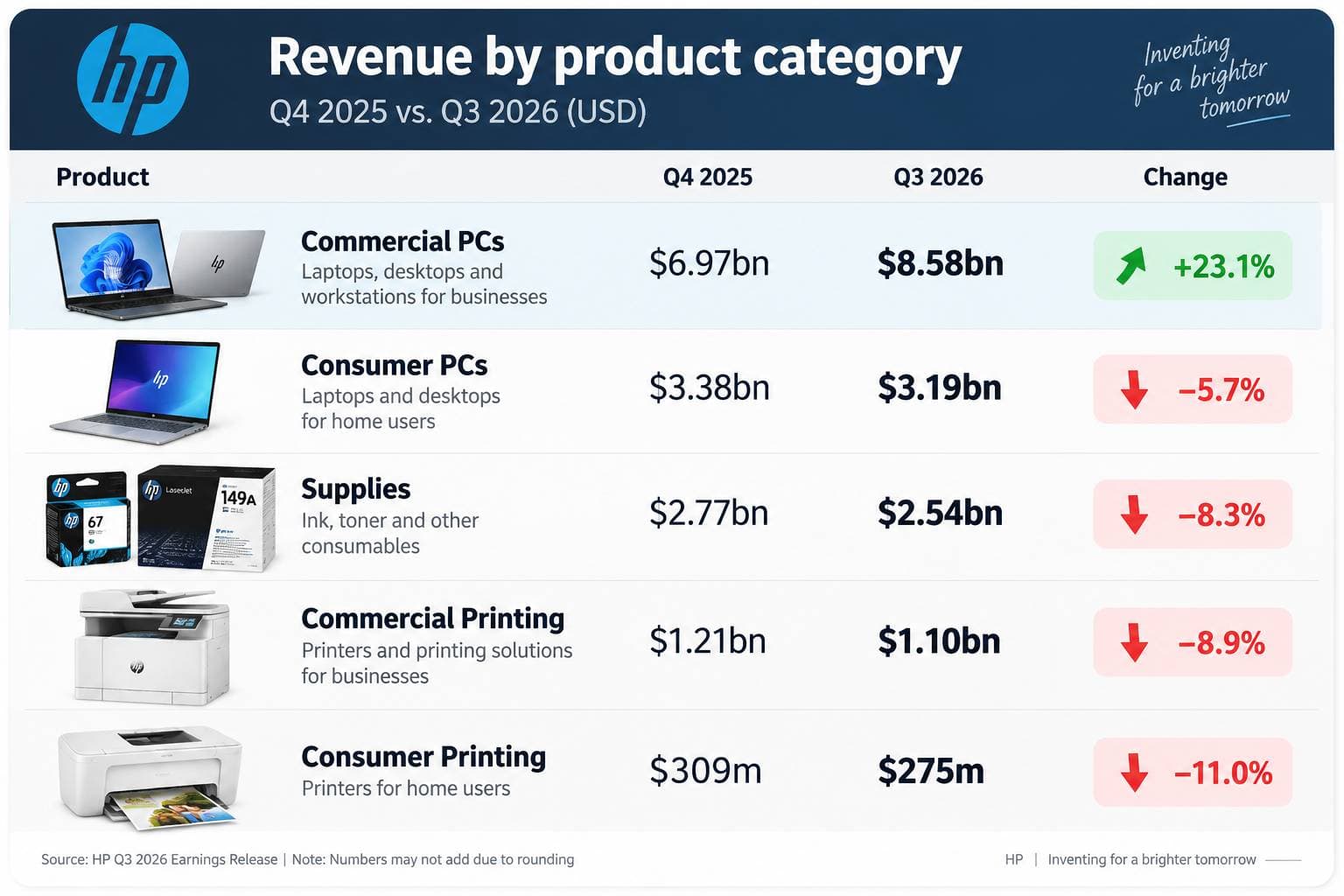
Look at what's happening underneath HP's overall revenue growth in the chart below. Commercial PCs went from $6.97 billion to $8.58 billion, up 23%. Everything else is red. Consumer PCs down 5.7%. Supplies down 8.3%. Commercial Printing down 8.9%. Consumer Printing down 11%.
One note on the chart: it compares Q4 2025 with Q3 2026, so the percentages aren't the year-over-year growth rates HP reports. But the direction is what matters here.
Commercial PCs are flying.
Almost everything related to Printing is moving in the opposite direction.
HP is growing where margins are low and shrinking where margins are high.
That's basically the entire investment case in one sentence. Every dollar of revenue that moves from Printing to PCs earns roughly a quarter of the operating profit it used to. As I write this, the company-wide operating margin sits around 5.4%, which tells you how much the PC side already dominates the blend.
Will this trend continue, or will there be brighter days?
The printer is actually good business
Selling PCs is a difficult business.
HP competes with Lenovo, Dell, Apple, Asus and Acer, and there's not much stopping a customer from switching brand. If you own an HP laptop today, Tim Cook isn't going to send someone to your house if you buy a MacBook tomorrow.
That makes pricing power difficult.
Printing works differently.
Once HP sells you a printer, there's a good chance you'll come back for ink, toner, service or perhaps a subscription. It's basically the razor-and-blades business model.
Sell the printer once - keep selling the expensive ink.
This is why Printing matters so much. Supplies alone generated more than $8 billion in revenue during the first nine months of fiscal 2026, and those recurring purchases help explain why Printing can operate at an 18% margin while PCs sit below 5%.
The problem is obvious: people print less than they used to.
I used to put that down to cloud services, but HP's own annual report gives a longer list. Digitization, hybrid work, generic ink and toner from other suppliers, and customers moving toward refillable tank printers. That last one is worth a second look. HP actually sold more tank printers last quarter. But a tank printer means fewer expensive cartridge purchases later. So HP is growing in the kind of printer that eats into its own supplies revenue.
There are pockets of growth. Industrial printing grew, and HP now counts its Print-as-a-Service business inside the Printing segment. But those are small next to supplies.
One more thing about that 18% margin. Management said the Printing profit last quarter was helped by tariff refunds and by pricing actions. So I don't want to assume 18% is purely the ink machine working as normal. Some of it is one-off.
Supplies revenue fell 3% in Q3, and the broader Printing business continues to shrink. HP is therefore slowly losing revenue from its most profitable engine.
For me the margin is less important than the rate of decline. A business shrinking 3% a year at 18% margins can fund a lot of dividends for a long time. A business shrinking 10% a year cannot.
You've just read why Simen treats an 18% Printing margin as less important than how fast supplies revenue is shrinking, and why 3% a year and 10% a year describe two different companies. That distinction only pays off if someone keeps checking it quarter after quarter. In the Solberg Invest community, Simen's portfolio risk work continues past the publish date, so you can follow how his read on cases like this one develops as new numbers arrive. If this way of separating a good margin from a durable one matches how you want to think about your own holdings, you can read about how the community works and what membership involves. See how the Solberg Invest community works
PCs are growing again
Luckily, something interesting is happening on the other side of HP.
Personal Systems revenue grew 11% in Q1, 13% in Q2 and 18% in Q3. Commercial PCs have been particularly strong, helped by businesses replacing older computers and upgrading their fleets.
There's a simple reason for some of that. Microsoft ended standard support for Windows 10 in October 2025. Companies didn't have to replace their machines, but a lot of them had an excuse to do it. That's the kind of refresh that shows up for a few quarters and then fades.
AI-PCs could add another reason to upgrade.
These machines include hardware designed to process some AI workloads locally rather than relying entirely on the cloud. HP launched a new range of commercial AI-PCs in March this year. If AI applications become useful enough, companies may decide to switch out the machines they have for HP's new ones.
I'm not building the HP thesis around that, though.
What interests me more is what customers are buying. In Q3, PC revenue increased 18% even though unit volumes fell. HP pointed toward a richer mix of premium devices, workstations and AI-PCs.
In other words, HP generated considerably more revenue per machine.
That's promising.
But here's the catch.
When you listen to what management actually said on the call, the higher revenue per unit came from three things: higher-value products, price increases to cover component costs, and more services attached to the machines. They wouldn't say how much came from each. So part of that 18% is HP passing its own cost inflation on to customers, which is good for revenue and does nothing for profit.
And that's what the margin tells you. PC margins still fell to 4.6%. Management also said to expect more pressure on PC margins in the near term.
So I don't care if HP sells increasingly expensive laptops if those sales don't eventually translate into higher profits. Passing cost increases on to customers doesn't make HP a better business.
HP produces a lot of cash
Over the last twelve months, the company generated around $4.7 billion in operating cash flow. Free cash flow was around $3.9 billion on HP's own definition. The data I pulled as I write this shows a lower number, closer to $3.4 billion, and the difference comes down to what you count as investment. I'll use the lower one to be safe.
Either way, it's a lot of cash. HP's market cap is around $28 billion as I write, so even the conservative number gives a free cash flow yield of around 12%.
HP then returned roughly $2.3 billion to shareholders through dividends and share buybacks.
That's somewhere around 60–70% of free cash flow going back to shareholders, depending on which free cash flow figure you use.
The dividend itself uses only around 28% of FCF per share, so HP doesn't need to empty the bank account to maintain it. The rest can go toward buybacks, debt or investment in the business. The yield is 3.7% at today's price.
Buybacks become particularly interesting when a stock is cheap.
Imagine HP earns $100 and there are 100 shares outstanding. That's $1 of earnings per share.
If HP buys back 10 shares and still earns the same $100, those earnings are now divided between 90 shares.
Nothing magical happened to the business - you simply own a slightly bigger piece of it.
The important words in that example are "still earns the same $100". The buyback math only works if earnings hold up. If earnings fall 10% while the share count falls 10%, you're back where you started and HP has spent billions getting there.
That's why HP doesn't necessarily need explosive growth to produce a decent result for shareholders. If the company can maintain its cash generation, pay a 3–4% dividend and keep retiring shares at sensible valuations, a fairly boring business can still do useful things for your portfolio.
Who says boring is bad? On the contrary. My ResMed newsletter should have taught us that already.
Don't get hypnotized by the cash flow
There's a reason I'm not simply looking at HP's high free-cash-flow yield and screaming BUY at my computer.
HP's working capital is enormous.
At the end of Q3, the company had around $10.3 billion in inventory and $7.2 billion in receivables, while accounts payable stood at a massive $21.4 billion.
Put simply, HP receives a lot of financing from its suppliers.
You can see it in one number. HP's current ratio is below 0.8, which means short-term liabilities are bigger than short-term assets. For HP, running with liabilities bigger than short-term assets is normal and has been for years. Suppliers get paid after HP has already sold the machines and collected the money.
There's nothing wrong with that. It's part of how the business operates. But changes in inventory, customer payments or supplier terms can make cash flow jump around significantly.
That's especially relevant because inventory has increased.
If HP keeps selling PCs, no problem.
If demand suddenly weakens, $10 billion worth of inventory becomes a much less attractive number. And when sales slow, the payables that financed that inventory still come due.
There's a second reason to be careful with last quarter's numbers. HP's Q3 earnings got a boost from tariff refunds, on both the reported and adjusted figures. HP raised its full-year earnings and free cash flow outlook at the same time, which is good news. But a refund is not something I can count on next year.
So the question isn't whether HP generated a lot of cash this quarter.
It did.
The question is how much cash HP can sustainably generate over several years, without refunds, without inventory swings and without leaning harder on suppliers.
That's the number I'm interested in paying for.
Cheap – but there's a reason
As I write this, HP trades around $31.4. That's around 10x forward earnings, around 12x trailing earnings and roughly 9–10x EV/EBIT. On EV/EBITDA the stock is under 8x.
That's cheap compared with most large technology companies.
Two things about the share price are worth knowing before you get excited. The stock has already come a long way, from a 52-week low around $17.6 to a high around $36.2, and it's now sitting a few dollars below that high. And the average analyst target is actually slightly below today's price. So the market isn't expecting much from HP.
But HP isn't like most technology companies. There's no software-like recurring revenue machine growing 30% annually. There's no enormous moat keeping competitors away. HP has brand, distribution and procurement advantages, but none of that stops a customer from buying a Dell instead. Printing is shrinking, PC margins are thin and customers can easily switch between HP, Dell and Lenovo.
The gross margin tells the same story. Around 20% for the whole company. Apple's is more than double that. HP is a hardware assembler with a profitable consumables business attached.
So HP deserves a lower valuation than a high-growth, high-margin technology business.
The interesting question is whether the discount has gone too far.
Because HP doesn't need to become an amazing company from here.
It just needs to avoid becoming a meaningfully worse one.
If Printing declines slowly rather than collapsing, PC margins recover somewhat and free cash flow remains strong, paying around 10x forward earnings starts looking reasonable. At a 12% free cash flow yield, HP could shrink a little every year and still give you a decent return through dividends and buybacks.
That's what makes HP different from On Holding for comparison. With On, I'm paying for future growth. With HP, I'm largely being paid to see whether today's earnings can survive.
And right now, I don't know whether they will, which is why the rest of this piece looks at what would convince me either way.
Simen doesn't know yet whether today's earnings survive.
That last paragraph sums up where Simen landed. HP is cheap, the discount is partly deserved, and the real question is whether the earnings you'd be paying for can hold. Simen says he doesn't know yet and that the answer sits in the next few quarters of PC margins and supplies revenue. Following an analyst through an open question like that is different from reading a one-time verdict. In the Solberg Invest community you can keep up with how Simen's view on a case evolves as the evidence comes in, within his Nordic equities and portfolio risk focus. If that kind of continuity is what you're missing, the community explanation page describes how it works. Learn about the Solberg Invest community
What could change the story?
There are a few ways HP could surprise positively without suddenly becoming a growth monster.
The first is better PC margins. Commercial PC revenue is already growing strongly. If component costs and tariff pressure ease, even a modest improvement from today's 4–5% margin would make all that extra revenue much more valuable.
Think about what one percentage point means here. Personal Systems is a business of well over $40 billion a year. One extra point of margin is more than $400 million of operating profit. That's a big number for a company earning around $4.6 billion in EBITDA.
Second, Printing doesn't need to start growing again - it just needs to stop falling so quickly.
An 18% margin business can remain extremely valuable even with little or no growth. If supplies settle into a slow decline of a few percent a year, the Printing segment keeps funding the dividend for a very long time.
And then there's cost cutting.
HP announced a restructuring plan in November 2025 that runs through fiscal 2028, targeting around $1 billion in annualized savings by the end of that period.
That sounds great.
But two things. The target is gross savings, and it comes with implementation costs along the way. And I don't give management credit for "saving" $1 billion if another $1 billion disappears through weaker margins and higher costs elsewhere.
I want to see the savings in the profits.
Otherwise it's just a very expensive PowerPoint slide telling me how much money we supposedly saved.
None of these three things require HP to do anything heroic: slightly better margins, slightly slower decline, and cost savings that actually show up.
What can go wrong?
The biggest risk is that HP slowly turns into a worse version of itself.
Imagine Printing keeps falling 5–10% while Commercial PCs continue growing. Total revenue could still look perfectly respectable, but HP would increasingly replace high-margin Printing revenue with low-margin PC revenue.
The company gets bigger - the economics get worse.
That's exactly the type of value trap I want to avoid. The chart above already shows this happening, and the pace is the open question.
PC competition is another problem. HP doesn't control Windows, the processors or most of the manufacturing. Lenovo and Dell can sell similar machines, and customers have plenty of alternatives. If the refresh cycle from Windows 10 fades and the AI-PC upgrade doesn't arrive, HP is left competing on price in a market where it already earns under 5%.
Then there's inventory and working capital. HP's cash generation is excellent today, but I want evidence that it remains excellent without inventories continually rising or the company becoming increasingly dependent on supplier financing.
On the balance sheet, HP had around $4.2 billion in cash at Q3 against around $10.3 billion of debt. That's roughly $6 billion of net debt, or around 1.2–1.3x EBITDA depending on how you adjust it, and the company continues generating substantial cash.
I'm not worried about HP surviving.
I'm worried about HP slowly becoming less profitable, and about the market being right to price it at 10x earnings.
What I'm watching
For me, HP comes down to three things:
Printing - PC margins - free cash flow.
Printing doesn't need to grow, but I want the decline to remain controlled. Supplies falling around 3% a year is manageable. An 8–10% annual decline would strain that.
PC revenue doesn't need to keep growing 15–20%, but I need to see more of that growth reaching operating profit. If Personal Systems keeps expanding while margins remain around 4–5%, I'm much less impressed. Management has already warned that the next few quarters could be worse on this front, so I'm not expecting the answer immediately.
Finally, free cash flow needs to remain strong. And I want it strong without tariff refunds, without inventory shrinking to flatter the number, and without payables climbing to fund it.
If those three things cooperate, the current valuation starts looking attractive because HP can continue paying dividends, buying back shares and potentially growing EPS without needing much revenue growth.
The equation is actually pretty simple:
Stable Printing → better PC margins → strong FCF → dividends + buybacks → fewer shares → higher EPS.
That's the HP story I would like to happen.
Not AI changing the world.
Not HP suddenly becoming a high-growth technology company.
Just a mature company producing a lot of cash and returning that cash to shareholders at a valuation where expectations are already fairly low.
So is HP cheap? On the numbers, yes, but I don't think it's cheap enough to buy today. I'd rather watch the next two quarters and see which way PC margins and supplies go. If both move the right way, 10x forward earnings is a good price. If they don't, I'll have saved myself a value trap.
I just need the printer to keep printing cash while the PC business learns how to keep a little more of what it sells.
Who knew we'd make it this far into 2026 and still be rooting for printer ink?
-Simen