


(Updated in September 2022)
Cosmos and Solana strive to make the crypto space faster, easier, and more practical. Born in 2014, Cosmos is a veteran. Solana is a younger project with a technical birth in 2020. The question is: which of them is the better investment?
In my comparison, Solana offered more short- to mid-term trading potential, while I preferred Cosmos as the lower-risk, more established long-term hold.
In this article, I will weigh each of these crypto projects against each other to uncover the similarities and differences, look at the tokenomics of each of their native tokens, and the historical performance as well as future potential they both have.
I will finish with my personal opinion of which was the better investment.
What Are Cosmos And Solana?
Cosmos is deemed "the internet of blockchains." ATOM is the native of Cosmos, coin and it has a capped supply. Cosmos is a project that works on interoperability in the general crypto space. They see a future where there are tons of different blockchains that communicate with each other.
It's Cosmos's mission to simplify and open up blockchain technology, helping developers to create practical and useful blockchains for their specific needs. They believe that interoperability amongst co-existing blockchains is essential to a free crypto world so there won't be a reliance on only one blockchain like Ethereum or Cardano.
Solana is a blockchain that is designed to run decentralized apps at lightning speed and extreme scalability. SOL (their native token) is used to pay staking rewards, transaction fees, and peer-to-peer transactions.
With its Proof of History (PoH) consensus mechanism, Solana can scale up to 65,000 transactions per second, and finalize transactions in less than a second. The fees are also extremely low, coming in at a fraction of a fraction of a cent (roughly $0.00025 per transaction).
It's Solana's mission to enable centralized entities like VISA and Master card to utilize blockchain technology and to enable dApps to scale beyond the current limits of leading blockchains like Ethereum.
How Are Cosmos And Solana Similar?
DAPPS. Each project focuses on bringing less complicated decentralized apps to the world, enabling developers to do their job more effectively.
FUNDAMENTAL: Both projects are fundamental in the sense that they're built from the bottom up.
NATIVE TOKENS: Both projects have native tokens listed on all the large exchanges.
SCALABILITY. Both projects concentrate on scalability. They attack the problem from different angles, as Solana aims to make a more scalable blockchain, and Cosmos aims to make more blockchains that can share the workload.
How Are Cosmos And Solana Different?
CONSENSUS: Solana uses a hybrid consensus: Proof of History (PoH) combined with Proof of Stake; Cosmos only uses proof of stake (PoS).
INTEROPERABILITY: Cosmos uses interblockchain protocol to help networks communicate with each other while Solana does not have that ability and is more or less isolated from other blockchains.
DECENTRALIZATION: Although Solana processes more transactions per second and has lower fees, it pays for this in the decentralization of the consensus mechanism used to achieve it. Basically, Cosmos is more decentralized than Solana.
SPEED/SCALABILITY: Solana is way faster and more scalable with its 50,000-65,000 per second and transaction finalization in 0.4 seconds.
Historical Performance:
I'll look at 2021 and 2022 for both projects. This will give you an idea of how well they did in a bull market and in a bear market.
Solana (SOL):
During the bullish market of 2021, SOL surged by close to twenty-five thousand percent. That's a 2,500x measured from bottom to top.
In the following bear market, which is still going on, it crashed by 88%.
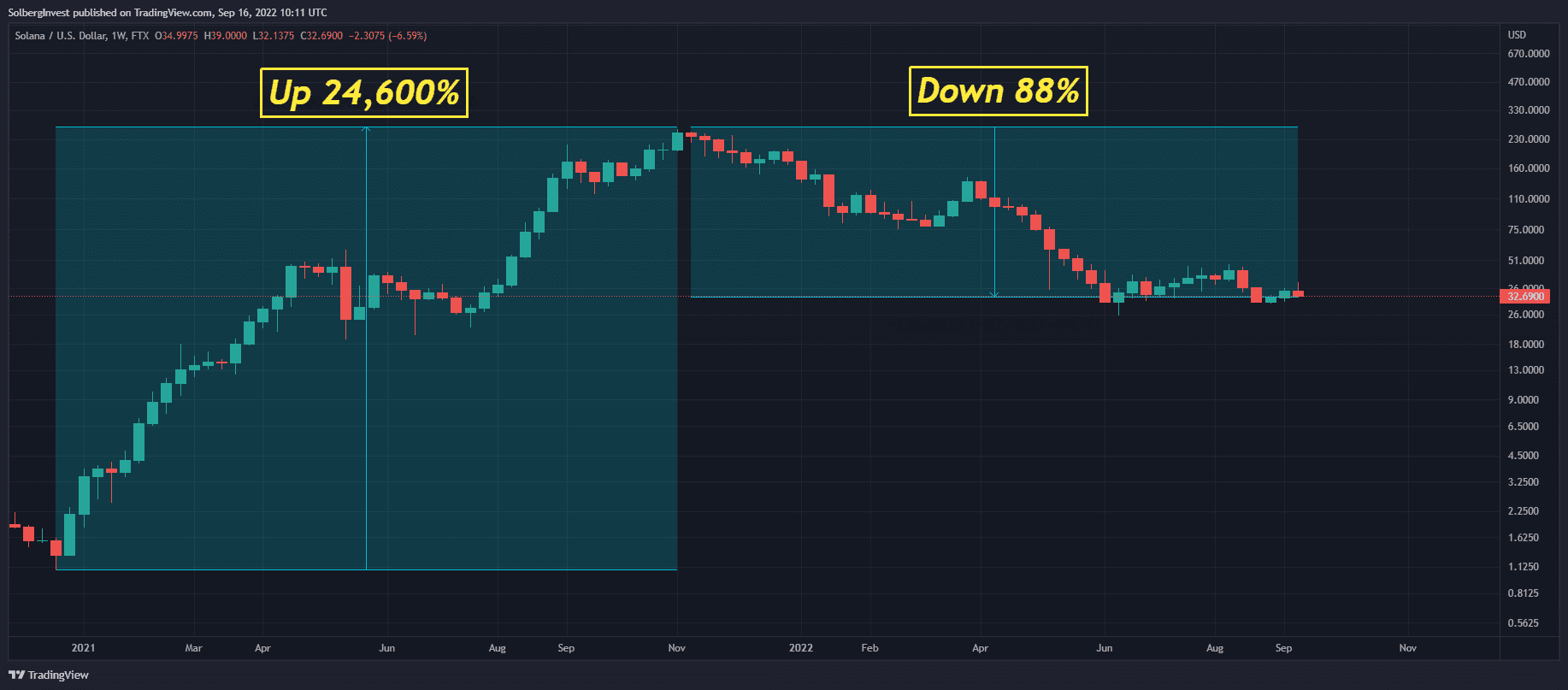
If you invested $1,000 in SOL at the end of December 2020, you’d have $264,000 in November 2021. That amount would then decrease to $31,680 in September of 2022.
Cosmos (ATOM):
Since Cosmos has way more historical data, we can measure it back to the beginning of the previous bull market - March 2020.
Below you see how ATOM did in the bull market from March 2020 to November 2021, and in the bear market from November 2021 to the present day (September 2022).
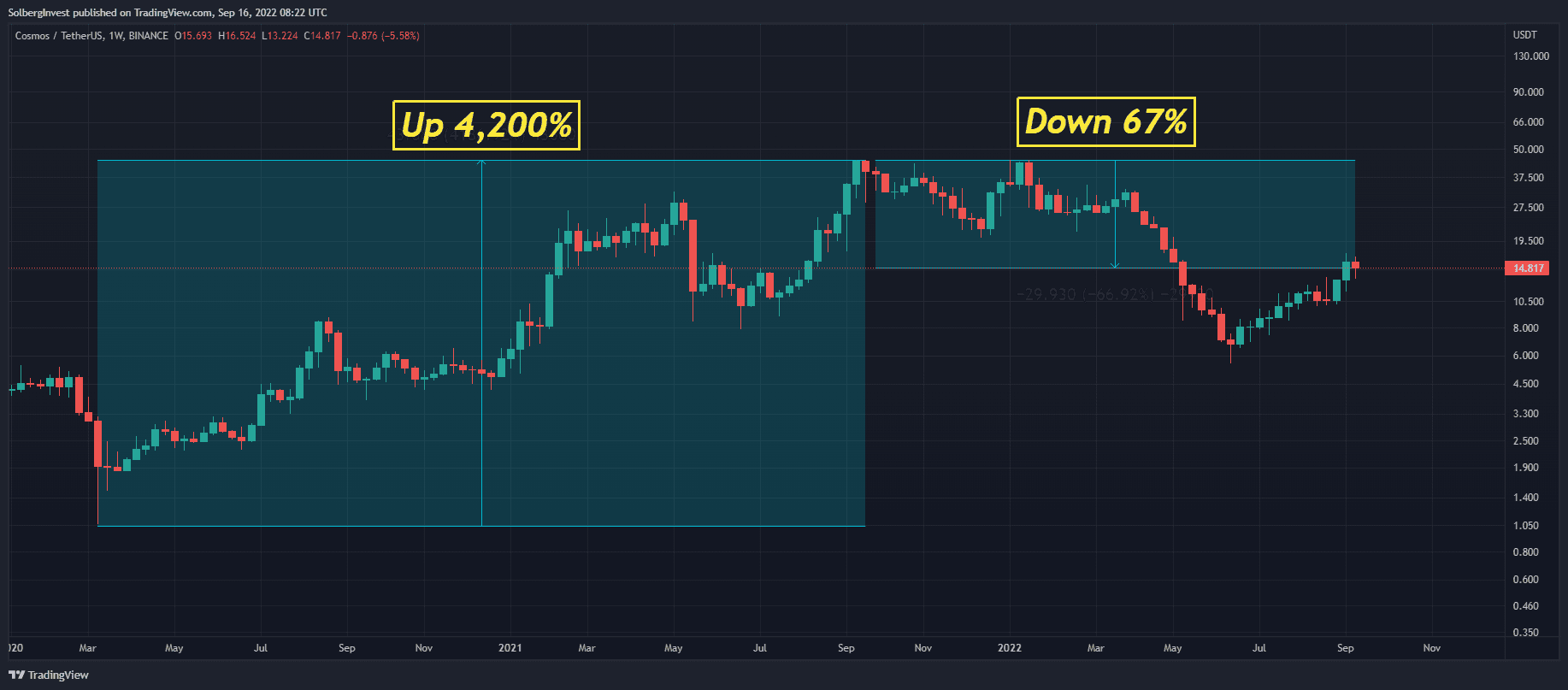
ATOM increased by 4,200% in the previous bull market, measured from the bottom of the covid-crash in March 2020 to the peak in November 2021.
In the following bear market, it crashed by 67%. That is mainly due to the multi-month rally Cosmos has been on lately. This is a remarkable performance in a bear market.
If you invested $1,000 in ATOM in March of 2020, it would be worth roughly $42,000 in November of 2021, and $13,860 today.
Historically, Solana performed much better than Cosmos in bull markets, but that did not guarantee the pattern would continue. Solana was also much younger and had more room to grow in the previous cycle, so the comparison was not conclusive. Over the interval above, Solana still outperformed by a factor of three.
Nevertheless, if we were to draw any conclusions from this data, here is what it indicates:
Solana does better in bull markets, and Cosmos does better in bear markets. Overall, Solana performed 3x better than Cosmos in the previous cycle.
Token Economics (Tokenomics)
Let's take a look at how the two tokens work. Tokenmoics is an important part of cryptocurrency investing and can have the power to make or break projects.
Solana (SOL) :
Supply Cap: 489 million
Token: SOL. 47.6% of tokens were distributed to seeding, founders, and team members; the remains have been released to the public.
Incentives: Staking that automatically compounds interest. The current rate is roughly 5.4% per year.
Inflation: Spanning from 2020 to 2031, Solana has an initial inflation rate of 8% which descends yearly into a long-term outlook of 1.5%. A separate analysis covers Solana's tokenomics.
Cosmos (ATOM):
Max supply: There is no max supply.
Circulating Supply: 292,586,163
Initial Token Distribution: ATOM. 20% distribution amongst founding companies and 80% left available to investors.
Staking: At the time, reported annual staking rewards were around 8-10%.
Inflation: A higher rate of 7-20% was set in place to incentivize users to stake their tokens. Rates fluctuate depending on the overall staking percentage (goal of maintaining at least 66% staked).
Related comparisons:
Cosmos (ATOM) vs Algorand (ALGO): Which Is The Better Investment?
Cosmos (ATOM) vs Cardano (ADA): Which Is The Better Investment?
There are numerous other factors to consider, but I've covered enough to speculate on the...
Future Outlook For Cosmos And Solana:
Solana Solana, where art thou Solana? They are here and they are using a timestamp proof of history system that can support 65,000 transactions a second!
At its theoretical full potential, the model suggested support for up to 710,000 transactions a second. That was about seven times the stated VISA capacity of 65,000.
I saw Solana's future potential in serving large-scale payment networks such as VISA, PayPal and Mastercard. In my analysis, it led this niche.
Cosmos could be what connects all the blockchains together ultimately, literally. With their protocol, consensus, and development kits, they enable globalized interoperability that can allow easy-to-build blockchains that are made for users and governed by users.
By uniting blockchains, apps, and services, Cosmos could play a role in wider decentralized-finance adoption.
It's also important to know that, at least at the time of writing, Solana is five times more expensive than Cosmos, giving Cosmos much more room to grow.
Both had an edge and, in my view, a place in the crypto ecosystem. I saw Solana as the riskier asset with more upside, while Cosmos was the more established contender.
Either way, I see long-lasting decentralized goodness in the future for both projects.
Conclusions: Cosmos for Holders and Solana for Traders
I saw Cosmos's long-term roadmap as more ambitious, while Solana already led the niche I described and needed broader developer and user adoption. Cosmos still had major milestones ahead, creating both potential and execution risk.
So, which one's a better investment?
My conclusion was to swing trade Solana and hold Cosmos, using SOL's volatility while treating Cosmos as the steadier position.
At the time, I planned to hold both to spread my own risk.