


(Updated 16. September 2022)
The battle between Cosmos and Algorand is like the battle between "the internet of blockchains" and "the future of finance". Two of the most promising projects in the crypto space that actually innovate.
Here's the short answer:
Cosmos and Algorand are decentralized platforms that strive to become faster, easier, and more practical to use. They both utilize new technology like interoperability, but Algorand may have an edge as they are functioning as the bridge from centralization to decentralization.
In this article, I will compare their tokenomics and ingenuity to solidify my speculation on what is the better investment.
What Are Cosmos And Algorand?
Cosmos is deemed the internet of blockchains because they are an ecosystem of blockchains that are interoperable. The project launched in 2019 (with white papers published in 2016), and amis to speed up blockchain transactions, lower fees, and eradicate scalability problems. They want blockchain creators to experience less complexity and more ability.
Cosmos's purpose is to simplify and connect blockchain technology to developers by taking out the enigmas of decentralized apps. They believe that communication between co-existing blockchains is essential to a free crypto world so there won't be a reliance on only one block. Originally, blockchains transacted slowly and could never share information with each other.
Cosmos's website says: "Cosmos is an ever-expanding ecosystem of interconnected apps and services, built for a decentralized future."
Algorand is yet another blockchain high-speed-low-fee-innovator that went live in mid-2019. Their website promotes: "Algorand is the future of finance, disrupters of sports and gaming, modernizing the creator economy, and empowering national initiatives."
What that really means is, that Algorand wants to bring trust and mass adoption to a decentralization system that is easy to use.
Algorand has goals to enable everyone a way to exchange value efficiently, transparently, and securely. They also have functioning interoperable technology, described in more detail in the analysis of Algorand and the blockchain trilemma.
The Algorand blockchain hosts 474 applications and partnerships as of September 2022. Cosmos on the other hand, hosts 262 applications in their ecosystem.
How Are Cosmos And Algorand Similar?
OPEN-SOURCE. Algorand and Cosmos are open-source, meaning that the community can contribute to creating new and useful tools to improve their developments.
MULTI-USE. Both are platforms for building decentralized apps and both are cryptocurrencies.
CONSENSUS. Cosmos and Algorand both use proof-of-stake (PoS) to confirm transactions. However, the specific PoS variation they use is different, but it's the same basic idea.
SCALABILITY. They concentrate on providing easier methods for mass adoption and solving congestion and speed problems.
How Are Cosmos And Algorand Different?
MARKET CAP RANK. As of mid-September 2022, Algorand is ranked 32nd on CoinGecko, while Cosmos is in 22nd place.
MAX SUPPLY. The maximum supply of ALGO is hard-capped at 10 billion coins. ATOM, on the other hand, has no upper limit.
SPEED. Algorand's transaction speed is 5 seconds while Cosmos is a close 7 seconds.
Tokenomics And Historical Performance:
Algorand (ALGO):
Max supply: 10 billion
Circulating Supply: 6,920,020,533
Token: ALGO. The current inflation rate is roughly 5% per year, but decreasing every year. By the year 2030, all tokens will be in circulation, and inflation will stop. Since people lose their funds from time to time, ALGO will effectively become deflationary at that point.
Staking: At the time, reported annual staking rewards were around 5-6%.
Initial Token distribution: 3 billion into circulation, 1.75 billion for rewards, 2.5 billion for node runners, 2.5 for internal foundation, 0.25 for the end user grants
Below you'll see the price history of ALGO from the beginning of the previous bull market and into the current bear market:
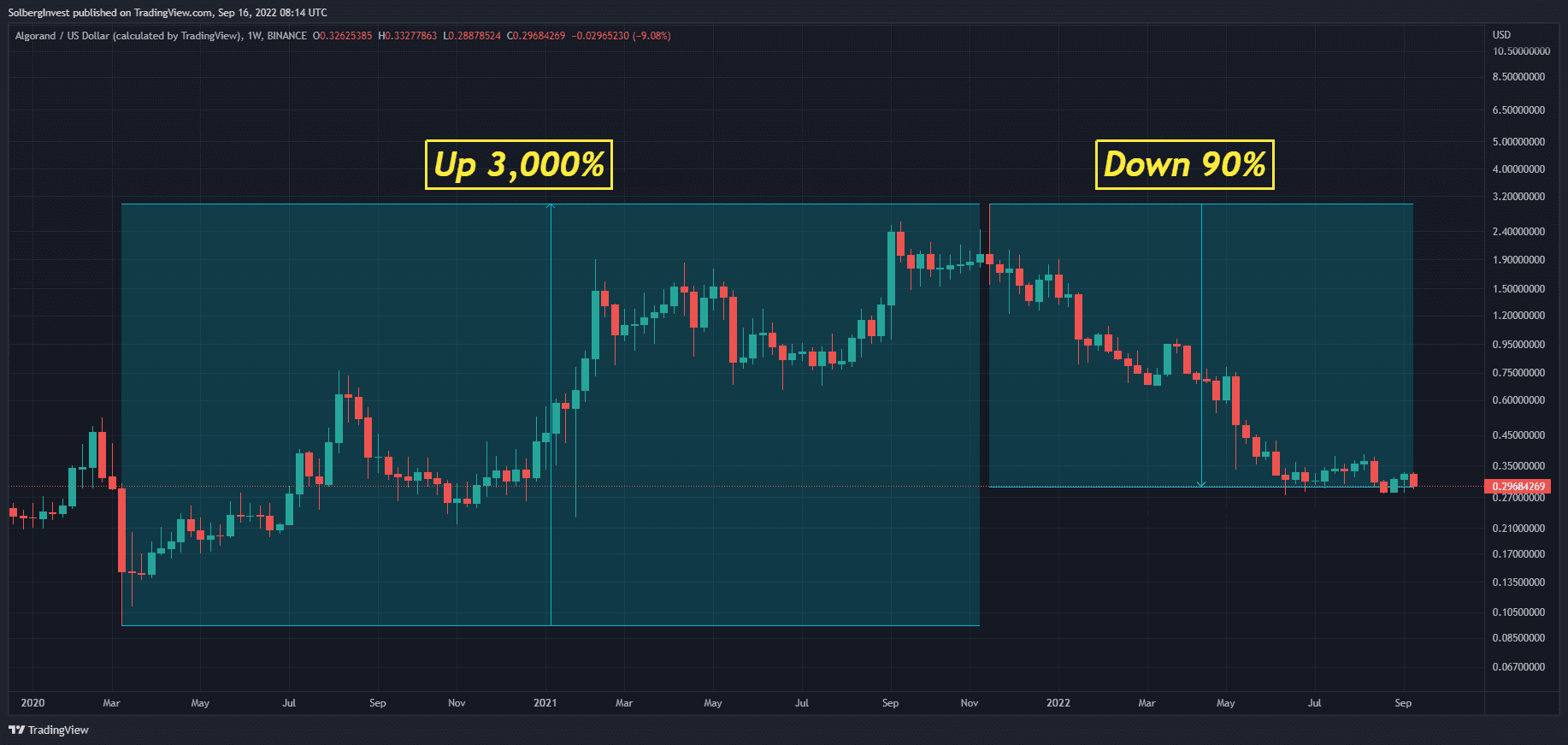
ALGO increased by 3,000% in the previous bull market, measured from the bottom of the covid-crash in March 2020 to the peak in November 2021.
In the following bear market, it crashed by 90%.
If you invested $1,000 in ALGO in March of 2020, it would be worth roughly $30,000 in November of 2021, and $3,000 today.
Cosmos (ATOM):
Max supply: There is no max supply.
Circulating Supply: 292,586,163
Initial Token Distribution: ATOM. 20% distribution amongst founding companies and 80% left available to investors.
Staking: At the time, reported annual staking rewards were around 8-10%.
Inflation: A higher rate of 7-20% was set in place to incentivize users to stake their tokens. Rates fluctuate depending on the overall staking percentage (goal of maintaining at least 66% staked).
Below you'll see the price history of ATOM from the beginning of the previous bull market and into the current bear market:
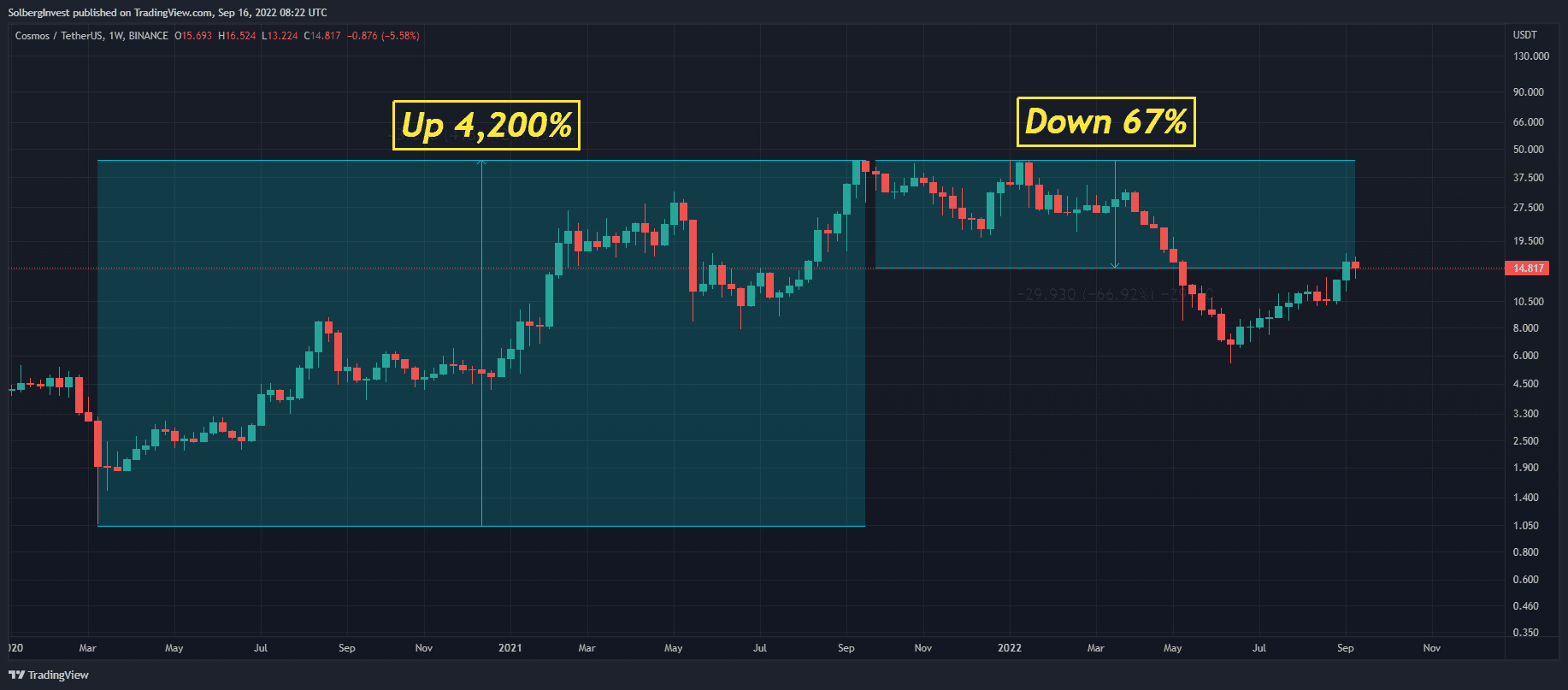
ATOM increased by 4,200% in the previous bull market, measured from the bottom of the covid-crash in March 2020 to the peak in November 2021. That is much better than ALGO's 3,000% surge.
In the following bear market, it crashed by 67%. That is mainly due to the multi-month rally Cosmos has been on lately. This is a remarkable performance in a bear market.
If you invested $1,000 in ATOM in March of 2020, it would be worth roughly $42,000 in November of 2021, and $13,860 today. That's 4.62x the $3,000 you'd have from investing in ALGO.
Future Outlook For Algorand And Cosmos:
ATOM and ALGO both understand the importance of interoperability and both want a prolific future in decentralized finance.
Cosmos's Future: They could be what connects all the blockchains together ultimately. With their protocol, consensus, and development kits, they enable globalized interoperability that can allow easy-to-build blockchains that are made for users and governed by users. If Cosmos ends up at the center of the crypto space, I expected that adoption to support ATOM's value.
Algorand's Future: ALGO basically has similar expectational visions of DeFi and they've created an interoperable ecospace too, but how will they stand out when there are so many other competitors? Is the CeFi-DeFi bridge they're creating actually going to be helpful? I think so. If they dumb down smart contract explanations enough to be understood by centralized moguls, there is a good chance they may leave the dark side - we need all the support we can get!
Another thing that helps both of their popularities is the ability to create NFTs on their platforms. Yes, those trendy, nifty, magical, incredulous, impracticable, and sometimes laughable NFTs!
In the crypto space, NFTs were the new craze. At first, I thought they were a little silly, but then I found some use cases. The winner would need the features the market demanded.
Related comparisons:
Cosmos (ATOM) vs Solana (SOL): Which Is The Better Investment?
Cosmos (ATOM) vs Cardano (ADA): Which Is The Better Investment?
Conclusion:
Over the historical interval I measured, ATOM outperformed ALGO by a factor of 4.6.
However, historical performance does not guarantee future results.
At the time, I preferred Algorand for four reasons:
Silvio Micali is the founder of Algorand. Coinmarketcap says: "He is a recipient of the Turing Award (in 2012) for his fundamental contributions to the theory and practice of secure two-party computation, electronic cash, cryptocurrencies and blockchain protocols." His long experience in cryptography strengthened my confidence in the project.
They were partnering with centralized entities while maintaining a decentralized philosophy.
Transactions are confirmed in 5 seconds (only 2 seconds faster than ATOM but hey, people love that)
I regarded its valuation as low relative to its fundamental strength.
Both Algorand and Cosmos were progressively pushing the limits, but I preferred Algorand based on the points above and its valuation at the time. ALGO was priced at 29 cents when I wrote this.
I believed Cosmos could remain ranked in the top 30 for quite some time, but its vision would likely take longer to play out. If the team executed its mission, I thought Cosmos could enter the top 10.
There you have it. I hope you've gained some value and learned more about ALGO and ATOM.
**_Trade wisely, my fellow crypto fanatics!
Oskar_**