

Improving return on investment (ROI) requires a repeatable process. Here are four methods I used to make that process more systematic.
Related reading: The broader three-step system behind these methods.
Dynamically Dollar Cost Averaging (DDCA)
One of the cornerstones of successful crypto investing is optimizing your average buy-in price. With market volatility, timing can make or break your portfolio. Dynamically dollar cost averaging (DDCA) merges the benefits of lump-sum investing and traditional dollar cost averaging (DCA).
How It Works: Unlike standard DCA, where you invest a fixed amount periodically, DDCA adjusts your investment based on market conditions. For example:
Allocate more funds when prices are lower.
Reduce investments as prices rise.
Benefits:
Lower average buy price over time.
Minimized risk during volatile market conditions.
The potential for a lower average entry without trying to time the market perfectly.
Action Steps:
Set risk levels for price ranges of the asset you want to accumulate.
Define how much to invest at each level.
Monitor your average buy price and adjust periodically.
Staking for Passive Income
Staking lets you earn rewards by holding and securing cryptocurrencies in a specialized wallet or lending them out. It’s a low-effort way to generate additional income.
Why It Works: Staking rewards are paid in the same cryptocurrency you're staking. As the value of the coin increases, so does the value of your rewards. For instance, staking 1 ETH at 5% annual interest would become more valuable if ETH's price rose.
Example:
Stake 10 ETH at $4,000 each.
After a year, you earn 0.5 ETH in interest.
If ETH's price rises to $15,000, that 0.5 ETH becomes worth $7,500.
Action Steps:
Compare staking or lending options, including their lockups, custody model, and risks.
Stake assets and reinvest earned crypto for compounding.
Monitor staking risks continually. Even reputable platforms can go down, like Celsius back in 2022.
Setting Price Targets
Profit realization is one of the most overlooked aspects of crypto investing. Setting price targets helps you lock in gains and minimize losses during market volatility.
How to Do It:
Define clear price points for selling portions of your holdings. For example:
Sell 20% at $100,000.
Sell another 30% at $150,000.
Use technical indicators like the Pi Cycle Top to fine-tune exits.
Sell slightly below your target (2-5%) to ensure your trades are executed before market reversals.
Action Steps:
Research and set realistic price targets for each asset.
Calculate portions of your holdings to be sold at each target.
Combine price targets with technical analysis for better timing.
For exiting the crypto market in general, like when you think the bull market is close to an end, I preferred using a basket of indicators instead of relying only on price targets. This gave me a more systematic average exit price.
I use an indicator that aggregates data from several indicators like Pi Cycle Top and MVRV Z-Score. This is what it looks like:
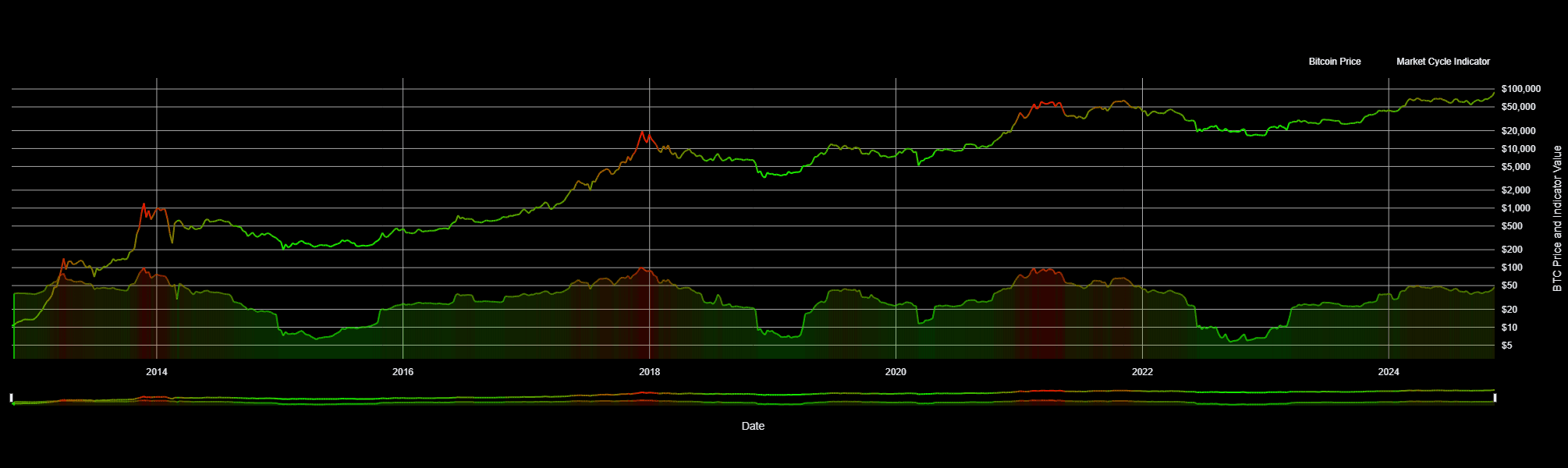
It estimates market-cycle risk on a scale from 1–100. My strategy was to sell specific percentages of my holdings at specific levels of this indicator.
For example, I might begin by selling 25% of my holdings at 80/100, then 30% of my holdings at 90/100, etc.
This ensures I don't get stuck holding my bags through the next bear market, hoping and praying for another bull.
Invest in Knowledge
Your ability to maximize ROI depends on your knowledge and decision-making skills.
Why It's Crucial: Markets evolve rapidly. Staying ahead requires understanding new trends, deep knowledge of the history from prior cycles, and strategies to make the most out of the volatility.
Ways to Level Up:
Read books and guides on crypto investing.
Follow market leaders.
Reflect on your past trades to identify areas for improvement.
Action Steps:
Dedicate time to learning every week.
Use primary sources and analytical tools to test what you learn.
Keep track of your progress to build confidence in your strategy.