

Stablecoins are versatile digital assets. Since they are tethered to external assets, like fiat currencies and other cryptocurrencies, they offer price stability while providing liquidity. Two of the most popular stablecoins operating on the Ethereum blockchain are USD Coin (USDC) and DAI, but which is better?
At the time, I preferred USDC because I found its reserve and legal structure easier to assess. DAI offered greater decentralization but introduced a more complex collateral and governance model.
My preference reflected USDC's dollar-backed reserve model and the fact that I found its legal structure easier to assess. I was more comfortable with legacy-finance settings and less concerned about USDC's centralization than I was about DAI's collateral and governance complexity.
The USDC vs USDT comparison examines the two largest centralized stablecoins.
How Are USDC and DAI Similar?
The Ethereum operating system powers both USDC and DAI.
Both USDC and DAI were widely available on cryptocurrency exchanges.
Both USDC and DAI utilize smart contracts
I can use both USDC and DAI as hedges against market volatility.
Both USDC and DAI are asset-backed (collateralized) and designed around a 1:1 value with the US dollar.
Both USDC and DAI are regularly audited.
Both USDC and DAI are open-source projects.
How Are USDC and DAI Different?
USDC and DAI are different in several key aspects, including:
Ownership: DAI is not owned by anyone, while USDC is (kind of)
Governance - Centralization/Decentralization: USDC is centralized while DAI is decentralized.
Stablecoin collateralization and ecosystem: USDC is backed 1:1 by USD while DAI is a bit more complex.
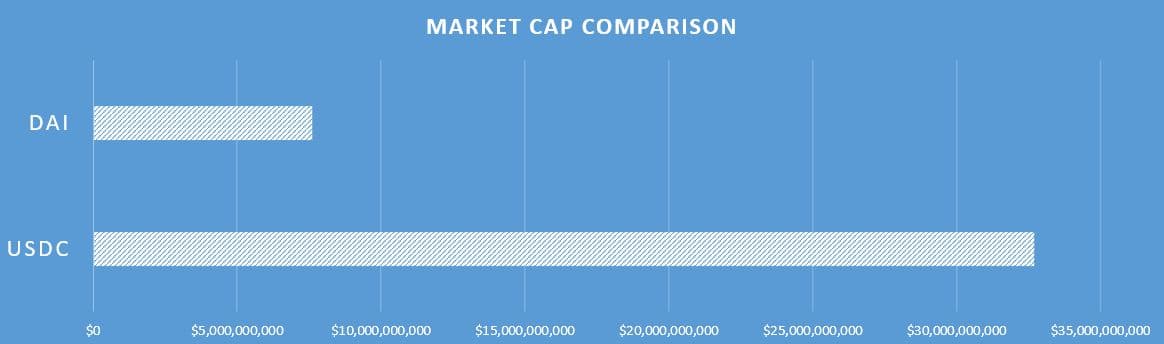
Market capitalization: USDC is much bigger than DAI, as seen on the chart below:
Let's get deeper into each of the points above!
1. Ownership
Circle Ltd founded a consortium known as Centre, which manages USDC, which was launched in 2018. Centre includes members from Coinbase, a cryptocurrency exchange platform, and Bitmain, a Bitcoin mining company that invests in Circle. Centre provides standard governance for the stablecoin.
DAI, on the other hand, was launched in 2017 and is managed and maintained by MakerDAO. MakerDAO is a decentralized autonomous organization (DAO). This means it is represented by encoded rules maintained on the Ethereum blockchain that is transparent and not influenced by a central government.
MakerDAO comprises the owners of MKR, its governance token. These members can vote for reforms to some smart contracts parameters to ensure DAI is stable.
2. Governance - Centralization/Decentralization
USDC is a centralized fiat-backed stablecoin. This means that it is operated by one central entity, in this case, Centre. Centralization has always been a tricky issue in the cryptocurrency space. The user agreement of USDC gives the governing entity the right to freeze assets at its discretion.
Circle Ltd has frozen funds upon request by law enforcement. While I see this as sometimes necessary ethically, I believe it detracts from the ethos of power decentralization that pervades digital currencies.
As an investor, I need to trust that the governing entity backs its stablecoins with the stated equivalent in alternative assets. Fortunately, I, and many other traders and investors in the crypto space, have gained trust in the highly transparent auditing and funding processes of USDC.
MakerDAO's smart contracts in the form of a decentralized application (DApp) facilitate the over-collateralization and repayment process that creates DAI. I considered DAI the first decentralized-finance (DeFi) project to gain widespread adoption and a standard currency in Ethereum's DeFi ecosystem at the time.
DAI's smart contracts reduced reliance on a single issuer that could freeze assets. However, contrary to popular notions, I did not consider DAI entirely decentralized because MakerDAO governance still controlled parameters such as accepted collateral.
3. Stablecoin Collateralization and Ecosystem
USDC is a fiat-collateralized stablecoin. USDC uses the US legal tender as its source of collateral for the issuance of tokens. USDC retains a 1:1 peg to the US dollar or other approved investments by holding an equivalent amount of the legal tender through reserves held by trusted third parties (established financial institutions and auditors).
The tokenization of the US fiat into USDC occurs in three steps: I can send a US dollar amount to the Centre (ERC20 token issuer) bank account. The Centre utilizes a USDC smart contract to create an equivalent amount of USDC. The newly minted USDC is sent to my account, and my substituted US dollar amount is held in reserve. If I want to redeem my USDC for US dollars, the process will be similar but in reserve.
DAI, on the other hand, is a crypto-collateralized stablecoin. Instead of being backed by legal tender, DAI holds other cryptocurrencies such as Ether (ETH) in escrow through Maker vaults for the issuance of new DAI. With this operational model, users can mint and burn tokens without a single fiat custodian. Its collateral and issuance process operates on-chain.
If I deposit ETH or other accepted cryptocurrencies, I can borrow against the value of my deposit and receive a newly created DAI. Another difference between DAI and USDC in this regard is that where USDC only needs to hold a 1:1 reserve in fiat, DAI and other crypto-collateralized stablecoins need over-collateralization to mitigate price volatility.
The collateralization ratio for DAI : Ether is set to 150% currently. This means that if I deposit $150 worth of ETH, I would be able to borrow up to 100 DAI (which is roughly equivalent to $100). If the collateral value dips below this ratio, the smart contracts can automatically liquidate the loan. Conversely, if the value of the collateral rises, I can borrow additional DAI.
By repaying a loan and the interest accrued, the returned DAI is burned automatically, and the collateral is available for withdrawal. The US dollar value of DAI is backed by the dollar value of the underlying collateral that MakerDAO's smart contracts hold.
MakerDAO can control the circulating amount of DAI by controlling collateralization ratios, types of supported collateral, and the DAI borrowing and storing interest rates. This is how MakerDAO controls the value of DAI.
4. Market Capitalization
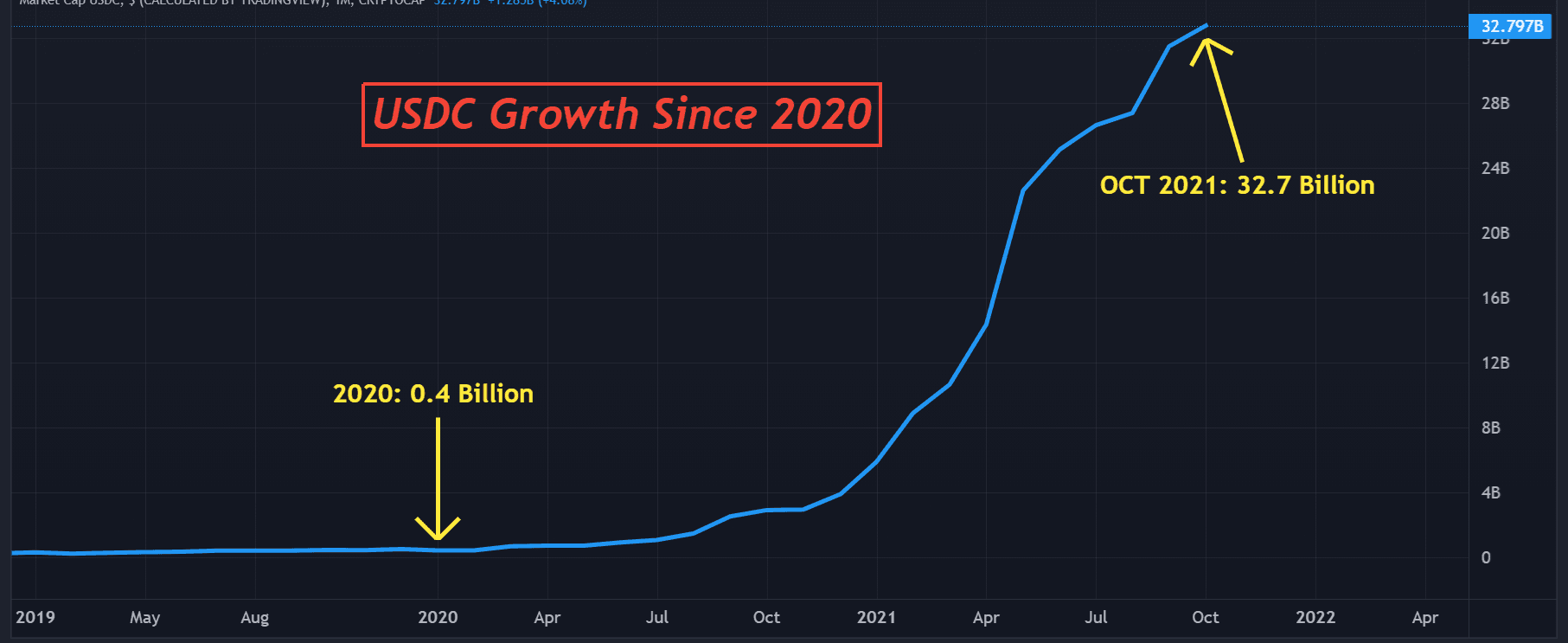
USDC has a market cap of $32.7 Billion USD with a roughly equivalent amount of coins in circulation. DAI has a market cap of $6.4 Billion USD with an equivalent amount of coins in circulation.
Keep in mind, this will have changed by the time you're reading this, but it gives you an idea of the difference in size/adoption.
Why I Preferred USDC to DAI
While DAI offered greater decentralization, I considered USDC's fiat reserve model easier to evaluate at the time.
The operational model behind DAI means that the stablecoin can only exist as long as the MAKER token and Ether exist. This is a major potential risk with DAI since it doesn't have all of its reserves in stable assets like the US dollar and other fiat currencies.
That preference partly reflected USDC's fiat-collateralized structure. DAI's different risk profile became visible in March 2020, when Ethereum fell by one-third and MakerDAO briefly considered an emergency shutdown.
If this had happened, as a DAI holder at the time, I would have been forced to redeem my coins for Ether. MakerDAO subsequently added USDC to its collateral mix. This episode reinforced my historical preference for USDC, especially for longer holding periods.
I find that USDC has little price volatility compared to DAI and other cryptocurrencies. DAI has to keep a large amount of cryptocurrency in its reserves to cover market fluctuations, meaning the pegging ratio isn't always 1:1. Error margins of up to 5 percent on either side occur now and then.
In the period I reviewed, those deviations generally lasted only a few days. DAI used over-collateralization to absorb fluctuations in its collateral. USDC had generally tracked the US dollar more closely in that sample.
In the period I reviewed, I found USDC's reserve reporting easier to assess than DAI's collateral model. DAI still offered more on-chain transparency than centralized stablecoins such as Tether (USDT), but its structure was different from USDC's.
USDC releases monthly publicly verifiable reports of audits conducted by Grant Thornton, one of the top accountancy firms globally, attesting that the stablecoin is indeed back 1:1 by USD reserves. The Circle consortium also complies with regulatory and prudential standards while governing the USDC ecosystem.
On the other hand, DAI is largely unregulated (although this may soon change), meaning it features less accountability. However, I have to give MakerDAO a thumbs up for conducting routine audits even though this is not a legal requirement in the stablecoin space. However, USDC transparency policies are more robust.
How I Chose Between USDC and DAI
The use case will determine an investor's choice between USDC and DAI. Personally, I go with USDC whenever possible. Decentralization isn't everything. As an Investor, I must have confidence that my chosen stablecoin won't be highly impacted by an unforeseen black swan event (like COVID-19).
I preferred USDC partly because of its dollar-backed reserve model. MakerDAO had an established smart-contract system, while traditional financial institutions had risks and operating histories I found easier to assess.
I also felt more comfortable with legacy-finance structures and found the DAI ecosystem comparatively complex. At the time, I saw DAI as the alternative for experienced users who prioritized decentralized control and understood its collateral model.