

Decentralized exchanges (DEXs) have witnessed an increase in popularity over the past few years. Users don’t want to register and deal with permissions on exchanges to trade top cryptocurrencies.
Two of the most popular decentralized crypto exchanges at the time were Uniswap and PancakeSwap. This comparison examines their key distinctions and the use cases I preferred for each.
I'll also look at the historical performance of the two and figure out which has historically been the better investment.
What is Uniswap?
Uniswap is a decentralized crypto exchange that utilizes the Uniswap protocol. This protocol enables automated transactions between ERC-20 tokens on the Ethereum blockchain. The protocol uses smart contracts, thus eliminating the need for intermediates (banks and companies) and the associated enforcement costs. Uniswap is the largest decentralized crypto exchange by daily trading volume.
What is PancakeSwap?
PancakeSwap is a decentralized exchange for swapping BEP-20 tokens built by anonymous developers. This DEX is built on the Binance Smart Chain platform and uses an automated market maker model. The AMM protocol prices assets according to a pricing algorithm. Instead of order books or bid/ask systems, you trade against a liquidity pool.
How Are PancakeSwap and Uniswap Similar?
· Automatic. Both exchanges utilize an automated market maker model.
· Earn a yield. Users can earn from providing liquidity on both platforms.
· Decentralized. Both exchanges use decentralized platforms.
· Community-driven. Both exchanges are community-governed and supported.
· Liquidity pools. Both exchanges utilize automated liquidity protocols.
· Browser wallet. Both exchanges require a browser wallet extension.
How Are PancakeSwap and Uniswap Different?
· Different chains. Uniswap operates on the Ethereum blockchain, while PancakeSwap runs on Binance Smart Chain.
· Native tokens. The native token on Uniswap is the UNI token, while the native token on PancakeSwap is CAKE.
· Number of pairs. Uniswap supports a lot more trading pairs than PancakeSwap.
· Fees. Uniswap has slightly higher fees for token swaps than PancakeSwap due to higher gas fees.
· Economic model. Uniswap fees go entirely to liquidity providers, while PancakeSwap fees go to liquidity providers, PancakeSwap treasury, and token buyback.
· Speed. Transactions execute faster on the PancakeSwap platform than on Uniswap.
· Tokenomics. Uniswap has a supply cap of 1 billion UNI tokens, while PancakeSwap doesn't have a supply cap, making CAKE an inflationary token.
· Additional features. The PancakeSwap platform features Lottery Tickets while Uniswap does not.
Comparing Uniswap and Pancakeswap:
Overall, both Uniswap and PancakeSwap are significant additions to the decentralized finance (DeFi) ecosystems. The permissionless AMM protocol eliminates the need to sign up and disclose your identity.
There is no central authority to block or seize my funds in either of the projects. However, I find that the Uniswap platform is more decentralized than PancakeSwap. Ethereum is generally more decentralized than BSC, which is a considerable advantage for Uniswap over PancakeSwap.
Uniswap allowed blockchain projects to release tokens through its router contract without listing fees or a centralized vetting process. Liquidity providers could earn a share of fees by supplying assets to its pools.
One of the main drawbacks of Uniswap is the higher transaction fees. Since it utilizes the Ethereum network, network congestion and high gas prices drive the transaction fees up. And at least until ETH2, it can take longer for transactions to go through.
On the other hand, the gas price on PancakeSwap's Binance Smart Chain is lower, encouraging smaller and cheaper transactions. In addition, PancakeSwap transactions execute much faster.
UNI vs CAKE: Historical Price Performance
Let's look at the historical performance of the tokens UNI and CAKE, and compare them as investments.
I will look at the historical returns since December 2020, and compare how hard they correct when the general crypto market bleeds.
UNI historical returns: 578.16%
UNI has returned over 575% since December of 2020, which is equal to a 6.75x ROI:
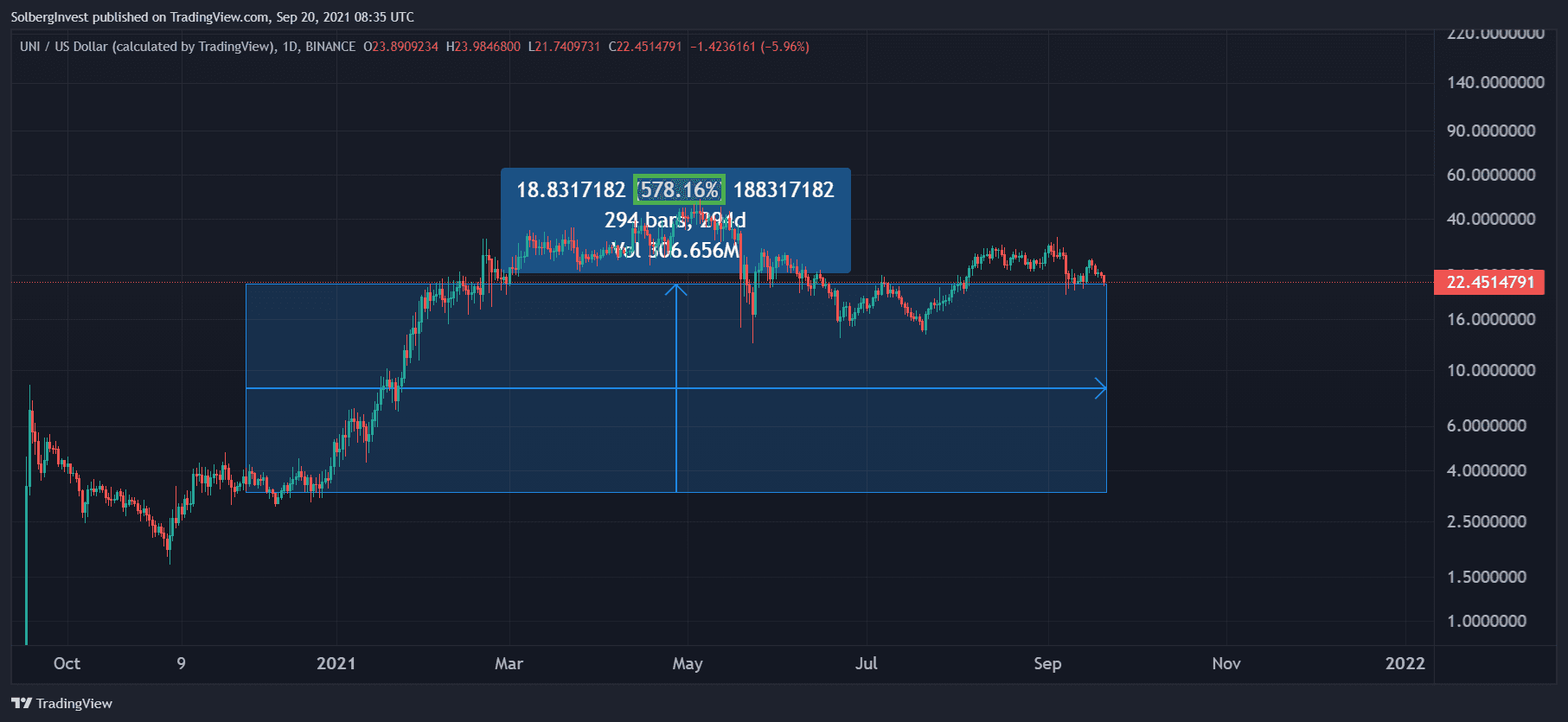
CAKE's return was higher over the same selected period. Before comparing them, here are the corrections I measured for UNI:
UNI correction: 51.33%
There have been three substantial corrections since December of 2020 (at the time of writing). These can be seen on the chart below:
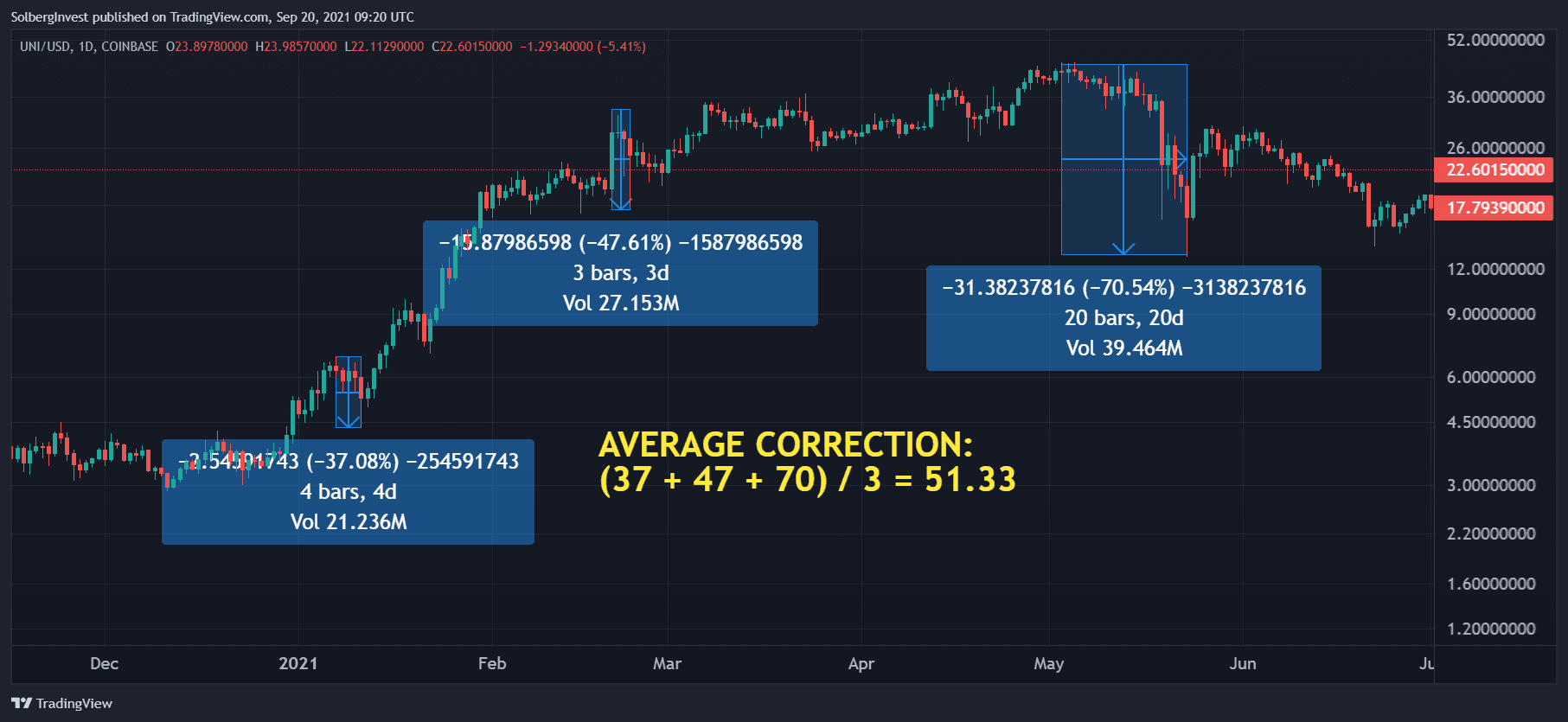
The average of these three corrections is 51.33%. This does NOT mean that most corrections are roughly 50%. It just means that the average of the three corrections was 50% in this narrow time window.
To summarize UNI's performance:
578.16% returns
50% correction (average)
Let's look at how CAKE performed in comparison:
CAKE historical performance: 5962.01%
CAKE returned almost 6,000% over the selected period, which was roughly a 61x multiple. The chart below shows that move:
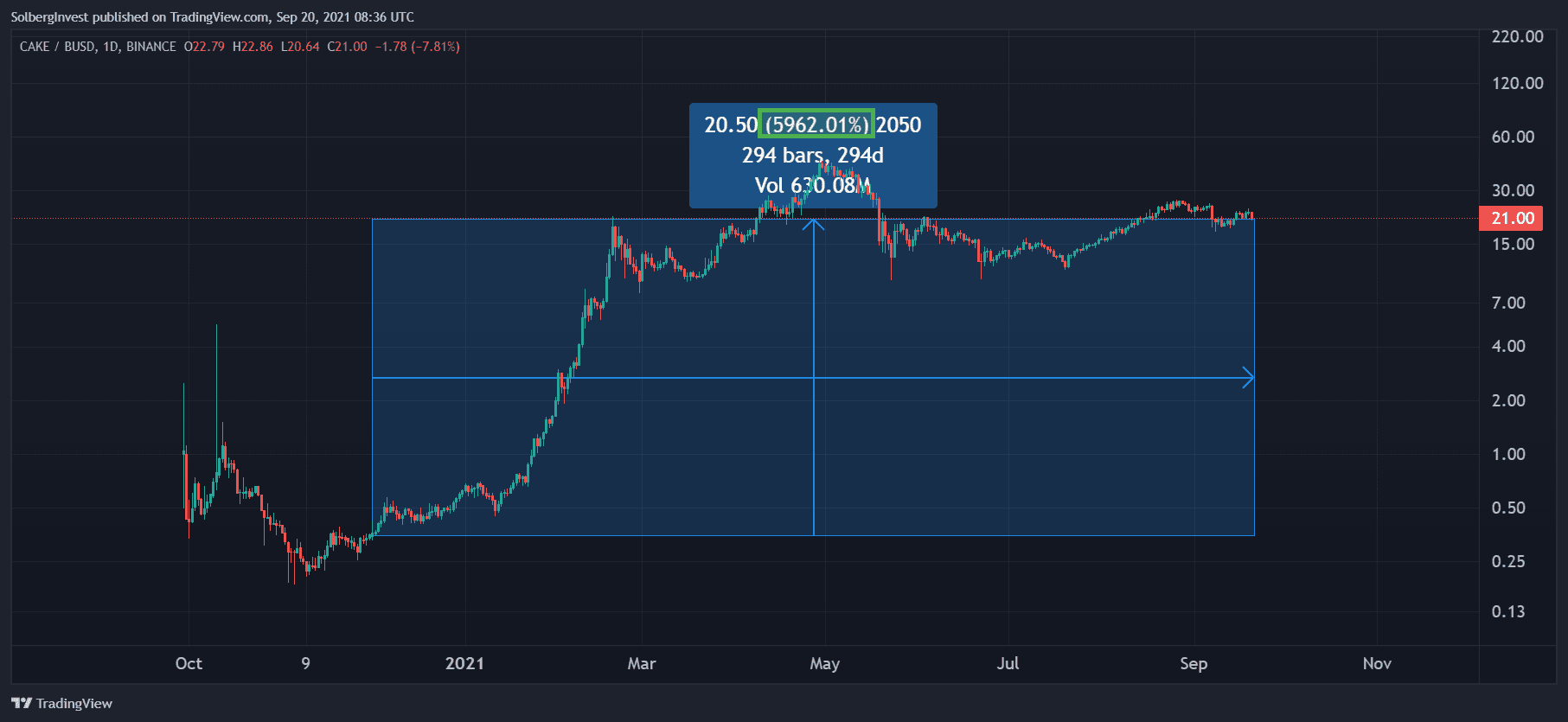
CAKE's selected-period return was roughly ten times UNI's.
A hypothetical $10,000 UNI purchase in December 2020 would have been worth about $67,500 at the comparison endpoint.
A hypothetical $10,000 CAKE purchase in December 2020 would have been worth about $610,000 at the comparison endpoint.
The selected time frame was important to that comparison:
Uniswap was more established and had already surged before December 2020, making the chosen time frame favorable for CAKE. Historical performance alone did not establish which token would perform better later.
CAKE had the higher selected-period return. I then compared the historical drawdowns:
CAKE correction: 60.66%
CAKE had the larger average correction in this three-drawdown sample. An 80% decline would require a fivefold increase to recover.
An 80% decline takes an asset from $1 to $0.20; returning from $0.20 to $1 requires a 5x gain. Large drawdowns therefore require disproportionately large gains to recover.
Below you see the three corrections:
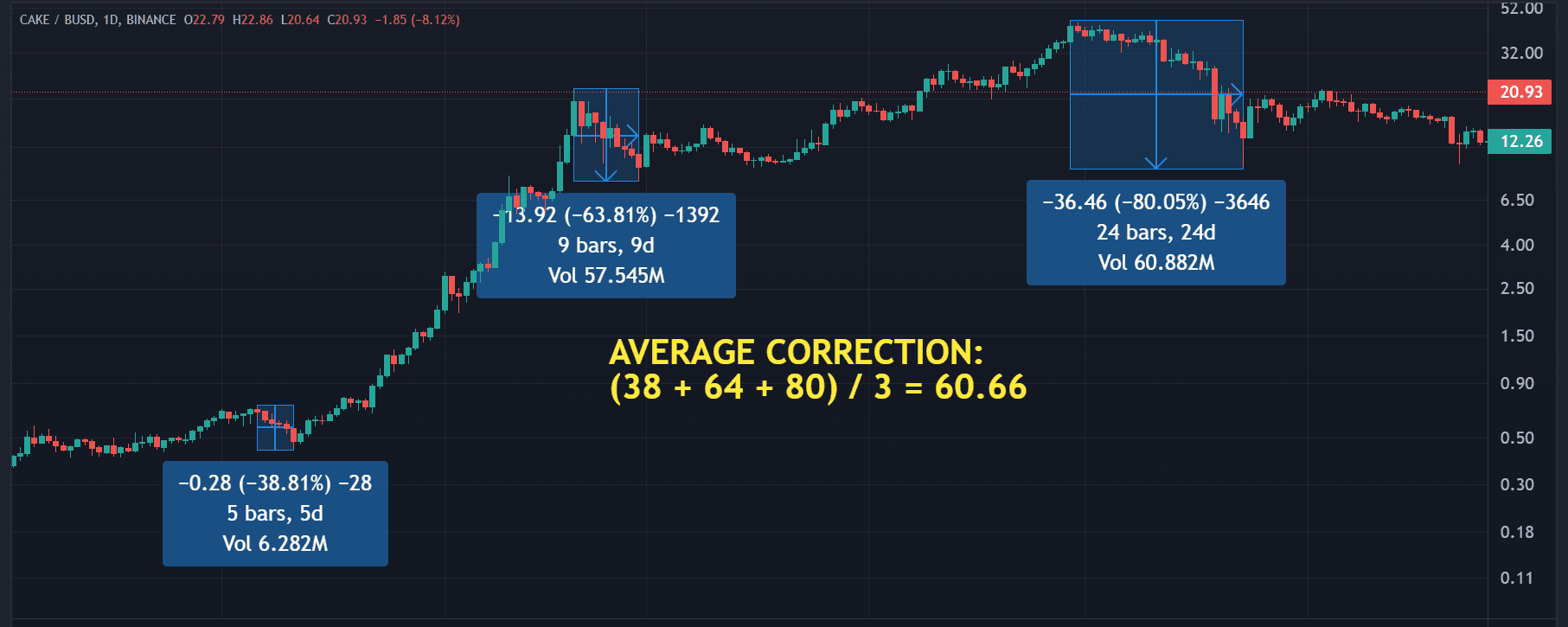
These sampled corrections were larger than UNI's. That difference might partly reflect CAKE's smaller size and younger age.
UNI had the smaller average correction in this sample.
Conclusion:
My preferred exchange at the time was PancakeSwap, depending on the use case.
In my opinion, the choice came down to the available pair, the objective and the importance of fees and transaction speed. Those considerations and PancakeSwap's extra features drove my preference at the time.
My higher-risk preference was CAKE; my lower-risk preference was UNI.
PancakeSwap's CAKE token had produced almost 10 times the returns over the selected period, but it was substantially more volatile than Uniswap's UNI. That tradeoff drove my conclusion.
(all charts from tradingview, none of this is financial advice, just my personal opinion)