

When the likes of Citibank and JP Morgan predict Bitcoin prices from $150 000 up to almost $400 000 within a few years, it makes you wonder:
What is the maximum potential for Bitcoin in terms of price?
Here's the short answer:
My upper scenario for Bitcoin was approximately $5 million if it matched the bond market. A much more extreme thought experiment produced figures as high as $60 million.
I'll walk you through why and explain the "roadmap" of Bitcoin as it matures as a store of value.
In this article, I argue for Bitcoin as the ultimate store of value and best global reserve currency, however, this is not a price prediction. This is a thought experiment where I try to figure out the maximum potential of Bitcoin and if it's a realistic outcome. Unfortunately, I do not know the future.
Bitcoin 2021-2026: Taking over Gold
Bitcoin is now a recognized store of value, competing with Gold. In recent years, we've seen an increasing number of institutional investors moving their capital from Gold ETF's, and physical Gold, over to Bitcoin.
According to J.P. Morgan, this trend is just getting started. (Source: Bloomberg)
We also have predictions from the likes of Citibank of over $300,000 per coin, based on the belief that Bitcoin will overthrow Gold as the ultimate store of value. (Source: Forbes)
Gold, at the time of writing, has a market cap of over $11 Trillion, while Bitcoin is resting at a modest $1 Trillion (in 2021).
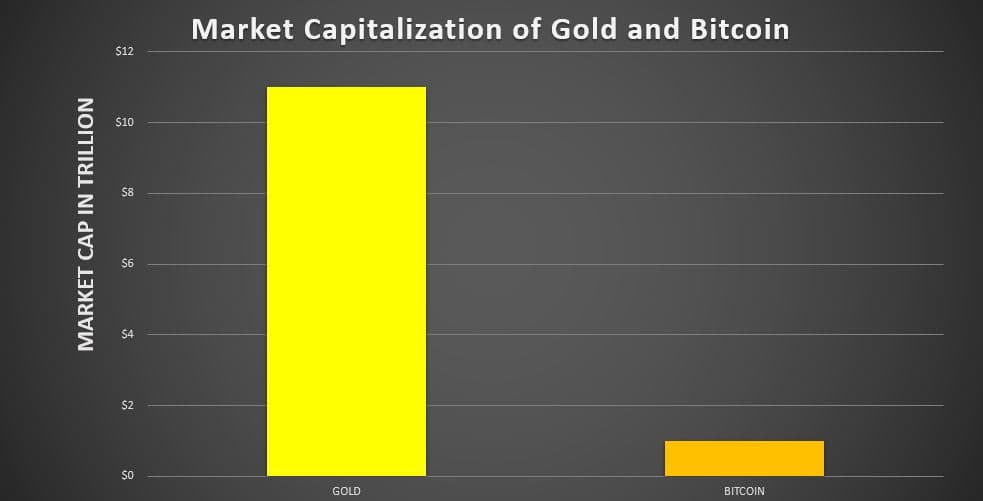
If Bitcoin successfully hijacks the capital currently invested in Gold, the Bitcoin price would reach roughly $350,000.
Remember, it's not just some random guy on the internet with a tinfoil hat who's predicted this. These predictions come from J.P Morgan, Citibank and Bloomberg.
Even Blackrock has talked about Bitcoin overtaking Gold. (Source: Forbes)
Although many thought Bitcoin would overtake Gold in 2021/2022, I later considered that outcome more plausible in the post-2024-halving cycle and expected a possible peak around 2025.
"Why 2025?"
Because Bitcoin would have another halving in 2024, which I expected to affect supply and the next market cycle as described in the halving analysis.
Bitcoin 2030-2035: Taking Over The U.S. Dollar
My argument about long-term pressure on the U.S. dollar is developed further in the inflation analysis. Here's the short version:
Why I Believed the U.S. Dollar Faced Long-Term Pressure
Basically, the economy works like this: Your spending is someone else's earning.
If you spend more money, someone else earns more money.
Since 1990, the median spending per U.S Citizen has roughly doubled.
Below you see the median spending of U.S. Citizens from 1990 to 2019:
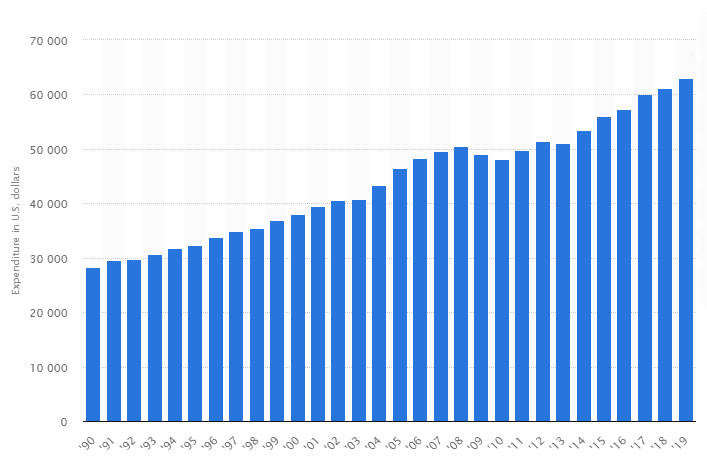
Source: https://www.statista.com/statistics/247455/annual-us-consumer-expenditures/
As you can see, the spending/earning of U.S. Citizens have increased by over 100% in the last 30 years.
Credit and other forms of borrowed money work like steroids to the economy. It artificially increases the spending power of an individual or institution.
This artificial increase in spending leads to an increase in earnings for other people, boosting the economy.
The increased earnings lead to even more credit, as you can loan more when you earn more.
This leads to a blown-up economy where spending and earnings are artificially increased by credit, making the economy balloon into a huge bubble.
Let's look at some concrete numbers:
At the same time as the median spending has increased by roughly 100%, the debt of U.S. Citizens has increased by over 400% (5.24x):
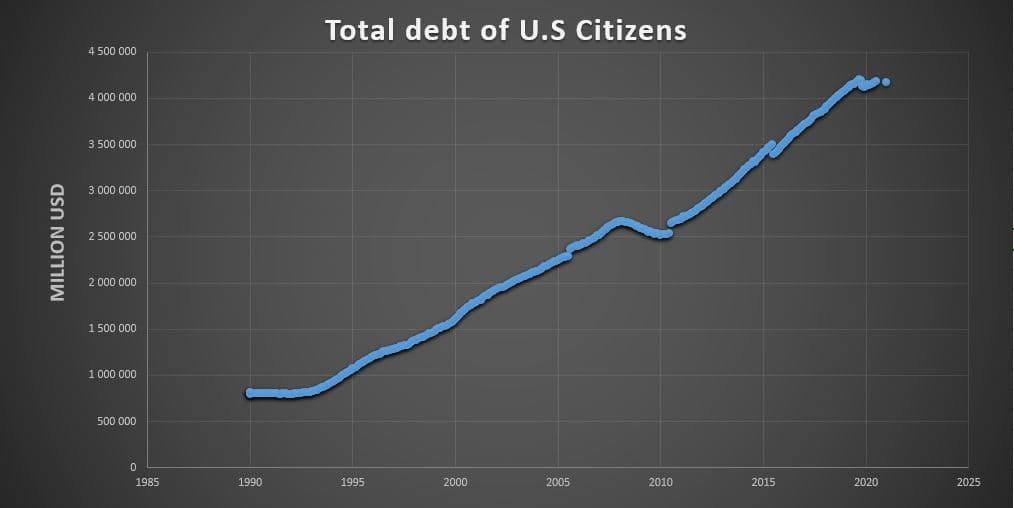
Source: https://www.federalreserve.gov/
After adjusting for population growth, the debt per citizen has increased 2.62 times faster than the income/spending.
"Why should I care about this...?"
**People, in general, are over-leveraged with debt relative to earnings.
Also, a large part of the spending of U.S Citizens is financed by debt.**
"Well, why is this a problem?"
If the interest rates increase, and credit is less available, the spending power of U.S. Citizens will decrease a lot.
"... and what then?"
Remember, your spending is someone else's earnings. If U.S. Citizens start spending less money, businesses and institutions will start earning less.
These businesses, too, are generally financed on debt, making it hard to survive a decrease in their earnings, forcing them to fire employees or take out even more credit.
Firing employees will decrease the spending of U.S. Citizens even more, so the best option in general for the economy is for struggling businesses to take out short-term loans to get them through the rough times.
This leads to even more debt.
Every time that the economy dips, more debt is accrued.
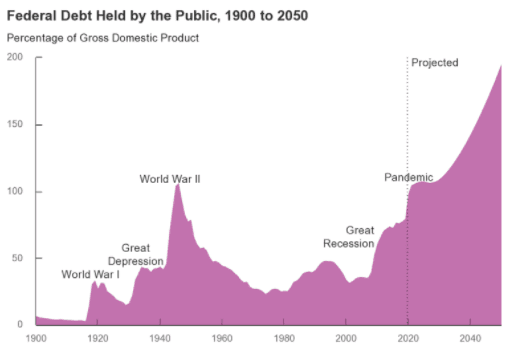
Look at the debt relative to GDP projections made by the Congressional Budget Office:
Source: https://www.cbo.gov/publication/56598
That projection is not very optimistic regarding the "soundness" of the economy.
Under this debt path, I expected the United States to remain heavily indebted for decades because rapid repayment would reduce spending and economic activity.
It's important to remember that taking on debt can support short-term growth, but I believed the strategy created mounting long-term risks.
I expected repeated debt-funded responses to downturns to become increasingly difficult to sustain.
Jeff Booth argued in his book "The Price of Tomorrow":
A day will come, probably sooner than later, when we realize that the only thing driving our economy is the explosion of debt ... Once bond holder determine that governments have little ability to repay or service the debt ... the interest rates will rise, [making it harder for the government to keep the economy floating].
Sure, governments can monetize and make their currencies worth less [to make it easier to pay the debt], but as other central banks [does the same] the strategy becomes irrelevant.
... this strategy has only one endgame: 1) higher inequality 2) people losing hope in the system due to not being able to make ends meet 3) more polarization 4) a rise of leaders that use the polarization to create "us versus them" narratives to consolidate power 5) commonplace revolutions and war.
[The short-term solution of taking on even more debt] in the end, is a dissolution.
Jeff Booth
In my scenario, Bitcoin could emerge as an alternative to the U.S. dollar if debt and monetary expansion continued.
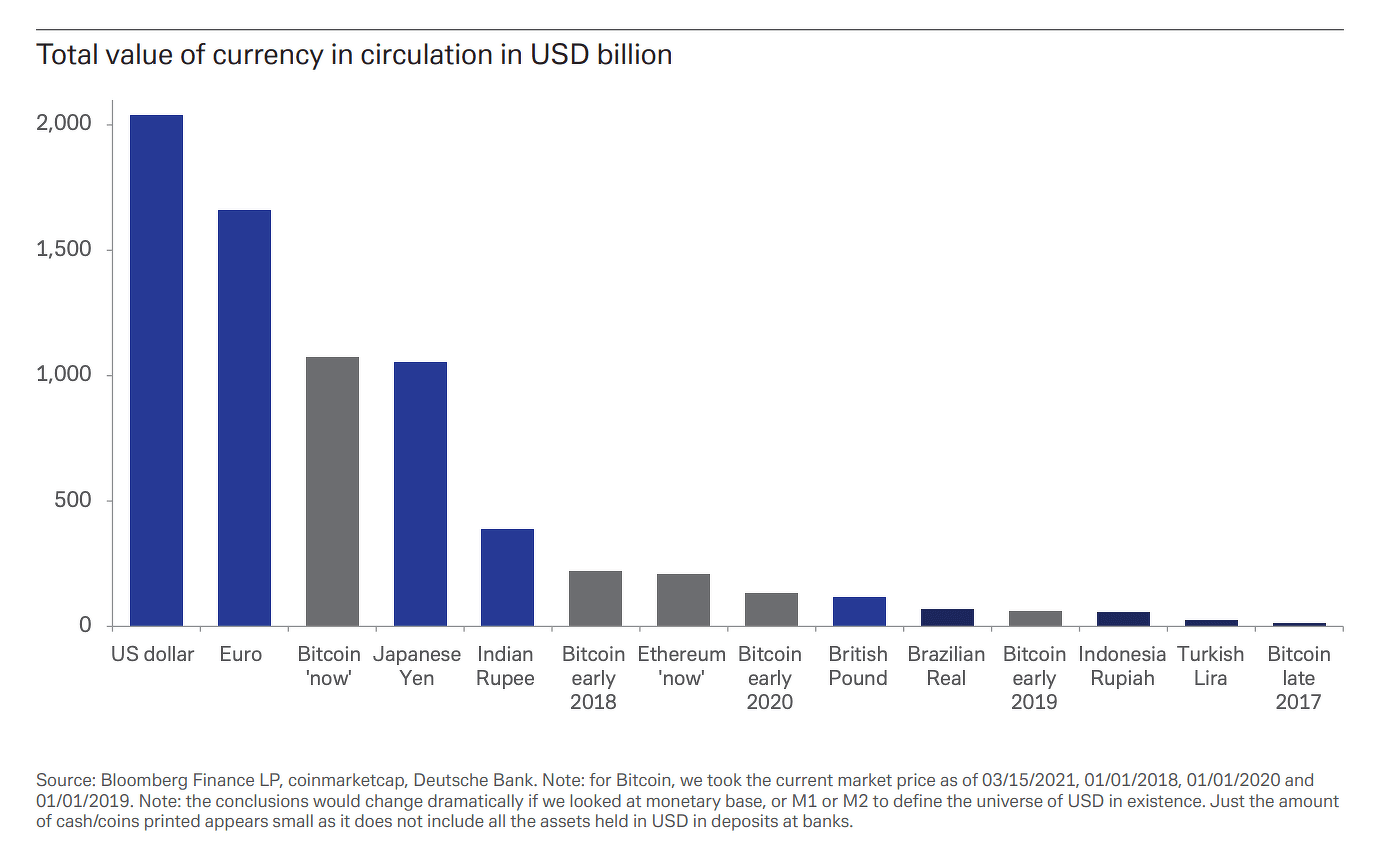
Below you see Bitcoin's value compared with the largest fiat currencies in the world. All the gray pillars are Bitcoin at different times in the past.
It's catching up quickly: (now = 2021)
Source: https://decrypt.co/39425/bitcoin-is-3rd-largest-world-currency
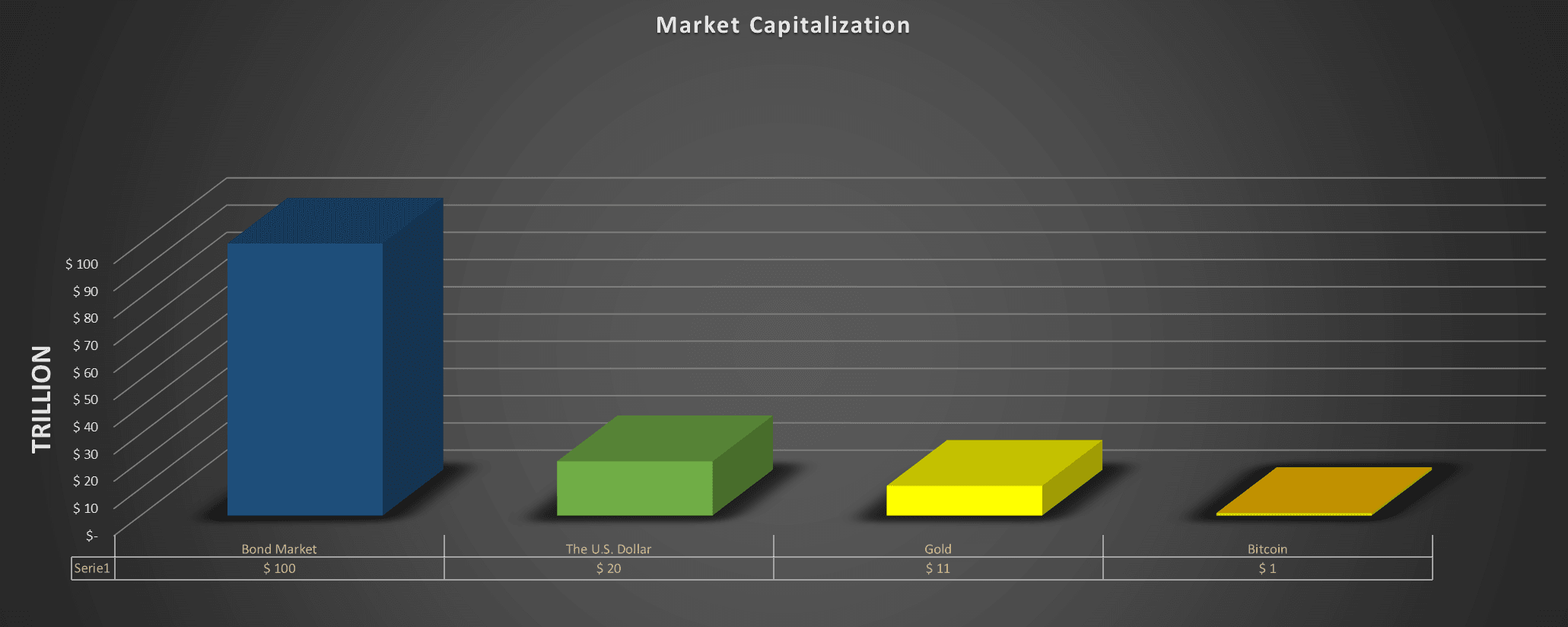
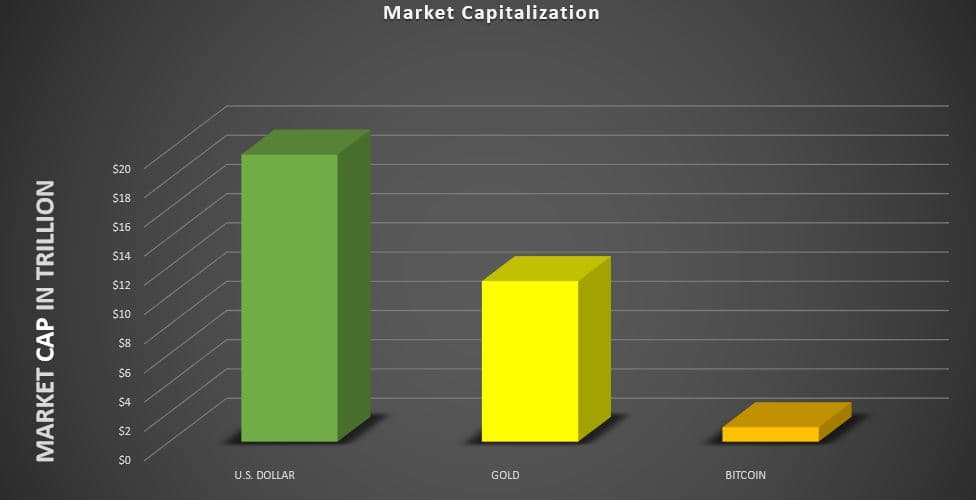
Below you see a visual presentation of the difference in market cap between Bitcoin, Gold and the U.S. Dollar.
This includes more than just the actual USD circulation; it's the M2 I've used in this calculation:
Time: March 2021
If Bitcoin manages to swallow the market cap of The U.S. Dollar, it will reach a price of over one million USD.
"When will this happen?"
One stock-to-flow and adoption scenario circulating at the time placed Bitcoin's market cap above $20 trillion by 2030.
However, it's impossible to know and far from certain that it will happen or when it will happen.
Nevertheless, if the money printing and debt accruing continues, it's not unreasonable to assume that Bitcoin might replace The U.S. Dollar at some point in the future.
Bitcoin 2040-2050: Taking Over The Bond Market
Let us first look at how the bond market essentially works and then how Bitcoin might swallow this market too.
How the bond market works
Let's say that the government needs 10 million dollars to fund a new project. One way they can raise it is to issue a bond worth 10 million, and sell it to investors:
When governments create this bond, they essentially just create a piece of paper and say it's worth $10,000,000. This paper also says that whoever holds this paper will receive a yield of 3% of the $10,000,000 for the next 10 years, and then the government will buy it back from you for the same price you paid for it.
The investor that buys the bond has to give the government 10 million USD and receives the newly created piece of paper (the bond). Holding this bond, the investor receives a 3% yield on the ten million he/she paid for it for the next 10 years. After ten years, he gets the ten million dollars he paid for it back.
In other words:
Bonds are created by governments, companies, or institutions to raise money. Bonds are essentially debts that investors buy to receive a yield.
Bonds issued by the government are called T-bonds (treasury bonds). They are backed by the government's ability to repay, but their real return can still be negative after inflation.
I argued that a rapidly growing debt burden could make repeated monetary intervention more likely. If inflation then exceeded bond yields, those bonds would become less attractive in real terms.
For example, with 10% inflation and a 3% bond yield, purchasing power would decline by roughly 7% per year.
Where Investors Might Look If Real Bond Yields Turn Negative
At the time of writing, the bond market is at a valuation of $100,000,000,000,000. That is one hundred trillion U.S. Dollars.
In that scenario, I expected some investors to reconsider assets producing negative real returns.
I expected investors to look for alternatives if inflation exceeded bond yields and the dollar lost purchasing power. Some of that capital could move into markets viewed as inflation-resistant; my thesis was that Bitcoin could attract a meaningful share.
The reason behind this thesis was Bitcoin's limited supply and protocol-defined issuance schedule.
The monetary policy of the FED can change tomorrow. They might decide to print 10 Trillion next week. That's bad for long-term bondholders, as it increases the inflation rate and decreases the chance of their bonds being profitable.
They need an asset with predictability, transparency, and a predetermined inflation rate.
Bitcoin offers this. The inflation rate of Bitcoin is halved every four years.
The article How the Bitcoin Halving Affects the Price of Bitcoin explains the supply mechanism used in this thesis.
Well then... What would happen to the Bitcoin price if it swallowed the bond market?
Upper-Bound Scenario for Bitcoin:
If Bitcoin actually swallows Gold, The U.S Dollar, and eventually the bond market, the market capitalization of Bitcoin will be over $100 Trillion USD.
Technically, it doesn't make sense to price Bitcoin in USD at this point as Bitcoin will be the "standard" to price stuff in ... but let's ignore that.
Below you see a visual representation of the market valuation of Bitcoin, Gold, The U.S. Dollar, and the bond market:
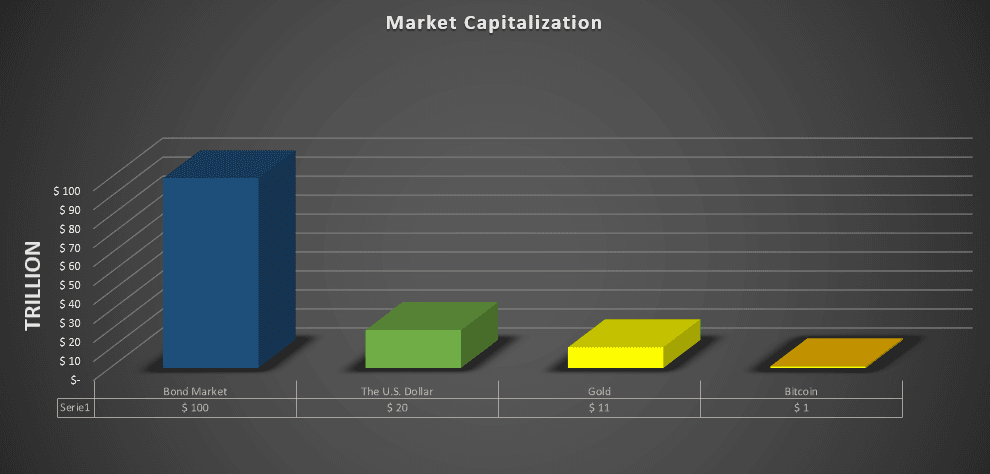
We can calculate the price Bitcoin will reach by dividing the market valuation by the supply. The supply of Bitcoin is predictable, as it's predetermined in the code.
The rate at which new Bitcoin is issued is halved every four years, making the inflation rate of Bitcoin exponentially decreasing.
However, let's just go with the maximum supply, the hard cap of Bitcoin at 21 million BTC, to keep it conservative:
$100 000 000 000 000 / 21 000 000 BTC = $4 761 905/BTC
In other words:
If Bitcoin reaches the current market capitalization of the bond market, one hundred trillion USD, the Bitcoin price will reach over $4 750 000 per BTC.
The Absolute Maximum Potential of Bitcoin
Some argue that the maximum potential of Bitcoin is even higher than $4 750 000.
Some people speculate that Bitcoin will swallow all of the money in the world, including bond markets, real estate, the stock market, the forex market, and the futures market.
Financial expert estimate that this number is somewhere between 630 and 1200 trillion USD (source: The Sun)
Let's run the numbers on both ends of the scale and calculate the absolute maximum potential of Bitcoin:
Higher end:
$1200 Trillion / 21 000 000 BTC = $57 142 857/BTC
That's almost 60 million dollars per Bitcoin.
Lower end:
$630 Trillion / 21 000 000 BTC = $30 000 000/BTC
At the lower end of estimations, we get a 30 million dollar Bitcoin price.
Final Thoughts
Bitcoin reaching almost 60 million dollars is not realistic. It's possible, but extremely unlikely.
The same goes for $30 million, however, this is a tiny bit more realistic.
The only way I can see $30 million as a possible outcome is if the dollar is devalued to such an extent that $30 million is worth something like $5-$10 million in today's valuation of USD.
The $4,750,000 figure was my best estimate of the upper scenario I considered plausible under these assumptions.
Please, do not read this as a price prediction. I'm not saying that Bitcoin will reach $4 750 000.
What I'm saying is this:
If Bitcoin were to reach its full potential as a store of value while monetary expansion and government debt continued at the assumed rates, it could approach the combined scale of gold, the U.S. dollar and the bond market, implying a price near $4,750,000 in this thought experiment.