I'm being bombarded with questions about this; What are the best ways to invest in altcoins for a beginner? How do I research altcoins? Where do I buy altcoins?
I've decided to cover those questions in detail and explain the process I used.
Table of Contents:
What are altcoins?
Why invest in altcoins?
What to look for in altcoins
Where to buy altcoins
How much of your portfolio should be in altcoins?
The Bitcoin dominance
What altcoins I have invested in
Atlcoins: What are they?
Basically, Altcoins are every cryptocurrency that exists excluding Bitcoin. "Alt" is short for alternative, as in alternative to Bitcoin.
As you know, Bitcoin is the cryptocurrency, and everything else is beneath it. For this reason, everything else is just called an altcoin.
Why Invest in Altcoins?
Why should beginners care about what the best altcoins to invest in are? After all, Bitcoin is the king, right?
Well, that's true, but the altcoin cycle I examined offered higher potential returns than Bitcoin alone.
In other words:
I used altcoins to seek higher returns than Bitcoin alone offered.
This came with added risk because altcoins were more volatile, and selecting the wrong ones could produce large losses.
Historical Gains in The Altcoin market:
Let's take a look at the gains you would have made by investing in altcoins vs. investing in Bitcoin in 2017.
Below you see the gains Bitcoin had in 2017:
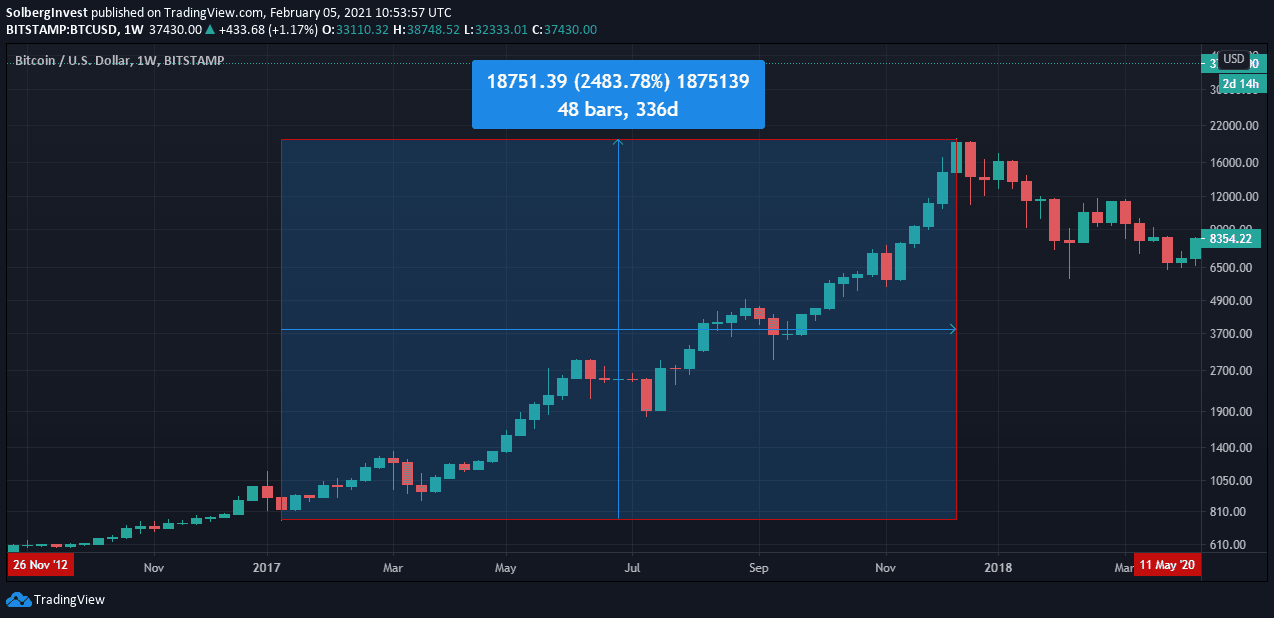
Bitcoin 2017
Bitcoin increased 2500% through 2017, which is a 26x. If you invested $10 000 dollars, you would have been sitting on $260 000 after one year.
That's a great ROI, and an achievement few can brag about. Altcoins however, far outdid Bitcoin.
Below you see the gains of the general altcoin market in 2017:
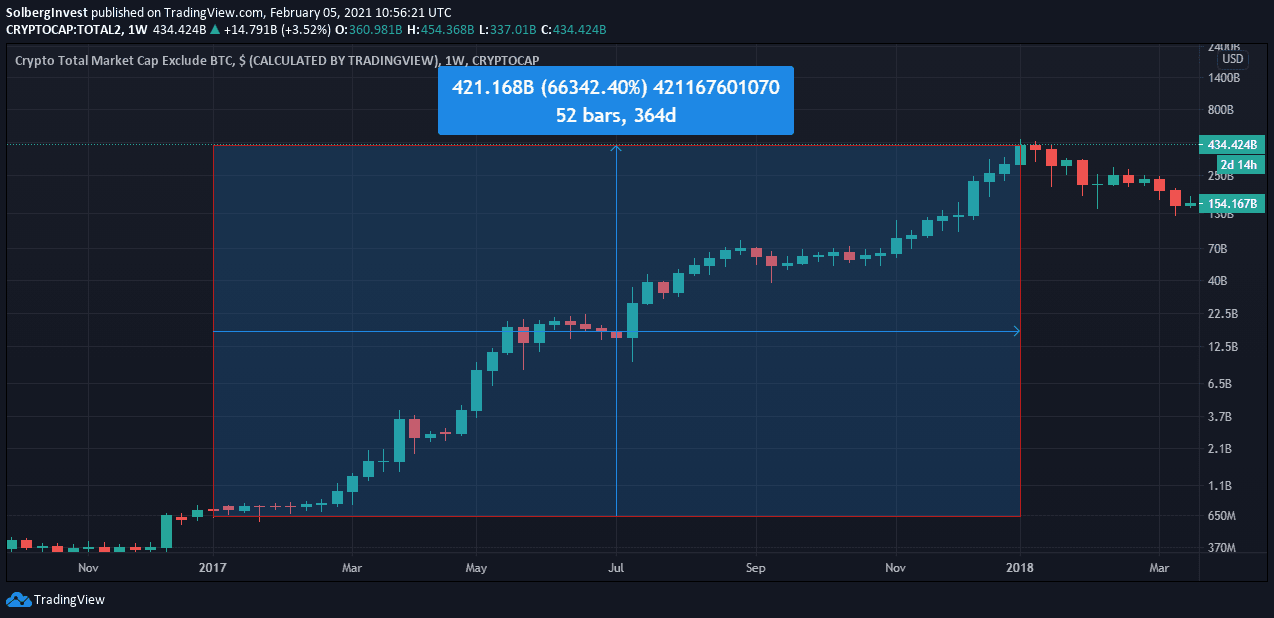
Altcoins 2017
Altcoins increased 66,342%, more than 650x. A $10,000 investment in the general altcoin market at the start of that interval would have been worth over $6.5 million at its end.
Now, the question is how to pick the right altcoins. What do we look for, and where do we find them?
What to look for in Altcoins
It's hard for beginners to find good altcoins to invest in. There are thousands of them, and they all promise they will change the world and make you rich.
At the same time, lot's of bad altcoins are begin "shilled", which means "pushed" or "advertised" in a dishonest way.
Different people in the crypto space constantly push new "great" altcoins to their followers. These coins are often just "the flavor of the day" and disappears the next week, leaving investors with a loss.
How the heck are you supposed to orient your way through this mess?
I used a standardized checklist to analyze an altcoin and compare it with others.
The Altcoin Investing Checklist
When analyzing altcoins, you need to have a checklist. This is to make sure that you don't act on your emotions, and that you have a legit way to compare them to each other.
This is what my checklist looks like:
Amazing Product/Tech?
Good-looking price charts?
Inspiring Road-map?
Good team behind the project?
Is there a strong Twitter, Reddit or FB community?
Is this Altcoins within a trending sector of the cryptocurrency industry, like DeFi?
I like to go through all the point on the list, and rate each on from 1-10. This gives me an overall idea of the altcoin I'm researching.
What you need to do is to pick a few altcoins you've heard of, and go through the list. After a while, you'll find a few good ones.
Then, you need to look at the price, and the potential they have. Is now a good time to buy? Should you dollar cost average? Should you lump sum invest?
Related: Crypto Investing Strategy For Beginners
Now that you've got a few altcoins you want to invest in, you need to figure out where to buy them.
Where to buy Altcoins
To find where an altcoin traded, I used market-data sites such as CoinGecko or CoinMarketCap.
The example below uses CoinGecko.
I used Ethereum to illustrate the process step by step:
STEP #1
CoinGecko listed cryptocurrencies by market cap (the total value of all coins in circulation). Its first page showed the top 100 coins.
The search field accepted a token symbol such as ETH or the asset name Ethereum.
Selecting the asset opened its detail page.
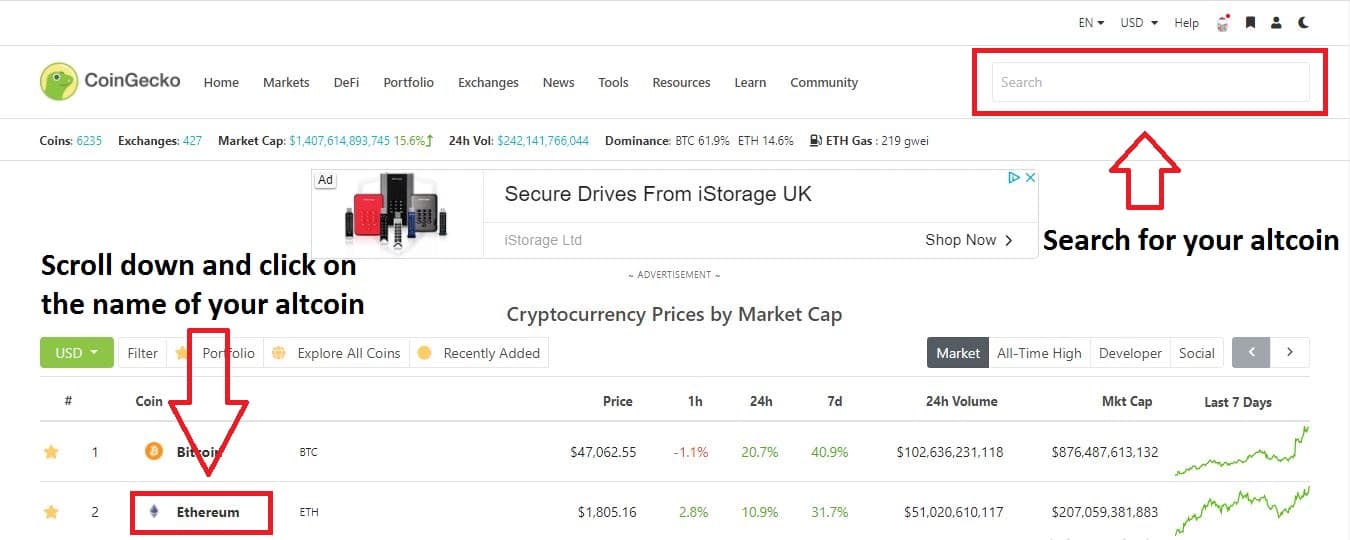
Step #1 Homepage on CoinGecko.com
In this example, Ethereum was the second-ranked coin and easy to locate.
STEP #2
The asset page showed its price, a chart, and a list of trading pairs further down the page:

Step #2 After scrolling down on the Ethereum page on CoinGecko.com
The "See all Trading Pairs" control opened the full list.
STEP #3
The resulting table showed the available trading pairs for the asset.
Trading pairs show which assets can be exchanged for the selected altcoin. At the time, many coins traded against BTC, ETH, or stablecoins such as USDT and USDC.
The list identified each trading pair and the exchanges that supported it.
The example looked like this:

All trading pairs for Ethereum listed on CoinGecko.com
On the far left side you see the name of the exchanges.
On the far right you see the "trust score". I treated a green score as one screening input.
The second column from the left showed the different trading pairs. I checked whether I could fund one of those pairs.
The listings showed which exchanges supported each trading pair. I compared availability and the published trust-score data rather than treating one venue as the default.
RECAP:
1) I located the coin on CoinGecko and opened its asset page.
2) Below the price chart, I opened "All Trading Pairs."
3) I compared the listed exchanges, trading pairs, and published trust scores.
How Much Should You Invest in Altcoins?
This is a tricky one, as it depends on the investor in question. It all depends on how much risk you're willing to take on.
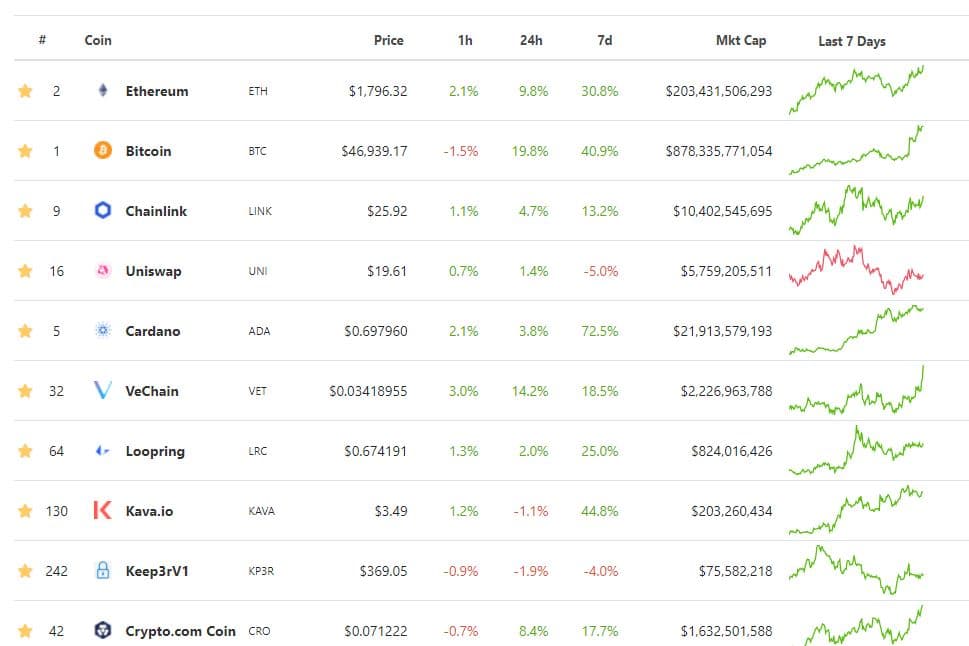
It also depends on the coin, as smaller coins carry more risk. I like to divide between big-caps, mid-caps and small-caps. Big-caps are projects with big market caps like Ethereum and Litecoin. Mid-caps are projects like Uniswap and Monera. Small-caps are projects like Enjin Coin and Matic Network.
Using CoinGecko, I treated the top 10 coins as big-caps, ranks 10-30 as mid-caps, and ranks 30-120 as small-caps. I avoided the micro-caps below that range.
The Rough Allocation Limits I Used:
I kept at least 50% of the portfolio in Bitcoin.
Ethereum was my largest altcoin position.
I capped individual mid-caps at 15% of the portfolio.
I kept the combined small-cap and highly speculative allocation below 10%.
The Bitcoin Dominance
The Bitcoin dominance is the most important metric to follow when investing in altcoins. It's the percentage of the total cryptocurrency market that lies in Bitcoin.
I used Bitcoin dominance as one rough signal for whether altcoins looked cheap or expensive relative to Bitcoin.
If the Bitcoin dominance is 60%, it means that 60% of the total crypto market cap is in Bitcoin.
When dominance was high, I treated altcoins as generally cheaper relative to Bitcoin; when it was low, I treated them as more expensive.
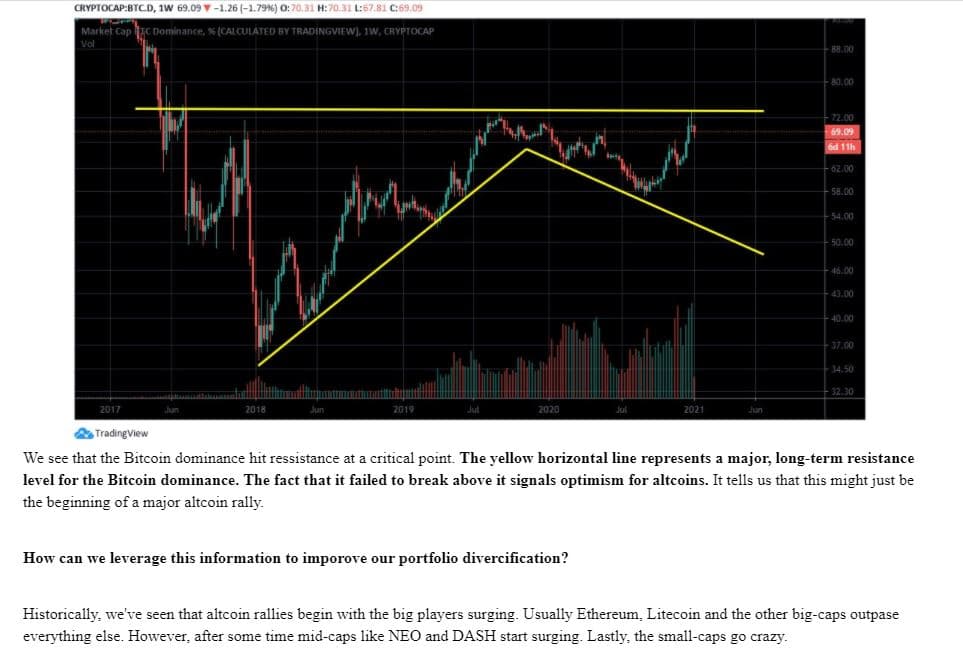
Looking at the chart of the Bitcoin dominance, we can try to predict if it's going up or down in the future.
In my framework, falling Bitcoin dominance suggested altcoin outperformance, while rising dominance suggested Bitcoin outperformance.
This is a chart-based prediction I recorded at the beginning of January:
What altcoins I have Invested in:
The chart below recorded my personal portfolio at publication. It was a dated snapshot, not necessarily what I held later.
Most of my positions are long term holds, but a few of them are short to mid term trades.