
(Updated 08.09.2022)
Pi Network was launched by a group of Stanford Ph.D.s with a mobile token-distribution model intended to lower the barriers associated with conventional crypto mining. This archived analysis examines the project's launch status, user base and potential valuation. The project's official website provided background on its design.
The Pi Network aims to be a decentralized smart contract platform that minimizes technical and economic barriers to entry. This allows everyday people to mine, trade, and interact in a peer-to-peer fashion, fueled by the Pi cryptocurrency.
Their YouTube channel published a short overview of the project.
Is Pi Network Legit?
At the time, Pi Network let users accumulate tokens by downloading the app and logging in each day. The process was simple, but those tokens depended on the network and exchange launching before they could have an active market.
However, some do question whether Pi Network is legit:
Firstly, technical questions have been asked regarding the legitimacy of 'mining'. Miners do not expend energy (as in bitcoin mining) or risk capital (as in proof of stake projects). It is questionable what security the act of mining confers to the network. Additionally, as miners earn rewards for bringing in new participants, some claim the mechanics are simply a pyramid or multi-level marketing scheme.
I believe these views to be misplaced:
It's true that the 'mining' Pi doesn't meet the typical blockchain criteria. However, it does represent a means of distributing Pi tokens widely, which is an essential component of a block reward program. By rewarding those users who bring in new members, the network also bootstraps its adoption.
To conclude this section:
At the time, I concluded that Pi Network was a legitimate project. Unlike Bitcoin mining, its mining process distributed tokens and encouraged adoption rather than securing the network. Existing miners did not receive a portion of new miners' rewards.
What Is The Value Of Pi Network?
The question as to whether the Pi Network is worth anything divides opinions.
On the one hand, as the network is not yet launched, there is no active market for Pi tokens. Clearly, without a market, the price of the tokens is nil. So technically, you could argue that the Pi Network is worthless.
I believe that is a short-sighted and one-sided view. In any good valuation model, one must assess future as well as current prospects.
At the time, millions of people were actively mining Pi and engaging with the community. That activity led me to expect that a launched marketplace could attract buyers for the token.
Let's do an illustrative example to explore the potential of the network:
At the time, Ethereum had about 1.3 million transactions per day and a market cap of $350 billion. This equated to roughly $2,700 per daily transaction.
If Pi Network launched with 100,000 transactions per day and 25% of Ethereum's value per daily transaction, the illustrative calculation implied a $68 million market cap.
This was hypothetical. It illustrated how a successful launch could give the tokens a market value, not that the outcome was likely.
Other crypto networks had risen sharply after gaining users, but that comparison did not establish Pi's future value. If an exchange never launched or users lost interest, much of the potential value could disappear.
I guess my answer is this:
At the time, I believed Pi could acquire market value if it launched successfully and retained its large user base. Without an active market, its token price remained zero.
Does Pi Network Have Potential?
I saw meaningful but highly uncertain potential in Pi Network.
I considered awareness and network use important drivers of token demand, alongside underlying utility. Several newly launched networks had seen their native tokens rise sharply.
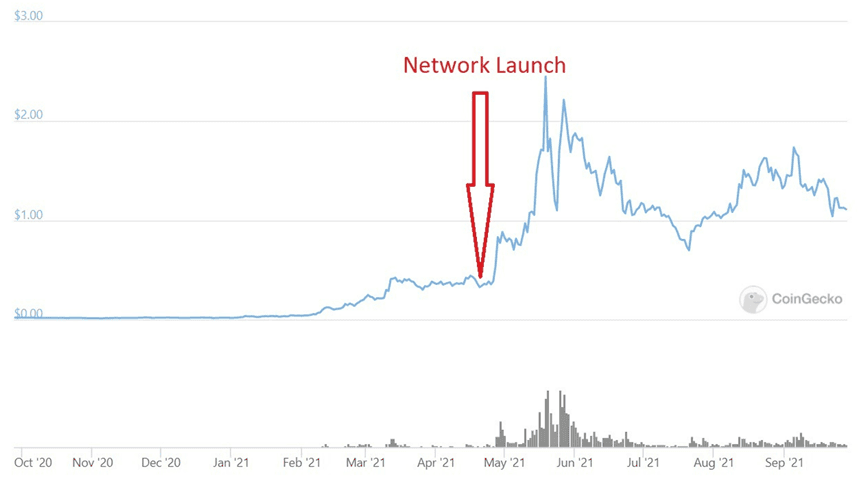
A notable example is MATIC, the Polygon Network token, whose price history is charted below:
Source: CoinGecko
Shortly after the network launched in April 2021, MATIC's price increased eightfold. I associated that move with greater visibility, more users and speculation, although it did not establish that Pi would follow the same path.
Estimates at the time placed Pi Network at between 35 and 50 million miners. That suggested substantial brand recognition and public awareness, which I treated as possible drivers of demand if the network launched.
For context, there were about 157 million Ethereum addresses and 77 million Bitcoin addresses. Because individuals can have more than one address, these figures did not map directly to holder counts. I nevertheless found Pi's estimated user base notable for an unlaunched network.
I linked the probability of realizing that potential to whether the network could launch successfully. At the time, it had an app, whitepaper, token-distribution system, Pi wallet and Pi browser, while the network remained in test mode.
Mainnet, also known as Phase 3, had begun. Pi started migrating miners to mainnet in July 2022.
Could Pi Network Have Material Financial Value?
As I alluded to above, the potential financial value of Pi Network was highly uncertain.
On the one hand, active and early users could accumulate Pi tokens more quickly because of the mining distribution model.
There were almost 100 projects with a market cap greater than $1 billion. If Pi Network launched successfully and reached that scale, a 0.1% share of the supply would be worth $1 million, although accumulating that share would be unrealistic for most users.
The point of the calculation was that a successful launch could make the tokens financially meaningful for existing holders.
Progress towards Phase 3 had been slow. The Pi Network might never launch or could experience technical errors, leaving its tokens without an active market. Its low acquisition cost was why I still considered the project worth monitoring.
Conclusion
I concluded that Pi Network was a legitimate project with a large user base, strong brand recognition and meaningful potential if it launched successfully. Its future value still depended on the network reaching an active market.